A parent calls two months into the session. Their child is moving cities and they want the rest of the fee back. Your receptionist says “no refunds”, the parent says nobody told them that, and by evening there’s a one-star review on Google.
Most fee disputes don’t happen because an institute is unfair. They happen because the rules were never written down clearly. A refund policy for your coaching institute fixes that: everyone knows the rules before they pay.
This guide covers what to include, what the 2024 coaching guidelines expect, how pro-rata refunds work, and a template you can adapt.
This article is general information, not legal advice. Rules vary by state, so check your state’s coaching regulations and consult a professional before finalising your policy.
Why Every Coaching Institute Needs a Written Refund Policy
- Fewer disputes. When terms are written and acknowledged at admission, conversations stay calm.
- More trust at admission. Parents feel safer paying a large fee when they can see a fair exit option.
- Protection for your reviews. Many angry reviews start with a refund argument.
- Compliance. Coaching regulations increasingly expect a published refund policy.
What the Coaching Guidelines Expect
The Ministry of Education’s 2024 model guidelines for coaching centres, as summarised by Drishti IAS and Lawrbit, say:
- Fees should be fair and reasonable.
- If a student leaves mid-course, the remaining fee should be refunded on a pro-rata basis.
- Centres should publish their fee refund policy (and an easy exit policy) on their website.
Some states have their own laws. Rajasthan’s Coaching Centres (Control and Regulation) Act, 2025, for example, provides for:
- A pro-rata refund within 10 days, including hostel and mess fees
- No fee increase during an ongoing course
- A full refund if the centre closes or loses its registration
Check which rules apply in your state. Our guide to coaching institute registration explains the wider framework.
What to Include in Your Refund Policy
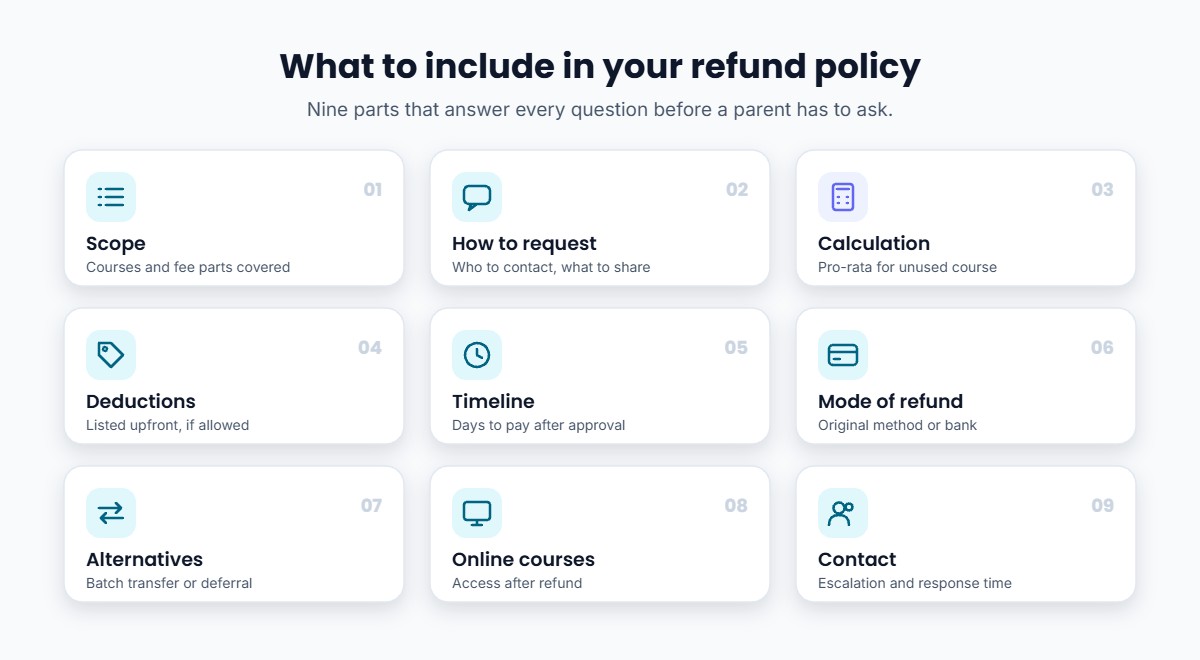
- Scope: which courses, batches and fee components the policy covers (tuition, study material, test series, hostel).
- How to request a refund: who to contact, in what form, and which details to share.
- How the refund is calculated: for example, pro-rata for the remaining part of the course.
- Deductions, if any: clearly list any items that are not refundable, such as study material already delivered, and make sure this fits your state’s rules.
- Timeline: how many days after approval the refund will be paid.
- Mode of refund: to the original payment method or bank account.
- Alternatives: batch transfer, course switch or deferral to a later batch.
- Online and recorded courses: how access works after a refund.
- Contact and escalation: who handles disputes, and the response time.
How Pro-Rata Refunds Work: A Simple Example
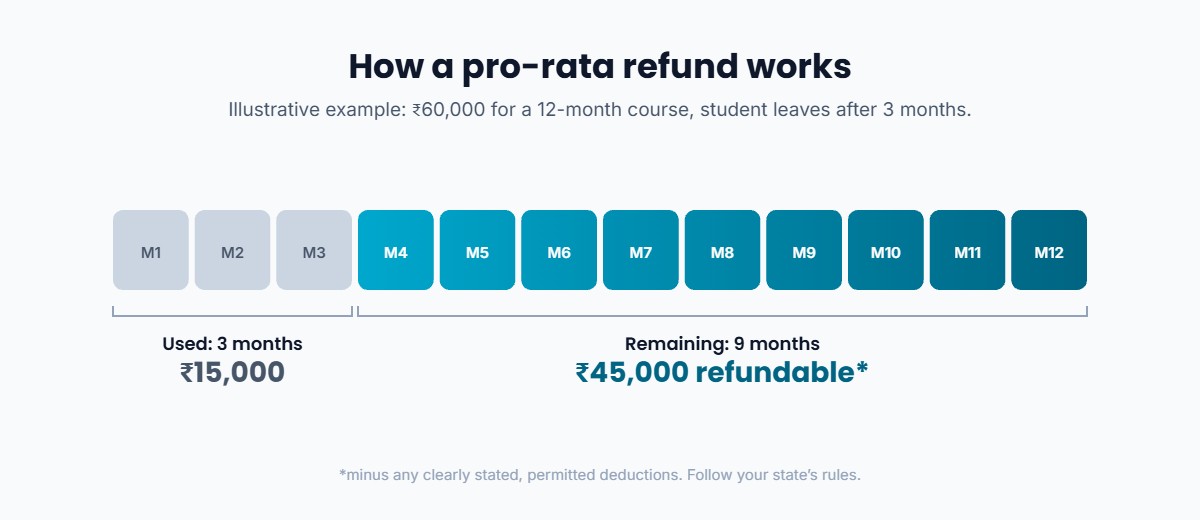
Say a student pays ₹60,000 for a 12-month course and withdraws after 3 months. Under a simple pro-rata approach:
- Course used: 3 of 12 months (25%)
- Fee for the period used: ₹15,000
- Refund for the remaining 9 months: ₹45,000, minus any clearly stated, permitted deductions
This is an illustrative calculation. Your exact method should follow your state’s rules and your published policy.
Refunds for Online and Recorded Courses
Online courses need a few extra lines:
- Trial or demo access: offer a free demo or first lesson, so students can decide before paying.
- Partly watched courses: explain how refunds work once a student has accessed recorded lectures or downloaded material.
- Access after refund: course access, app login and downloads end once the refund is processed.
- Content misuse: state that sharing or recording paid content breaks your terms (see how to protect course videos from piracy).
A Refund Policy Template You Can Adapt
Replace the bracketed parts and check them against your state’s rules.
Refund Policy – [Institute Name]
- This policy applies to all courses offered by [Institute Name], online and offline.
- To request a refund, write to [email/phone] with the student’s name, course, batch and reason for withdrawal.
- Refunds are calculated on a pro-rata basis for the unused part of the course, from the date the written request is received.
- [List any non-refundable items, such as study material already issued, if permitted under applicable rules.]
- Approved refunds are paid within [X] days to the original payment method or the bank account provided.
- Instead of a refund, students may request a batch transfer or deferral, subject to seat availability.
- For online courses, access to classes, recordings and materials ends once the refund is processed.
- If [Institute Name] cancels a course or batch, students will receive [a full refund of unused fees / the option to transfer].
- For questions or disputes, contact [name, phone, email]. We respond within [X] working days.
Where to Display Your Refund Policy
- On your website, linked in the footer and on every course page
- In your app, near the course purchase button
- On the admission form, with a signature or checkbox confirming the parent has read it
- On fee receipts, as a short line with a link to the full policy
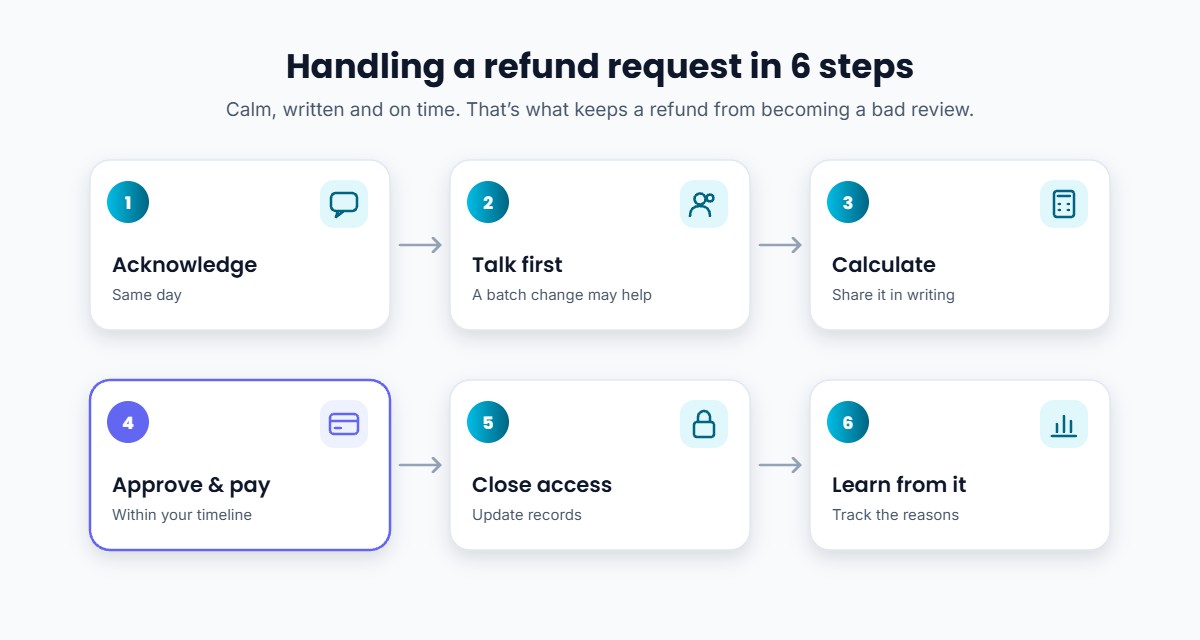
How to Handle Refund Requests Smoothly
- Acknowledge the request the same day.
- Talk first: sometimes a batch change or extra support solves the real problem, which also helps student retention.
- Calculate the refund using your published method, and share the calculation in writing.
- Approve and pay within your stated timeline.
- Close access to the course and update your records.
- Learn from it: track reasons for withdrawal to spot patterns.
Common Mistakes to Avoid
- “No refunds under any circumstances.” It looks unfair, invites disputes, and may conflict with coaching rules.
- Policies that exist only in someone’s head. Write it down and get it acknowledged.
- Hidden deductions that appear only when someone asks for a refund.
- Slow refunds. Delays turn a neutral exit into a public complaint.
- Inconsistent decisions for different families.
- Arguing with parents in reviews or WhatsApp groups. Keep refund conversations private and polite; our guide to parent communication helps.
How Classplus Can Help
Clear policies work best with clear records. With Classplus, your institute gets its own branded app and website, where you can show course details and policies before students pay. Fees are collected online with a clear payment record, which makes refund calculations easier, and you control access to live classes, recorded lectures, tests and study material for every student. Our guide to coaching fee management has more on keeping fee records clean.
Make fees and policies clear from day one. Your own branded app and website with online payments, course access control and student management. Explore Classplus →
Conclusion
A refund policy protects both sides. Write it in plain language, base it on pro-rata refunds for unused parts of a course, list any deductions upfront, set a clear timeline, and make sure every parent sees and accepts it before paying.
It’s also a good moment to check that your fees are fair and clearly structured; see our guide on how to price an online course.
Frequently Asked Questions
Is a refund policy mandatory for coaching institutes in India?
The 2024 central guidelines expect coaching centres to publish a fee refund policy and refund fees pro-rata if a student leaves mid-course. Whether it is legally binding for you depends on how your state has adopted these rules.
What is a pro-rata refund in coaching?
It means refunding the fee for the part of the course the student hasn’t used. For example, if a student leaves after 3 months of a 12-month course, the fee for the remaining 9 months is refunded, minus any clearly stated, permitted deductions.
How soon should a coaching institute process a refund?
State a clear timeline in your policy and stick to it. Rajasthan’s 2025 Act, for example, requires pro-rata refunds within 10 days.
Can I keep the registration fee or study material cost as non-refundable?
Only if it is clearly stated upfront and allowed under your state’s rules. Hidden deductions cause disputes, so list them in your policy and admission form.
How do refunds work for online courses?
Explain how refunds are calculated once lectures have been accessed, offer a demo before purchase, and state that access to the course ends once the refund is processed.
Where should I display my refund policy?
On your website and app, on the admission form with a signature or checkbox, and as a short line on fee receipts.