The best way to reduce student dropout rates in online courses is to make it easy for students to start, simple to keep going and obvious when they fall behind. In practice that means clear expectations, short modules, regular interaction, early tracking of disengagement, timely feedback and one convenient place for learners to study.
Enrolling a student is only the first half of the job. A learner who pays, attends two classes and quietly disappears does not recommend your course, does not renew and does not finish what they came for. For an online educator, tutor or coaching institute, student retention is what keeps a teaching business sustainable.
Three terms, defined plainly:
- Student retention is the share of enrolled students who keep learning with you over a defined period.
- Dropout rate is the share of enrolled students who stop attending or engaging before the course ends.
- Course completion rate is the share of enrolled students who finish the course, or its required parts.
Below, you will see why students leave, nine strategies you can start using this week, the warning signs to watch for and the metrics worth tracking.
Why Do Students Drop Out of Online Courses?
Students usually drop out of online courses because the course asks more of them than they can sustain, and nothing pulls them back when they slip. Research on large open online courses points the same way. A qualitative study of 34 MOOC learners put time at the centre of why learners leave, and cautioned that completion has to be read against what each learner intended to get from the course. An NCERT-published study of SWAYAM dropouts found many never joined with certification in mind. Those are free, open courses, so treat them as a pattern to learn from, not a benchmark for your paid batch.
For Indian tutors and institutes, these are the reasons you will meet most often:
- Lack of motivation. The excitement of enrolling fades by week two, and no one is waiting to notice.
- Poor time management. A working professional or a Class 12 student with school and tuition cannot fit a loose schedule.
- Lack of interaction with the educator. Students who never ask a question or hear their name soon feel like spectators.
- An overwhelming course structure. Fifty hours of recordings in one folder feels like a mountain.
- Lack of accountability. With no test, deadline or check-in, “I’ll catch up this weekend” becomes never.
- Technical difficulties. Weak networks, a low-storage phone or a confusing login are enough to make a student quit.
- Lack of personalised support. A doubt left unanswered for three days often ends the course for that student.
- Unrealistic expectations. If the course promised a rank or a job in 30 days, disappointment arrives early.
None of these is about intelligence or effort. Most are design and communication problems, which is good news, because you can fix them.
9 Strategies to Reduce Student Dropout Rates in Online Courses
1. Set Clear Learning Goals and Expectations
Students stay when they know what they are working towards. Before the first class, tell them the outcome in one line (“By March you will solve any JEE Main kinematics problem in under three minutes”), the weekly time they need, the class schedule and how progress will be measured.
Put it in a short welcome message and repeat it in week one. Be honest about difficulty too. A student told “weeks 3 to 5 are hard, and here is how we will support you” is less likely to quit when they hit that wall.
2. Break Courses into Smaller, Achievable Modules
Long, unbroken courses overwhelm people. Split yours into modules that each end with one visible win: a chapter finished, a quiz passed, a worksheet submitted. Ten-to-fifteen-minute lessons are easier to fit into a commute or a lunch break than a two-hour recording.
A Hindi-medium spoken English course, for example, can run as 20 short daily lessons with a mini-test every Friday. Students see themselves progressing, which keeps them coming back.
3. Make Online Classes More Interactive
Passive viewing is the fastest route to disengagement. Use live polls, quick quizzes, open questions and short discussion breaks every ten to fifteen minutes. Call students by name. Ask for one-line answers in chat so even shy students take part.
Our guide on how to make online classes interactive covers classroom features and participation tactics in detail.
4. Track Student Progress and Identify Disengagement Early
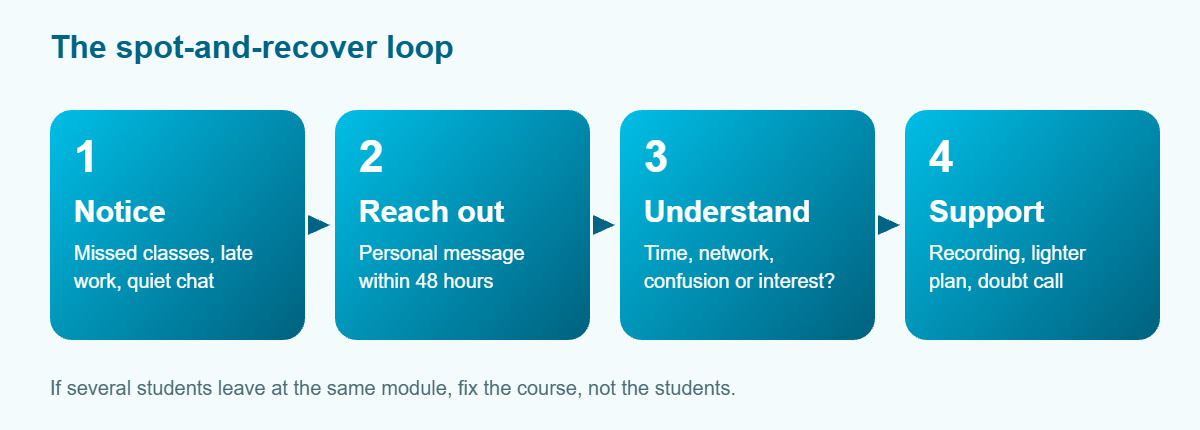
You cannot help a student you have not noticed. Keep an eye on attendance, assignment submission and quiz activity, and review them weekly. A student who misses two classes in a row, or stops opening recordings, is telling you something.
Set a simple rule: anyone who misses two sessions gets a personal message within 48 hours. Early contact is far more effective than a rescue attempt after a month of silence.
5. Provide Timely Feedback and Personalised Support
Students lose momentum waiting for answers. Run a weekly doubt-clearing session, set a clear response window for questions (say, within 24 hours) and return graded work quickly with a sentence or two of specific advice.
Personal attention need not cost hours. A short voice note or a message such as “Your algebra is strong, work on word problems this week” tells a student someone is paying attention. Institutes can assign each mentor a small group of students to follow.
6. Build Accountability Through Assignments, Tests and Learning Milestones
Regular checkpoints give students a reason to show up. A weekly practice test, a Sunday goal and a monthly milestone review create a rhythm. For exam batches, a short Saturday test with the score shared by Sunday works well. It shows students where they stand and keeps preparation steady.
Keep stakes low and feedback high. The aim is to build habit, not to scare anyone off.
7. Create a Community Among Learners
Students who know their batchmates are far more likely to stay. Create a WhatsApp or Telegram group for each batch, run weekly study circles, pair students as accountability partners and celebrate small wins publicly. Our look at cohort-based courses in India shows how a fixed batch rhythm builds this kind of belonging.
Moderate the group so it stays useful. One educator or mentor setting the tone matters more than any rule.
8. Make Learning Accessible Across Devices and Schedules
Most Indian learners study on a phone, often on patchy data. Give them recordings for missed live classes, notes they can download and a course that works on a mobile screen. A student who misses Tuesday’s class but can catch up on Wednesday night stays on track. One who cannot falls behind and often does not return.
Offer revision access after the course ends. It signals that the learning is worth keeping.
9. Use Technology to Simplify the Learning Experience
When live links sit in one app, notes in another, tests in a form and updates in a chat group, students lose time and patience. Bringing classes, content, tests and communication into one place lowers the effort of showing up each day. It also gives you one view of who is active and who is not.
This is where a digital teaching platform earns its place. A later section covers what to look for, and how to run an institute on one platform is covered in our guide to managing an online coaching institute.
How Can Educators Identify Students Who Are About to Drop Out?
Educators can spot at-risk students by watching for a change in behaviour: fewer classes attended, work left undone and messages left unanswered. The pattern matters more than any single event, because every student misses a class now and then.
Warning signs to watch for:
- Declining attendance, especially two or more missed live classes in a row.
- Missed assignments or tests that were submitted on time earlier.
- Reduced participation in quizzes, polls and chat.
- Inactivity on the learning platform, such as recordings left unopened for a week.
- Repeatedly missed deadlines.
- Unanswered calls, messages or reminders.
How to reach out before they disappear
Contact the student quickly and personally. A message like “We missed you in class on Thursday. Is everything okay? Here is the recording and what we covered” works better than a generic reminder.
Listen for the real reason. A student with a weak network needs a different fix from one who feels lost, and a student who is simply busy may need a lighter schedule for two weeks. If several students leave at the same module, treat it as a signal about the course, not the students.
Student Retention Metrics Every Online Educator Should Track
Track a few numbers consistently instead of many occasionally. Review them weekly for live batches and monthly for recorded courses.
| Metric | What it tells you | How to improve it |
|---|---|---|
| Course completion rate | Share of enrolled students who finish the course | Shorter modules, clear milestones, follow-ups for stalled students |
| Class attendance rate | Share of students attending each live class | Fixed timings, reminders, recordings for missed classes |
| Assignment submission rate | Share of students who submit assigned work | Smaller tasks, clear deadlines, quick feedback |
| Student participation | How often students answer polls, ask questions or join discussions | Polls, named questions, discussion prompts |
| Assessment performance | Whether students are actually learning, not just attending | Practice tests, doubt sessions, targeted revision |
| Student inactivity | Students with no login, view or submission for a set period | A personal message after a fixed gap, such as seven days |
| Re-enrolment or continuation rate | Share of students who join your next batch or course | Strong results, ongoing community, early offers for current students |
A “good” completion rate depends on your format, price and audience. Compare your own batches over time before comparing yourself to anyone else.
How a Digital Teaching Platform Can Help Improve Student Retention
A digital teaching platform helps retention by putting everything a student needs, and everything you need to see about them, in one place. Tools do not replace good teaching, but they remove friction that makes students drift away.
Here is what to look for:
- Organised learning content. Recorded lessons, notes and tests arranged by module, so students always know what comes next.
- Live classes. A reliable way to teach in real time, with recordings for those who miss a session.
- Assessments. Tests and assignments you can set, collect and review without chasing files on chat.
- Progress tracking. A clear view of attendance, submissions and activity, so you notice quiet students early.
- Communication. A direct way to reach students and share updates, instead of scattered groups.
- Easy access. Learners should reach their course from a phone without hunting for links.
Classplus is built for educators who want to run their teaching business from a branded platform. It brings live classes, recorded courses, tests and student management together, and lets you offer students your own branded app. Check what fits your batch size and teaching style before choosing any tool, whether it is Classplus or another.
Frequently Asked Questions
Why do students drop out of online courses?
Students drop out mainly because of low motivation, lack of time, little interaction with the educator, an overwhelming course structure, no accountability, technical problems and unanswered doubts. Most of these come from course design and communication, so educators can reduce them.
How can teachers improve student retention in online learning?
Teachers can improve retention by setting clear goals, breaking content into small modules, making classes interactive, tracking attendance and submissions, giving quick feedback, running regular tests and building a learner community. Reaching out personally to students who go quiet makes a large difference.
What is a good online course completion rate?
There is no single good number, because it depends on the course format, price and audience. Free open courses typically see low completion, and research on MOOCs shows many learners never intend to finish. Paid, mentored batches should aim higher. The most useful benchmark is your own previous batch.
How can educators keep students engaged in online classes?
Use polls, short quizzes and questions every ten to fifteen minutes, call students by name, set small tasks after each class and share recordings and notes quickly. Keep classes focused and give students a reason to take part.
How does student progress tracking improve retention?
Progress tracking shows who is attending, submitting work and staying active. That lets an educator contact a struggling student within days, before a small gap becomes a dropout.
What tools can help online educators reduce student dropout rates?
Useful tools include a teaching platform for live classes and recorded content, a testing tool for quizzes and assignments, progress and attendance reports, and a messaging channel for updates. Platforms such as Classplus combine several of these in one place.
Conclusion
Reducing student dropout is less about one big fix and more about steady habits: clear expectations, small modules, real interaction, early tracking, quick feedback and a community around the course. Students who feel guided and noticed tend to keep learning.
Start small. Pick two strategies from this list, run them for one batch and compare attendance and completion with your last batch. If juggling classes, tests and messages across several apps is slowing you down, it may be time to see how technology can simplify your teaching. You can explore Classplus to see whether it fits your way of teaching.