A follow-up system turns scattered enquiries into admissions by making sure every lead is recorded, contacted quickly and followed up on a set schedule until they enrol or say no. Most institutes do not lose students because of fees or faculty. They lose them because nobody called back in time. This guide gives you a simple stage list, a follow-up cadence, counsellor scripts and the numbers to track.
Step 1: Capture every enquiry in one place
Enquiries arrive by calls, walk-ins, WhatsApp, Instagram messages, website forms and ads. Put all of them into one sheet or CRM with these fields at minimum:
- Name, phone number and parent’s name if relevant
- Class or exam target and subjects
- Source (call, walk-in, Instagram, ad, referral)
- Date and time of enquiry
- Assigned counsellor and current stage
- Next follow-up date and notes
Step 2: Define stages
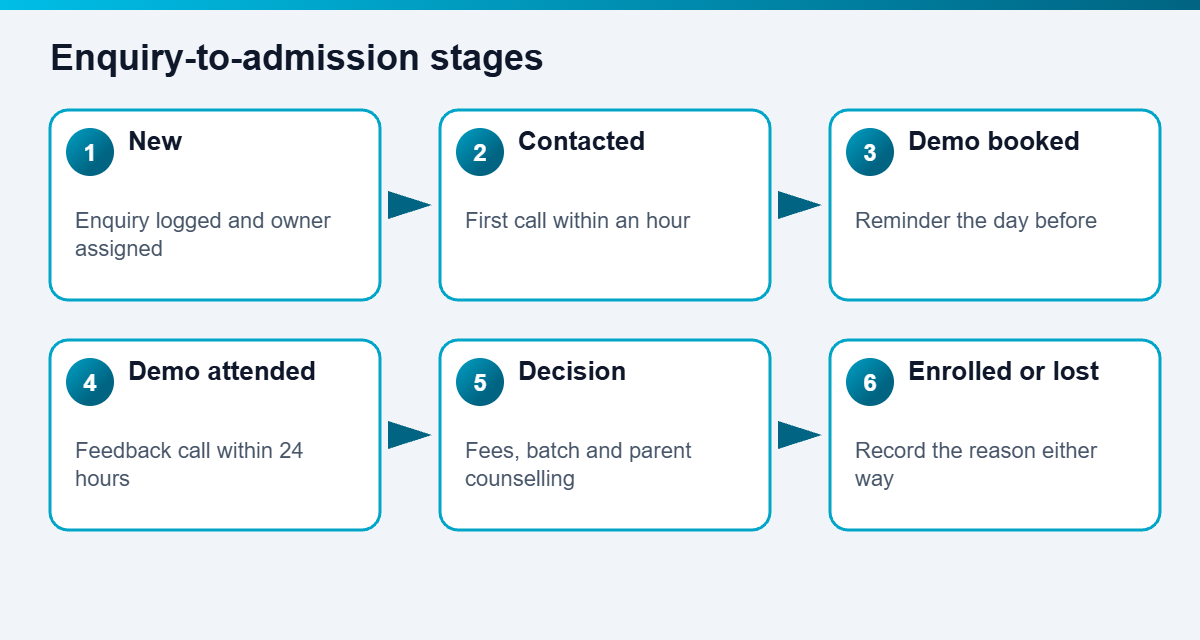
- New: enquiry received, not yet contacted
- Contacted: first conversation done
- Demo booked: demo class or counselling session scheduled
- Demo attended: student sat the session
- Negotiation or decision: considering fees, batch or timing
- Enrolled or lost: with a reason recorded if lost
Every lead must be in exactly one stage with a next action date. A lead with no next action is a lead you are about to lose.
Step 3: Respond fast
Aim to make first contact within an hour during working hours, and acknowledge after-hours enquiries with an automated message and a promise of a call-back time. An AI admission enquiry chatbot can handle the first reply at any hour while your team follows up.
Step 4: Follow up on a schedule
| When | Action |
|---|---|
| Within 1 hour | Call, and send a WhatsApp message with the brochure |
| Same or next day | Invite to a demo class |
| Day before demo | Reminder with time and link or address |
| Within 24 hours after demo | Call for feedback and share fee structure |
| Day 3 to 4 | Share a result story or a faculty introduction |
| Day 7 | Offer a counselling call with the parent |
| Day 14 and 30 | Final check-in, then move to a nurture list |
This is a starting cadence. Adjust it to your admission season, and stop contacting anyone who asks you to.
Step 5: Use counsellor scripts
First call
“Hello, this is [name] from [institute]. You enquired about [class or exam]. Is this a good time for two minutes? I would like to understand what you are preparing for and which subjects need most help.”
Demo invite
“The best way to decide is to attend a demo class. We have one on [day] at [time]. Shall I reserve a seat for [student name]?”
After the demo
“How did [student name] find the class? Which part was most useful? Based on that, I think the [batch] would suit you. Shall I explain the fee options?”
Handling a fee objection
“I understand. Can I ask what budget you had in mind? We have instalment options, and I can show what is included so you can compare properly.”
Train counsellors to listen first, avoid pressure, and never promise ranks or selections.
Step 6: Review the numbers weekly
- Enquiries by source
- Speed to first contact
- Contact rate, demo booking rate and demo attendance rate
- Demo to admission conversion
- Reasons for lost leads
- Cost per admission by source
Add these to your institute scorecard alongside the figures in coaching institute KPIs every owner should track. For wider ideas, see how to increase admissions in your coaching institute and WhatsApp marketing for coaching institutes.
Common mistakes
- Tracking leads in several personal phones and notebooks
- No owner for each lead
- Calling only once
- Not recording why leads are lost
- Sending messages without consent
From enquiry to enrolled student
When a student joins, their details should carry into batches, fees and attendance without retyping. Classplus helps coaching institutes manage live classes, tests, fees and student records under their own branded app, so the handover from admissions to teaching stays smooth.
Frequently asked questions
Do I need a CRM, or is a spreadsheet enough?
A spreadsheet works for a small institute if every lead has an owner, stage and next follow-up date. A CRM becomes useful when several counsellors share leads or enquiries come from many sources.
How many times should we follow up?
Many institutes make five to seven contact attempts across a month. Stop when the lead declines or asks you not to contact them.
What is a good demo to admission rate?
It varies by exam and location. Measure your own for a few months, then try to improve it by better demo quality and faster follow-up.
Who should call parents, a counsellor or the teacher?
Counsellors handle the process. Bring a teacher into the call when parents have academic questions.