
A cohort-based course is a live, time-bound programme where a group of students starts together, learns on a fixed schedule and finishes together. It suits educators who want higher completion, stronger results and premium pricing than a recorded course usually allows. The trade-off is that you must be present: fixed dates, live sessions and active support.
Cohort course vs recorded course vs ongoing batch
| Cohort course | Recorded course | Ongoing batch | |
|---|---|---|---|
| Start | Fixed date, group starts together | Any time | Rolling or yearly |
| Duration | Short and defined, for example 4 to 8 weeks | Self-paced | Months to a year |
| Teacher time | High during the cohort | Mostly upfront | High and continuous |
| Community | Central part of the format | Optional | Natural in classrooms |
| Best for | Skills, crash courses, exam sprints, bootcamps | Evergreen content | Full-year exam preparation |
For a wider comparison of live and recorded formats, read live classes vs recorded courses.
What kinds of courses work as cohorts in India
- Exam sprints: a 30-day revision programme before a test
- Skill courses with a project at the end, such as spoken English, Excel, coding basics or design
- Bootcamps and live workshops over a weekend or a few weeks
- Crash courses before board exams or entrance tests
- Transformation programmes where students follow a plan together, such as interview preparation
How to run your first cohort
- Define one clear outcome. For example, “speak confidently in a job interview in six weeks”. A specific outcome is easier to sell and measure than a topic list.
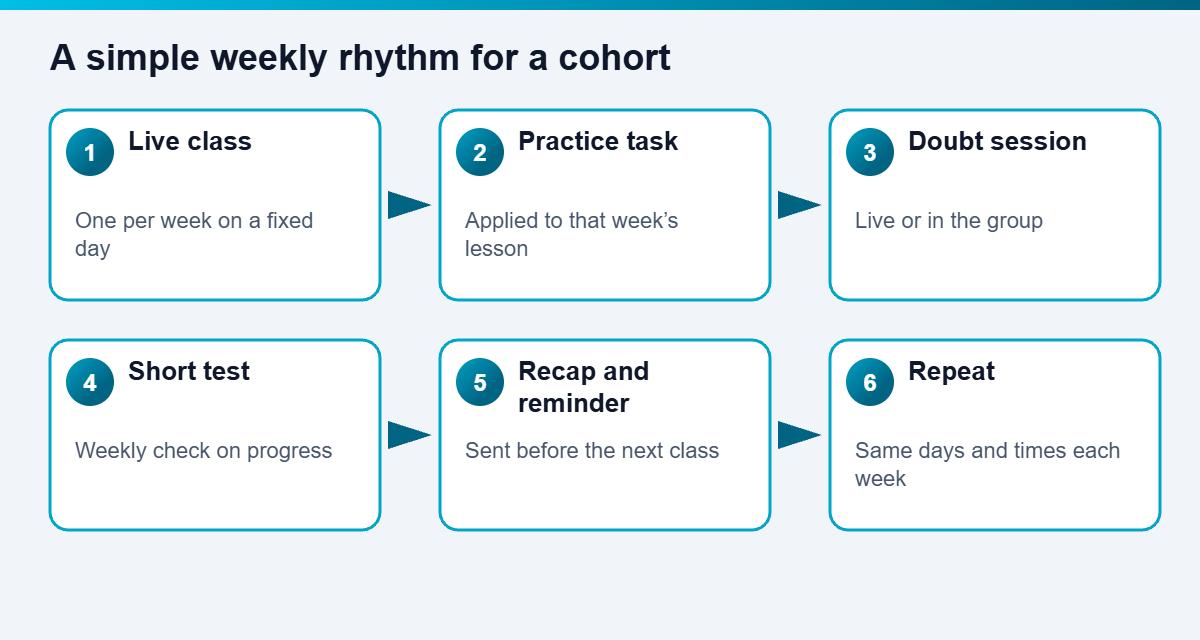
- Design the weekly rhythm. A simple structure: one live class, one practice task, one doubt session and one short test or assignment each week. Keep the same days and times.
- Set a small group size. Start with a number you can support, such as 25 to 50 students. A small first cohort gives you feedback before you scale.
- Price for the outcome. Cohorts normally cost more than recorded courses because of live access. Offer early-bird pricing and instalments, and consider UPI payment links for easy checkout.
- Open a waitlist before enrolment. A free live session or webinar is a good way to collect interested students and show your teaching.
- Create a community space. A WhatsApp group or in-app group lets students share progress and questions. Set rules on day one.
- Record every live class. Students who miss a session can catch up, and the recordings can become a later self-paced product.
- Close with results. End with a test, project showcase or certificate, then collect feedback and testimonials.
A sample six-week schedule
| Week | Focus | Activity |
|---|---|---|
| 0 | Onboarding | Welcome session, goals, community rules |
| 1 to 2 | Foundations | Live classes, practice tasks, first assessment |
| 3 to 4 | Application | Case work, mock tasks, doubt sessions |
| 5 | Review | Revision class, full test, feedback |
| 6 | Showcase | Final project or test, results, next steps |
Keeping students engaged
- Send a reminder before each live class and a short recap after it.
- Track attendance and message students who miss two sessions in a row.
- Give small weekly deadlines rather than one big task at the end.
- Celebrate progress publicly, with permission, in the community group.
Common mistakes
- Too many students for one teacher to support
- A vague outcome that cannot be tested
- No fixed schedule, so students drift
- Rushing to scale before reading the first cohort’s feedback
Tools you need
A cohort needs live classes, recordings, tests or assignments, attendance, payments and a way to message the group, all in one place if possible. Classplus helps educators run live classes, recorded courses, tests and student management under their own branded app, which makes it easier to run a cohort without juggling separate tools.
Frequently asked questions
How many students should my first cohort have?
Start with a group you can support personally. Many educators begin with 25 to 50 and grow once the format works.
How long should a cohort course be?
Short enough to keep momentum. Four to eight weeks suits many skill courses, while exam sprints can be as short as two to four weeks.
Can I sell recordings later?
Yes. Recording each live class lets you turn the cohort into a self-paced course afterwards, though live access is what justifies the higher cohort price.
Is a bootcamp the same as a cohort course?
A bootcamp is usually an intensive cohort with a fixed start, tight schedule and practical output. The planning steps are the same.