You’ve found the space, planned your batches and printed the first pamphlets. Then a parent asks, “Is your institute registered?” and you realise you’re not sure what that even means for a coaching centre.
You’re not alone. Coaching institute registration in India is a mix of ordinary business paperwork, tax registration and, since 2024, coaching-specific rules that differ from state to state. This guide explains what each registration is, who needs it, and the order to do it in.
This article is general information, not legal advice. Rules vary by state and change often, so confirm the current requirements with your local authority or a CA before you open.
What Registrations Does a Coaching Institute Need? The Short Answer
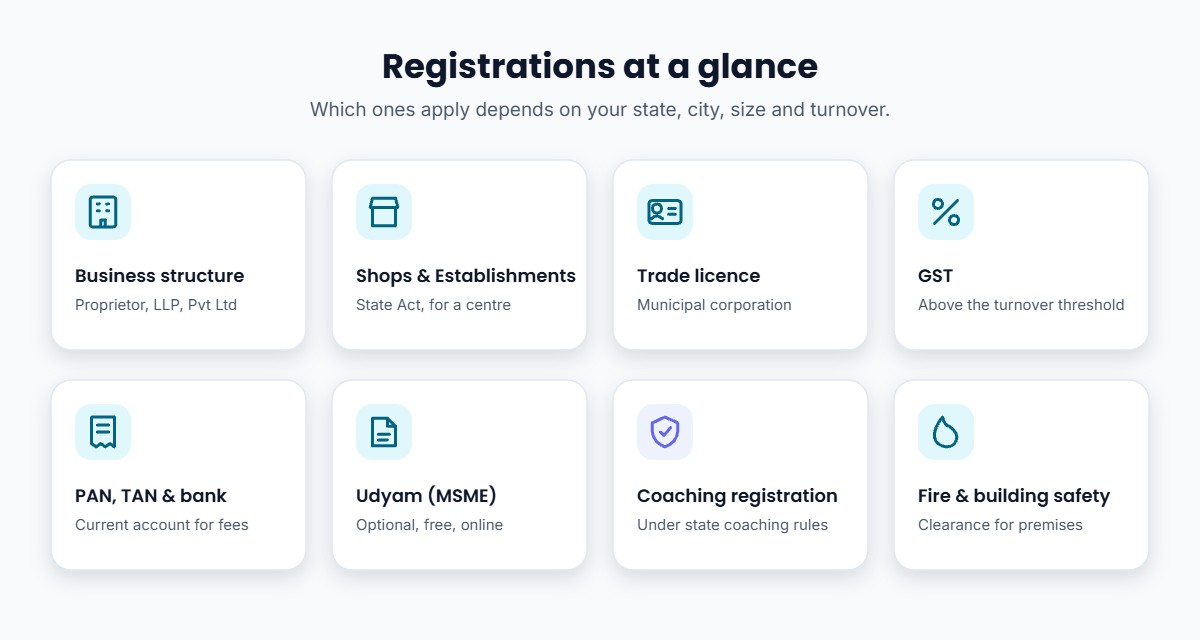
Most coaching centres in India deal with some or all of the following:
- A business structure: sole proprietorship, partnership, LLP or private limited company.
- Shops and Establishments registration under your state’s Act, for a physical centre.
- A trade licence from your municipal corporation, where your city requires one.
- GST registration, once your turnover crosses the threshold.
- PAN, TAN and a current account in the business name.
- Udyam (MSME) registration: optional, free and online.
- Coaching centre registration under your state’s coaching rules, where they apply.
- Fire and building safety clearance for your premises.
Understanding the 2024 Coaching Centre Guidelines
In January 2024, the Ministry of Education issued the Guidelines for Registration and Regulation of Coaching Centres 2024. These are model guidelines for states and union territories to adopt. They are not a single national law, so what actually applies to you depends on your state.
Key points from the guidelines, as summarised by Drishti IAS and Lawrbit:
- Who is covered: centres coaching more than 50 students. Counselling, sports, dance, theatre and other creative activities are excluded.
- Registration: with the appropriate state government, with a separate registration for each branch.
- Age: no enrolment of students below 16, or before they have passed the secondary school exam.
- Tutors: at least graduate-level qualification.
- Space: at least one square metre per student during class, plus fire and building safety compliance.
- Fees: fair and reasonable, with a pro-rata refund if a student leaves mid-course.
- Advertising: no misleading promises, rank guarantees or assured marks.
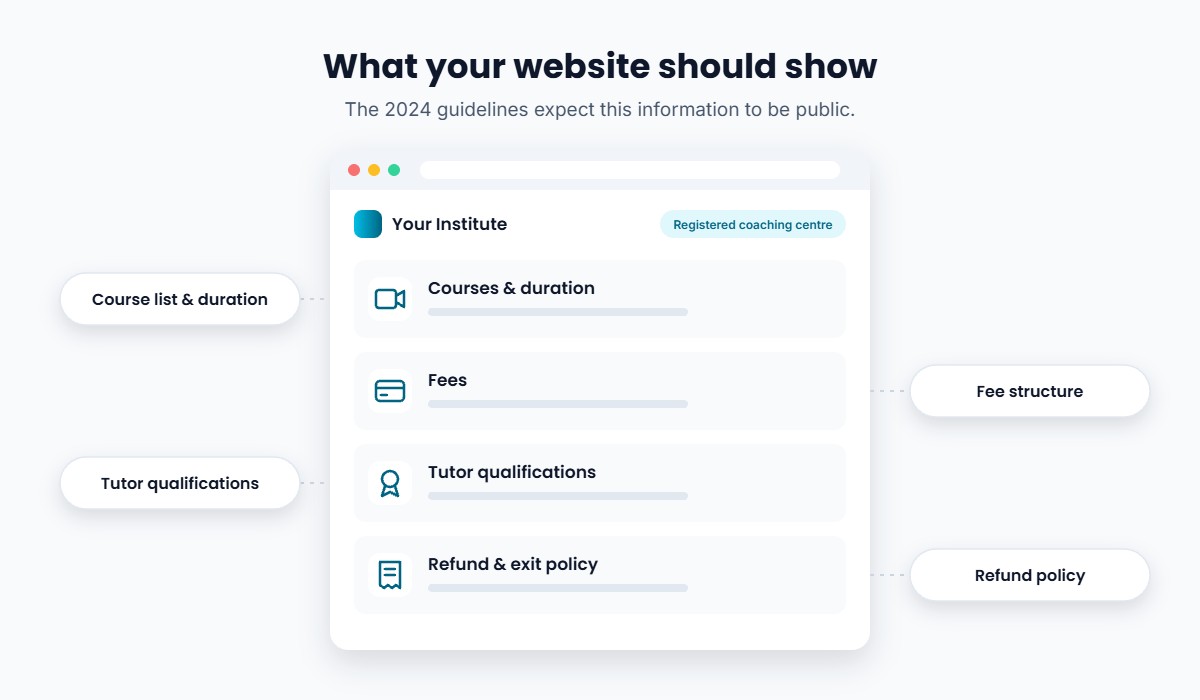
- Website: must show tutor qualifications, courses, duration, fees and the refund policy.
- Penalties: ₹25,000 for a first offence, ₹1,00,000 for a second, then cancellation of registration.
State Laws: Why Your State Matters Most
Some states have passed their own coaching laws, and these can differ from the central guidelines. Rajasthan is a good example. Its Coaching Centres (Control and Regulation) Act, 2025 was enacted in September 2025 and comes into force on a date the state notifies.
| Point | MoE model guidelines (2024) | Rajasthan Act (2025) |
|---|---|---|
| Who is covered | More than 50 students | More than 100 students |
| Registration | With the state government; each branch separately | With the District Committee via an online portal; valid 3 years |
| Fee refunds | Pro-rata if a student leaves | Pro-rata within 10 days, including hostel and mess fees |
| Instalments | Not specified | Option of at least four equal instalments |
| Penalties | ₹25,000, then ₹1,00,000, then cancellation | ₹50,000, then ₹2,00,000, then cancellation |
Other states have draft rules or their own requirements. Before you open, search for your state’s coaching centre rules, or ask your district education office whether any are in force.
Step-by-Step: How to Register Your Coaching Institute
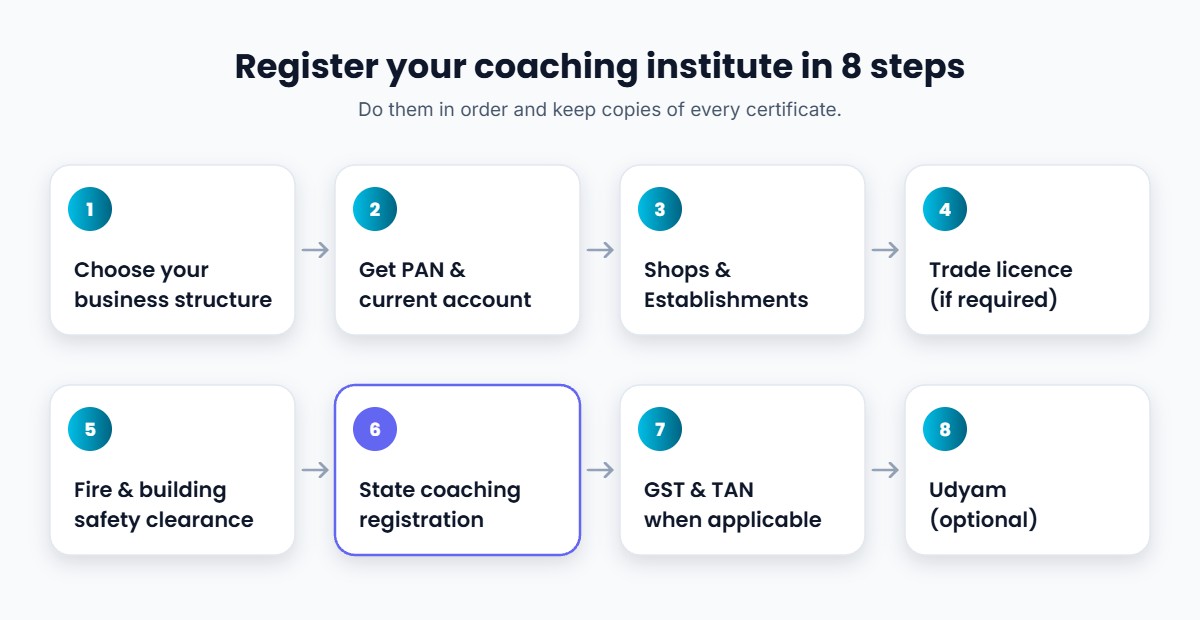
- Choose your business structure. Most single-owner institutes start as a sole proprietorship. Partners can form a partnership or LLP. If you plan to raise investment, a private limited company may suit you better.
- Get your PAN and open a current account in the business name, so fees and expenses stay separate from personal money.
- Register under the Shops and Establishments Act for a physical centre. In most states this is online. Deadlines vary by state, so check yours.
- Apply for a trade licence from your municipal corporation if your city requires one.
- Get fire and building safety clearance for your premises, especially if you’ll hold larger batches.
- Register under your state’s coaching rules, if your state has them and your student numbers fall within them.
- Register for GST once your turnover crosses the threshold (see below). Get a TAN if you’ll deduct tax at source, for example on staff salaries or rent.
- Optionally register on Udyam as an MSME. It’s free and can help with some loans and schemes.
Documents You’ll Usually Need
- PAN of the owner or business
- Aadhaar or other ID proof of the owner or partners
- Address proof of the premises (rent agreement or ownership papers, plus a utility bill)
- Photographs of the owner and premises
- Partnership deed or incorporation documents, if applicable
- Building plan, fire safety certificate and occupancy details, where your state or city asks for them
- Tutor qualification certificates, for coaching-specific registration
GST on Coaching Classes
Coaching is a taxable service under GST. According to OkCredit’s 2026 guide, coaching services are taxed at 18%. GST registration is required once annual turnover crosses ₹20 lakh (₹10 lakh in some special-category states). The education exemption for “educational institutions” generally doesn’t cover private coaching.
If you also sell online courses, read our guide to GST on online courses, and speak to a CA about your exact situation.
What About Online-Only Coaching?
The central guidelines and Rajasthan’s Act are written mainly for physical centres. Neither clearly says how they apply to purely online coaching.
What does still apply online: your business registration, PAN and bank account, GST once you cross the threshold, and honest advertising. If you teach both offline and online, follow the stricter rules for your physical centre and apply the same transparency online.
Staying Compliant After You Open
Registration is a one-time task. Compliance is everyday practice:
- Publish the required information on your website: courses, duration, fees, tutor qualifications and refund policy. A proper website for your coaching institute makes this easy.
- Keep clean fee records with receipts for every payment and refund. Good coaching fee management saves hours at audit time.
- Avoid rank or result guarantees in ads and posters.
- Track attendance and class hours, especially where your state limits daily hours.
- Renew on time. Under the guidelines, renewal applications are due two months before expiry.
Common Mistakes to Avoid
- Assuming small centres need nothing. Coaching-specific rules may start at 50 or 100 students, but business and tax registrations apply regardless.
- Relying on old articles. Many still mention pre-GST service tax rules.
- Calling yourself “recognised” or “approved”. The guidelines allow only “registered coaching centre”.
- Promising ranks in ads. It can attract penalties under both coaching rules and consumer protection guidelines.
- Mixing personal and business accounts. It makes GST, refunds and audits much harder.
How Classplus Can Help
Once your paperwork is done, the next job is running the institute smoothly and transparently. Classplus gives you your own branded app and website, where students can see courses, fees and faculty. Fees are collected online with clear records, and you can manage students and batches, take live classes, share recorded lectures, assignments and study material, run tests and send notifications from one place.
It won’t do your registration for you, but it makes the everyday part of compliance (clear information, clean fee records, organised students) much easier as you take your coaching institute online.
Set up the digital side of your coaching institute. Your own app and website, online fees, classes and student management in one place. Explore Classplus →
Conclusion
Registering a coaching institute in India comes down to three layers:
- Business: structure, PAN, bank account, Shops and Establishments, trade licence.
- Tax: GST once you cross the threshold.
- Coaching-specific: your state’s coaching rules, based on the 2024 central guidelines.
Do them in order, keep copies of everything, and check your state’s current rules before you open. If you’re still planning the business itself, our guide to starting an education business is a good next read.
Frequently Asked Questions
Is registration compulsory for a coaching centre in India?
Business and tax registrations apply to most coaching centres. Coaching-specific registration depends on your state: the 2024 central guidelines cover centres with more than 50 students, and some states, such as Rajasthan, have their own laws.
What licence is required to open a coaching centre?
Usually Shops and Establishments registration, a municipal trade licence where required, fire and building safety clearance, GST registration above the threshold, and coaching centre registration under state rules where they apply.
Is GST applicable on coaching classes?
Yes. Coaching services are generally taxed at 18% under GST, and registration is required once turnover crosses ₹20 lakh (₹10 lakh in some special-category states). Confirm your case with a CA.
Do home tuition or small coaching classes need registration?
Coaching-specific rules usually start at a minimum number of students (50 under the central guidelines, 100 under Rajasthan’s Act). Business and tax rules can still apply to smaller setups, so check with your local authority.
Can a coaching centre enrol students below 16?
The 2024 central guidelines say centres should not enrol students below 16, or before they have passed the secondary school exam. Check how your state has adopted this rule.
What is the penalty for not registering a coaching centre?
Under the central guidelines, ₹25,000 for a first offence and ₹1,00,000 for a second, then cancellation. Rajasthan’s Act sets ₹50,000 and ₹2,00,000, then cancellation.