To sell a regional-language course in India, teach in the language your target students think and study in, price for that audience, and reach them where they already spend time, such as YouTube, WhatsApp and local-language Instagram. A good regional course is not a translation of an English one. It is built around local exams, local examples and the way students in that language actually speak.
Why regional-language courses are worth considering
- Many students outside big cities are more comfortable learning in their own language, especially for school subjects and state-level exams.
- Fewer creators serve a given subject well in a specific language, so you may face less competition than in English.
- Trust is easier when students hear familiar words, accents and examples.
These are reasons to test the idea, not guarantees. Check demand for your own subject and language before you build.
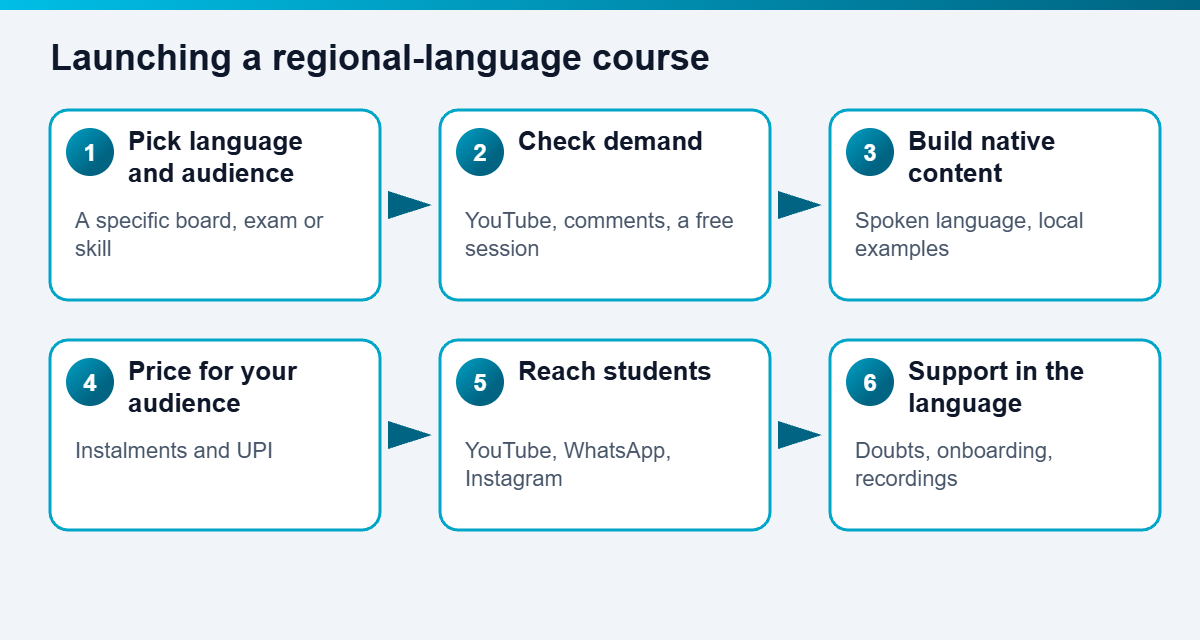
Step 1: Pick the language and the audience
Be specific. “Hindi course” is too broad. “Class 10 maths in Hindi for UP Board students” or “state police constable exam preparation in Marathi” is easier to market. Decide:
- The language and dialect your students use
- The board, exam or skill you teach
- Whether students are in cities, towns or villages, and their typical device and internet access
Step 2: Check demand
- Search YouTube and Google in the regional language and see what already exists.
- Read comments on popular videos to find unanswered questions.
- Ask 10 to 20 target students what they struggle with and what they would pay for.
- Run a free live session and count sign-ups before building the full course.
Step 3: Build content that feels native
- Teach in the spoken language. Textbook-formal language can feel distant. Mix in English terms where students actually use them, such as technical words.
- Agree on terminology. Decide whether to use English or regional terms for key concepts and stay consistent.
- Use local examples. Prices in rupees, local crops, cricket scores, public transport. Examples should feel familiar.
- Match the exam. Follow the state board or exam syllabus and question style, not a generic national one.
- Write notes in the same language. Check fonts and readability on mobile.
If you use AI to help translate or draft, have a fluent teacher review every lesson. Our guide to creating an online course with AI covers how to use it safely, and machine translation of technical content often needs correction.
Step 4: Price for your audience
- Check what comparable local courses and tuition cost.
- Offer instalments and payment by UPI, which most students already use.
- Consider a low-priced starter product, such as a mini-course or test series, before a full programme.
Step 5: Reach students where they are
- YouTube: free lessons in the regional language that lead to your paid course.
- WhatsApp: groups or broadcast lists for updates, with opt-in. See our guide to WhatsApp marketing for the basics.
- Instagram and Facebook: short clips in the local language, with captions and hashtags in the same language.
- Local word of mouth: schools, coaching centres and community groups.
For more on finding students, read how to get students for online tuition.
Step 6: Support students in their language
- Run doubt sessions and handle messages in the same language.
- Give simple instructions for installing the app, joining classes and paying fees.
- Offer recordings, so students with weak internet can watch later.
Common mistakes
- Translating an English course word for word
- Ignoring the state exam pattern
- Pricing at national or urban levels
- Providing support only in English
- Skipping a demand check
Delivering regional courses under your own brand
Your students should find your classes, recordings, tests and payments in one place. Classplus helps educators and creators run live classes, recorded courses, tests and student management under their own branded app, so you can focus on teaching in the language your students trust.
Frequently asked questions
Should I teach in pure regional language or mix in English?
Use the language your students actually speak. For most subjects that means the regional language with common English technical terms.
Can I use one course for several languages?
You can adapt it, but each language needs its own review, examples and support. Start with one language and expand once it works.
Which regional courses sell best?
It depends on your audience. Board-exam subjects, state recruitment exams and practical skills are common starting points, but test demand first.
How do I reach students with limited internet?
Offer recorded lessons, smaller video sizes where possible, and notes students can download.