For an engineering entrance coaching institute, the test series is not an add-on. It is how students learn to manage three hours, three subjects and a tricky marking scheme under pressure. If your online test portal does not feel like the real exam, students arrive at JEE Main or JEE Advanced having practised the syllabus but not the paper.
This guide is for JEE coaching institutes and faculty who are choosing, or switching, an online test portal. It focuses on what is specific to engineering entrance preparation: the exam interface, question types, marking rules, analysis that helps students improve their attempt strategy, and the test plan across Class 11, Class 12 and dropper batches. If you run a smaller institute with mixed courses, start with our broader guide on choosing an online test portal for a small coaching institute.
Why does JEE preparation need a specialised online test portal?
Three things make engineering entrance tests different from regular school or chapter tests.
- The exam is computer-based. JEE Main is conducted by the National Testing Agency (NTA) as a computer-based test, and JEE Advanced is also held on computer. Students need to be comfortable with on-screen navigation, the question palette and marking questions for review.
- Question types go beyond simple MCQs. JEE Main has multiple-choice and numerical value questions. JEE Advanced has used single-correct, multiple-correct, numerical and matching-type questions, and its pattern can change from year to year.
- Marking schemes reward strategy. Negative marking, and in JEE Advanced partial marking for some multiple-correct questions, mean that what a student chooses to skip matters as much as what they attempt.
A generic quiz tool can handle chapter practice. For full-length mocks, you need a portal that can mirror the real exam closely.
What features should a JEE online test portal have?
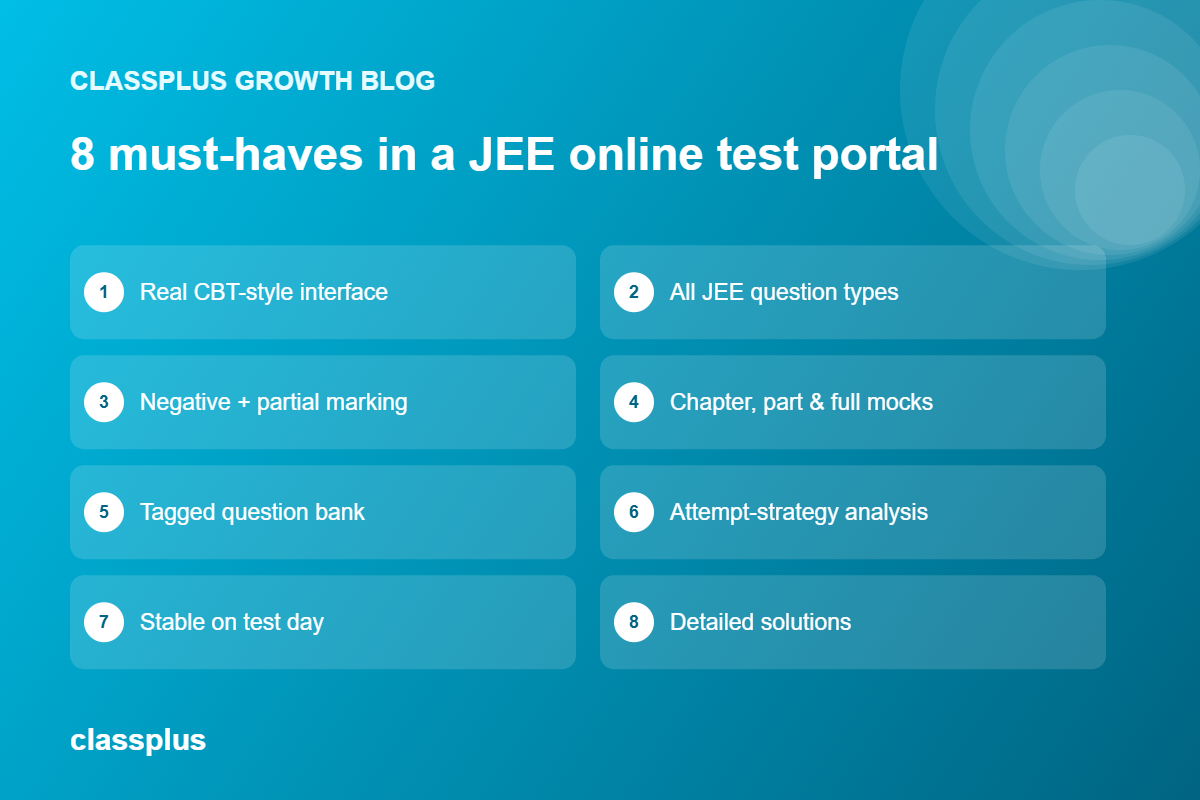
1. An exam interface close to the real CBT
The test screen should look and behave like the official computer-based test: a question palette showing answered, not answered, marked for review and not visited states, the ability to move freely between subjects, a visible countdown timer and a clear submit flow. Students who practise on a familiar layout waste fewer minutes on exam day.
2. All JEE question types
Check that the portal supports:
- Single-correct MCQs
- Multiple-correct MCQs
- Numerical value questions, including integer and decimal answers with a defined range or rounding rule
- Matching and list-type questions
- Paragraph or comprehension-based question sets
Also make sure questions can include diagrams, graphs and properly formatted equations. Physics, Chemistry and Maths questions that display badly on a phone or computer screen undermine the whole mock.
3. Configurable marking, including partial marking
You should be able to set marks for correct, incorrect and unattempted answers separately for each section and question type. For JEE Advanced-style tests, the portal should support partial marking for multiple-correct questions. Because NTA and the organising IIT announce the official scheme each year in the information brochure, the portal should let you update rules without rebuilding your tests.
4. Full-length, part and chapter test formats
A good JEE test plan uses several formats, and the portal should handle each easily:
- Chapter and topic tests after each unit
- Part tests covering a block of chapters
- Full-length mocks in the JEE Main and JEE Advanced pattern
- Previous-year paper practice under timed conditions
5. A tagged question bank
Questions should be tagged by subject, chapter, topic, difficulty and question type, so you can assemble balanced papers quickly and avoid repeating the same questions across batches. Our guide to building a custom question bank for JEE Advanced covers how to structure one.
6. Analysis that improves attempt strategy
Total marks are not enough. For JEE, the most useful reports show:
- Subject-wise and chapter-wise accuracy
- Time spent per question and per subject
- Correct, incorrect and skipped counts, with marks lost to negative marking
- How the student moved through the paper, for example whether they got stuck in one subject
- Rank and percentile within your batch or test series, and progress across mocks
This is what helps a student decide, for example, to attempt Chemistry first or to stop guessing on multiple-correct questions. See our guide to test result analysis for how to turn reports into action.
7. Reliable performance on test day
When every student starts a mock at 9 am on a Sunday, the portal has to handle the load. Ask how many students can take a test at the same time, whether answers are saved continuously, and what happens if a student’s internet drops mid-test.
8. Detailed solutions
Each question should have a worked solution, ideally with a short video explanation for difficult questions. Solutions should unlock only after the test window closes, so answers do not circulate during the test.
How should a JEE coaching institute plan its online test calendar?
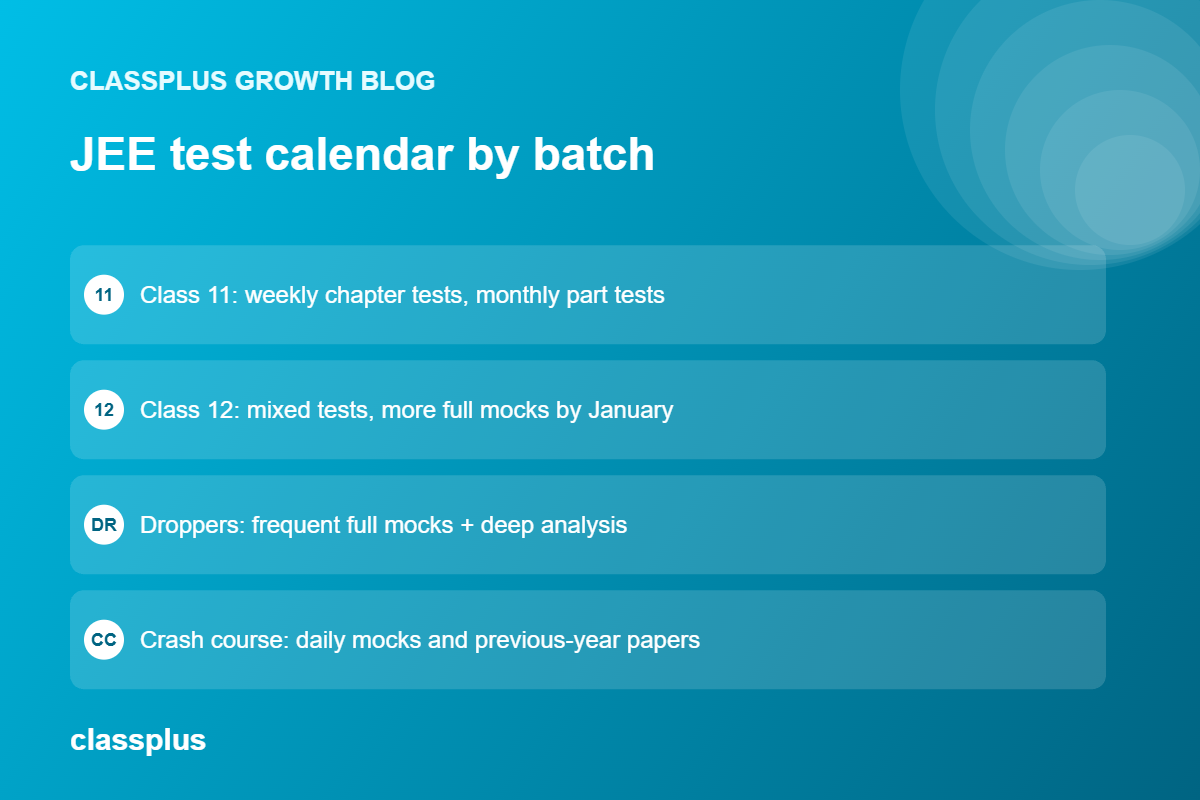
The right mix depends on the batch. Here is a practical starting point.
| Batch | Focus | Suggested test mix |
|---|---|---|
| Class 11 | Building concepts | Weekly chapter tests, monthly part tests, occasional full-length mocks from the second half of the year |
| Class 12 | Covering the syllabus while revising Class 11 | Weekly mixed tests, fortnightly part tests, full-length mocks increasing towards January |
| Dropper or repeater | Speed, accuracy and exam temperament | Frequent full-length mocks in JEE Main and Advanced patterns, with detailed analysis after each |
| Crash course | Final revision | Daily or alternate-day mocks and previous-year papers |
Keep JEE Main and JEE Advanced pattern mocks separate, and schedule mocks at the same time of day as the actual exam shift where possible. For the final weeks, our guide on planning a crash course before competitive exams shows how to structure that phase.
Should you build your own test series or buy one?
Many institutes combine both. A purchased or shared question source can fill gaps, but your own faculty-written tests reflect how you teach and what your students struggle with. Whichever you use, the portal should let you add your own questions and edit imported ones. If you want to create papers faster, our guide to the AI question paper generator explains how teachers are using AI to draft questions, which faculty should always review before use.
A strong in-house test series can also become a product. Students from other cities who are not enrolled in your classes often buy mock test series. Our step-by-step guide on how to create and sell an online test series covers pricing and launch.
Questions to ask before choosing a JEE test portal
- Can you show me a full-length JEE Main mock as a student sees it, on both a computer and a phone?
- How do you handle numerical answers with decimals or ranges?
- Can I configure partial marking for multiple-correct questions?
- Can I change the marking scheme for a test after it has been created, before it goes live?
- How many students can take a test at the same time, and how are answers saved?
- Show me the analysis for one student and for a full batch after a mock.
- Can I import questions with equations and diagrams in bulk?
- Can I sell the test series to students outside my institute and collect payments?
Common mistakes JEE institutes make with online tests
- Running mocks without reviewing them. A mock without a post-test discussion is half wasted. Schedule a review class within two days.
- Testing only on phones. Phones are fine for chapter tests, but students should take full-length mocks on a computer to match the real exam.
- Using an old marking scheme. Check the latest official information brochure each year and update your test settings.
- Repeating the same question bank across years. Students share questions. Refresh and rotate your bank.
- Focusing only on rank. Rank motivates some students and discourages others. Pair it with personal progress and accuracy trends.
How Classplus supports engineering entrance coaching
Classplus gives JEE coaching institutes and educators their own branded teaching app, with online tests and test series, test performance tracking, live classes, recorded lectures, study material, batch management and online fee payments in one place. That means your Class 11, Class 12 and dropper batches can attend classes, take tests and see their results in one app with your institute’s name on it, and you can sell your test series to students outside your batches.
Before you decide, take one of your own full-length mocks into the demo and check that the question types, marking rules and reports match how you prepare students.
Want to see your JEE test series running in your own branded app? Book a free Classplus demo.
Frequently asked questions
Which online test portal is best for JEE coaching institutes?
The best portal for JEE coaching is one that mirrors the computer-based exam interface, supports MCQ, multiple-correct, numerical and matching questions, lets you configure negative and partial marking, and gives detailed subject-wise and time-based analysis. It should also stay reliable when all your students take a mock at the same time.
How many mock tests should JEE students take?
It depends on the stage. Class 11 students benefit most from chapter and part tests, while Class 12 and dropper students should take full-length mocks regularly, increasing in frequency in the final months. Every mock should be followed by analysis and a review session.
Should JEE mock tests be taken on a computer or a phone?
Chapter tests can be taken on a phone, but full-length JEE mocks are best taken on a computer, because the actual exam is computer-based.
Can a test portal handle JEE Advanced partial marking?
Many coaching-focused portals can, but not all. Ask the vendor to show you how partial marking is configured for multiple-correct questions before you buy.
What analysis should a JEE test report include?
Subject-wise and chapter-wise accuracy, time spent per question, correct, wrong and skipped counts, marks lost to negative marking, rank or percentile within the test series, and progress across mocks.
Can a coaching institute sell its JEE test series online?
Yes. If your portal or teaching app supports online payments, you can sell your test series to students outside your batches. Make sure the series is clearly mapped to the latest exam pattern.