Your first centre is full. Evening batches have a waiting list, parents from the other side of the city keep asking if you will open “somewhere closer”, and you are starting to wonder if it is time for a second branch.
Opening a second branch of a coaching institute is one of the biggest decisions you will make. Done well, it doubles your reach without doubling your stress. Done in a hurry, it splits your attention, weakens results at the first centre and drains the cash you built up over years.
This guide walks through the whole decision: when you are ready, how to choose the location, the money, people and systems you need, and a realistic launch plan.
Signs you are ready for a second branch
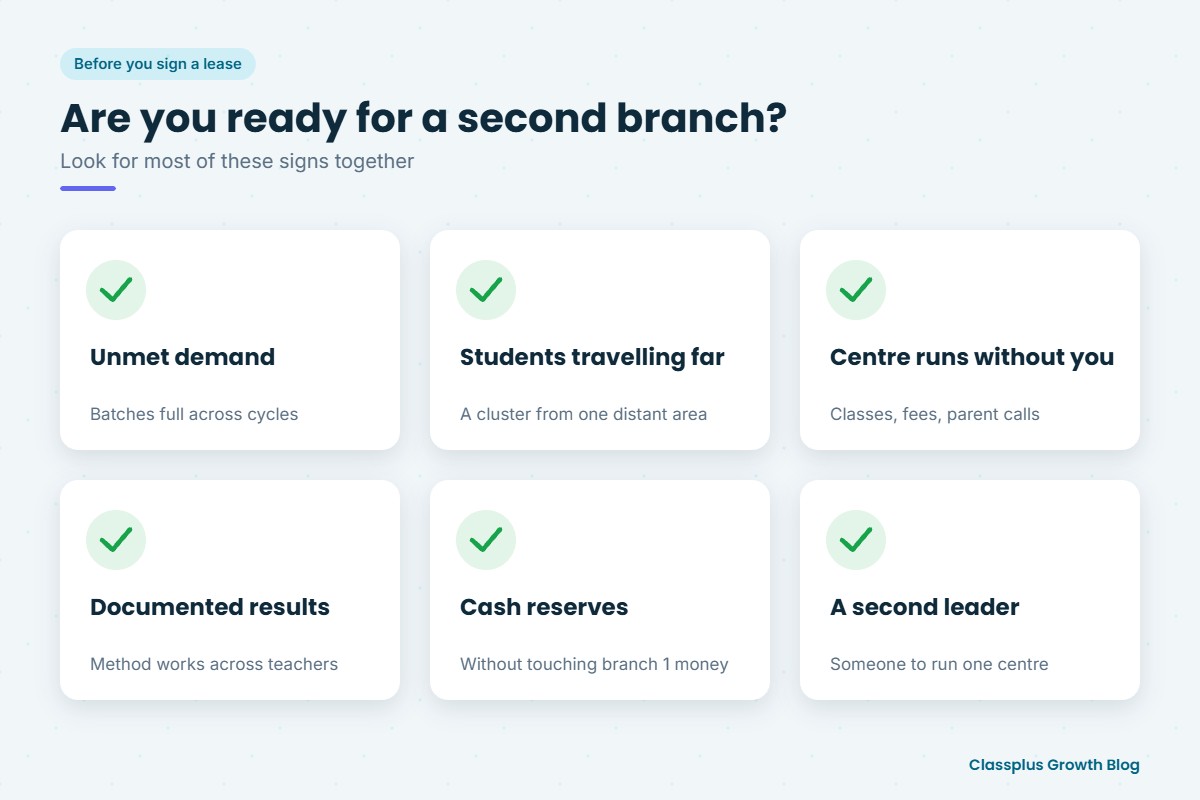
A full classroom alone is not a reason to expand. Look for most of these signs together:
- Demand you cannot serve. You are turning away students, or batches stay full across more than one admission cycle.
- Students travelling far. A good share of your students come from one specific area that is a long commute away.
- The first centre runs without you. Classes, fee collection and parent calls happen properly even on days you are not there.
- Steady, documented results. Your teaching method works across teachers, not only when you personally teach.
- Cash reserves. You can fund the new branch without touching the money the first centre needs to run.
- A second leader. Someone you trust can manage one of the two centres day to day.
If the third and sixth points are missing, fix them first. A second branch multiplies whatever you already have, including the problems.
Second branch, online batch or franchise?
Before you sign a lease, compare the three common ways to grow.
| Option | Upfront cost | Control over quality | Best when |
|---|---|---|---|
| Own second branch | High (rent, deposit, setup, staff) | Full | Demand is concentrated in one nearby area and you have a second leader |
| Online or hybrid batches | Low | Full | Students are spread out, or you want to test demand before opening a centre |
| Franchise | Low for you, high for the partner | Partial | Your brand and processes are strong enough to be copied by others |
Many institutes start with online batches for students from the target area. If those fill, you have proof of demand and a ready group of students before the new centre opens. Our guide on how to take your coaching institute online explains how to set that up.
Franchising deserves a separate, careful look. It needs written processes, training and agreements, so it is usually a later step than opening your own second branch.
Choosing the right location
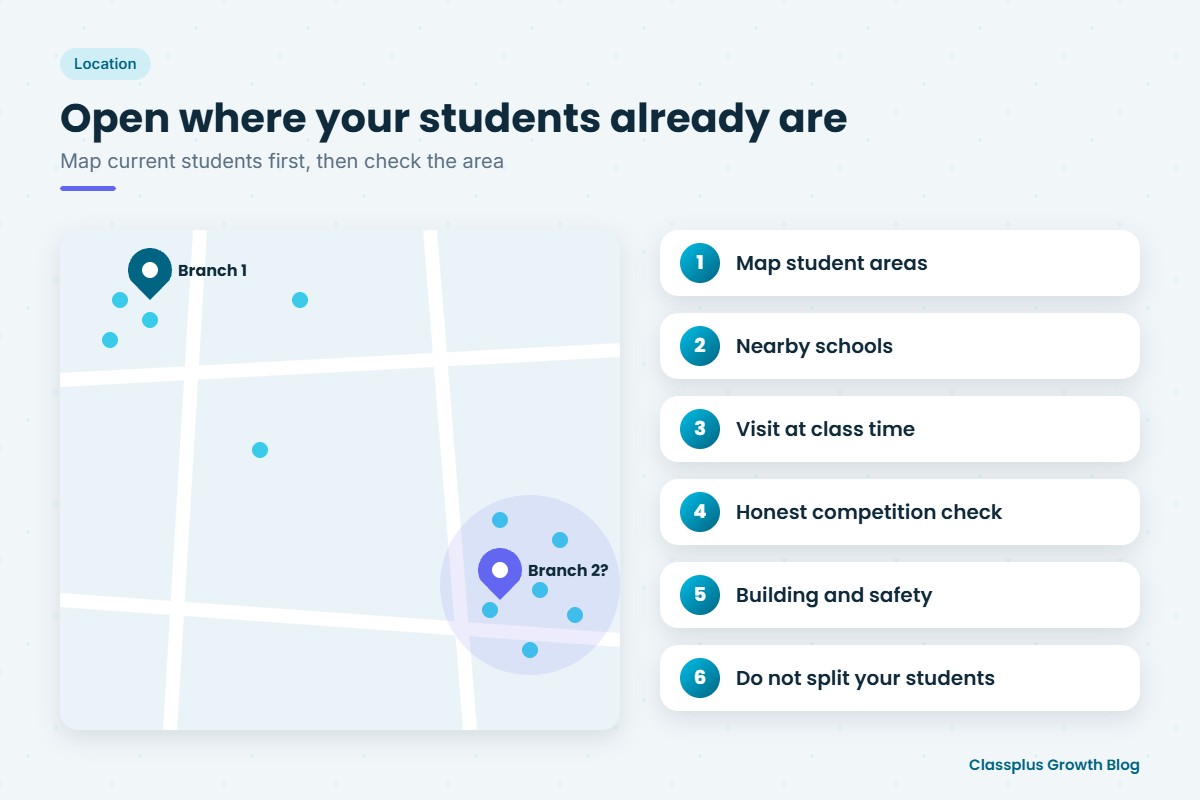
The best location is usually where your current students already come from, not where rent is cheapest.
- Map your current students. List the area or pin code of every enrolled student. Clusters far from your first centre are strong candidates.
- Check the schools nearby. Your future students study there. If you already have school tie-ups, see which ones are closer to the new area.
- Visit at class timings. Go at 6 pm on a weekday. Check traffic, parking, lighting, safety and how easy it is to reach by bus or metro.
- Look at competition honestly. Note which institutes are already there and what they teach. A gap, such as no good Class 11–12 Chemistry coaching, is an opportunity.
- Check the building. Fire safety, ventilation, washrooms, enough space per student and permission to run a commercial activity.
- Avoid splitting your own students. If the new centre is too close, you may just move students from branch one to branch two.
For a refresher on picking a first location, our guide on how to open a coaching centre in your city covers the basics.
Budgeting for a second branch
Costs vary a lot by city, so build your own budget rather than relying on average figures. Split it into three parts.
| Cost type | What to include |
|---|---|
| One-time setup | Security deposit, interiors, furniture, boards, projectors, CCTV, signage, initial marketing |
| Monthly running | Rent, salaries, electricity, internet, housekeeping, software, local marketing |
| Safety buffer | Enough to cover several months of running costs while admissions build up |
A few practical tips:
- Plan for a slow start. A new branch rarely fills in its first cycle. Your buffer should cover the gap.
- Work out your break-even. Divide monthly running cost by the average fee per student per month. That is roughly how many students you need to stop losing money.
- Keep accounts separate. Track each branch’s income and costs separately from day one, so you know which one is actually profitable.
- Check tax and registration. Talk to your CA about GST registration for the new address and any local registration. Our guides on coaching institute registration and GST on online courses give useful background.
People: who runs the new branch?
The biggest risk in a second branch is quality dropping because you cannot be in two places at once.
- Appoint a branch head. This person handles daily operations, parent queries and staff attendance. They do not have to be a teacher.
- Move one strong teacher. Shift one of your best teachers to the new branch, and hire new teachers into the established centre where your systems are already in place.
- Write down how you teach. Lesson plans, test schedules, homework rules and doubt-clearing routines should be documented so they work the same in both centres.
- Hold one review meeting a week. Compare attendance, test scores, fee collection and parent complaints for both branches.
Systems: run two branches like one institute
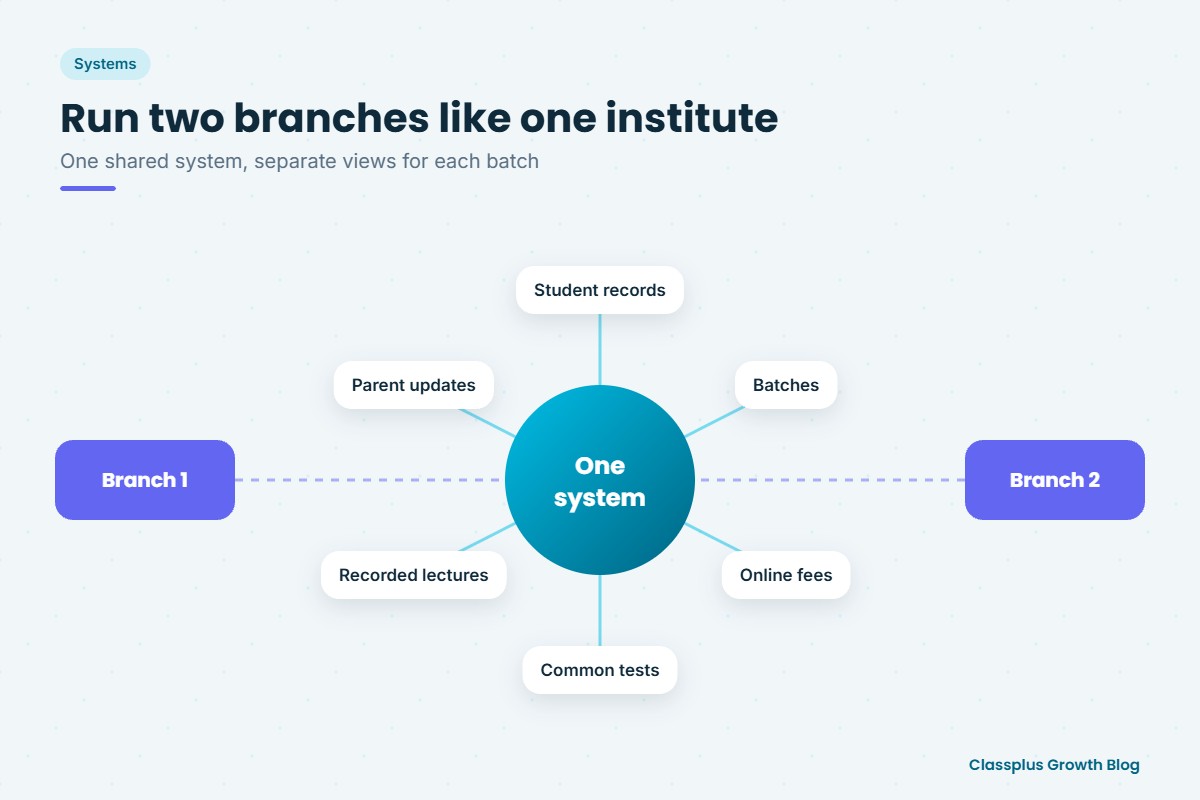
When you had one centre, a register and a WhatsApp group might have been enough. With two, you need everything in one place.
- One student database with each student’s branch, batch and fee status.
- Batch-wise timetables for both centres. Our guide on batch management shows how to organise this.
- Online fee collection with receipts, so you are not chasing cash at two counters.
- Common tests so you can compare results across branches fairly.
- Recorded lectures of your best teachers, so students at the new branch get the same quality even when a teacher is on leave.
- Attendance and performance updates for parents from both centres.
This is where a single platform helps. With your own branded app, both branches share one brand, one set of recorded courses and one testing system, while you can still see each batch separately. Our guide on coaching institute management software explains what to look for.
A 90-day launch plan
Here is a simple plan you can adapt. Start it roughly three months before the new academic session or admission season.
| Phase | Weeks | Key tasks |
|---|---|---|
| Prepare | 1–4 | Finalise location, sign lease, apply for registrations, start interiors, appoint branch head |
| Build demand | 5–8 | Run a demo week or scholarship test, start an online batch for that area, put up local signage, set up a Google Business Profile for the new address |
| Launch | 9–12 | Hold orientation, start first batches, collect fees online, share the first test results with parents |
Some ideas for the “build demand” phase:
- Hold a free scholarship test near the new location.
- Ask current students from that area to refer friends through a simple referral program.
- Create a separate Google Business Profile listing for the new branch address.
When you advertise the new branch using your existing results, follow the CCPA rules for coaching ads: show each topper’s real course and duration, and do not claim the new branch produced results it has not produced yet.
Common mistakes to avoid
- Expanding to escape problems at the first centre instead of fixing them.
- Choosing the cheapest building over the right location.
- Moving all your best teachers and weakening the first centre.
- Mixing the two branches’ money, so you cannot see which one is working.
- No written processes, so each branch slowly becomes a different institute.
- Opening during exam season, when you and your team are busiest.
Grow with one brand, across every branch
A second branch works best when students and parents get the same experience at both centres, and online too. Classplus helps coaching institutes run their own branded app and website, with live classes, recorded courses, tests, fee payments and batch management in one place. If you are planning to expand, book a free demo with Classplus to see how it would work for your institute.
Frequently Asked Questions
When should I open a second branch of my coaching institute?
Consider it when batches stay full across more than one admission cycle, many students travel from one distant area, your first centre runs well without you, and you have both a cash buffer and a second person who can lead a branch.
How do I choose a location for a new coaching branch?
Start by mapping where your current students live. Look for clusters far from your first centre, then check nearby schools, competition, safety, transport and the building itself at actual class timings.
Should I open a second branch or start online classes first?
If you are unsure about demand, start an online or hybrid batch for students from the target area. If it fills, you have proof of demand and your first group of students for the new centre.
How do I keep teaching quality the same in both branches?
Document your lesson plans, test schedules and doubt-clearing routines, run common tests across branches, share recorded lectures, and review both branches’ results every week.
Do I need a separate GST registration for a new branch?
It depends on your situation, such as whether the new branch is in a different state. Check with your chartered accountant before you open the new centre.
Is franchising better than opening my own branch?
Franchising needs less of your own money but gives you less control over quality. It usually works best once your brand and processes are strong and documented, so many institutes open their own second branch first.