Most coaching institutes test regularly, but few get full value. Marks are announced, toppers are praised and the batch moves on. The real benefit of a test comes after that: test result analysis that tells each student what to fix, tells teachers what to re-teach and tells you whether your test series is actually working.
This guide covers student-level and batch-level analysis, spotting bad questions, sharing results sensitively, and turning analysis into remedial classes and re-tests that show improvement across a test series.
Why Test Result Analysis Matters
A score alone tells you little. Two students with the same marks may have different problems: one made careless errors, the other ran out of time.
Good analysis does three jobs:
- For students: it shows exactly which topics and habits are costing them marks.
- For teachers: it shows which topics the whole batch has not understood, so class time goes where it is needed.
- For the institute: it shows whether tests are well designed and whether students are improving over the series.
Student-Level Test Result Analysis
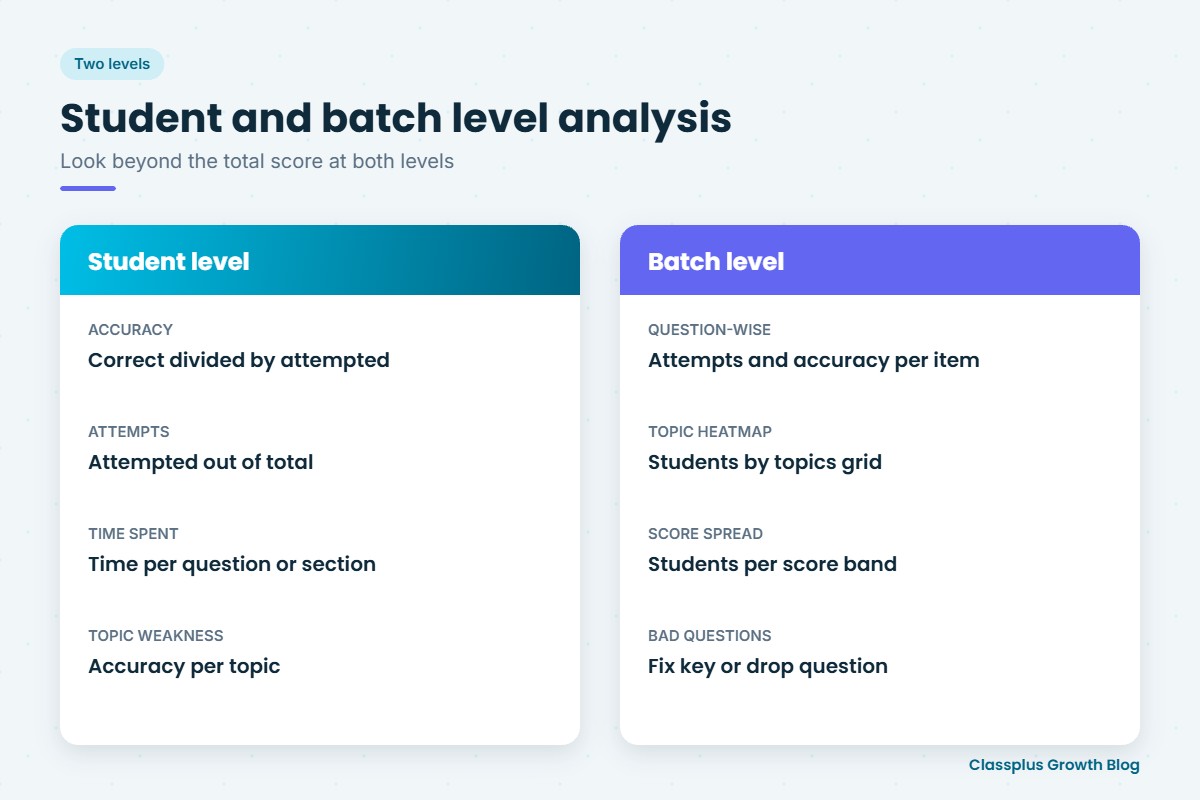
Start with each student. Four measures together give a much clearer picture than the total score.
Accuracy
Formula: Correct answers ÷ questions attempted × 100.
Accuracy shows how reliable a student’s attempts are. In exams with negative marking, low accuracy is expensive. A student with low accuracy should attempt fewer questions with more care, and review why each wrong answer happened: concept gap, misreading, or calculation slip.
Attempts
Formula: Questions attempted ÷ total questions × 100.
A low attempt rate with high accuracy usually means the student is either slow or too cautious. A high attempt rate with low accuracy often means guessing. Looking at accuracy and attempts together tells you which way the student needs to move.
Time Spent
If your tests are online, look at time per question or per section. Students who spend too long on a few hard questions often leave easy marks unattempted at the end. The fix is test strategy, not more content.
Topic Weakness
Tag every question with its subject, chapter and topic before the test. After the test, calculate accuracy per topic for each student. This turns “you scored poorly in Physics” into “you lost most marks in rotational motion and current electricity”, which is something a student can actually work on.
Batch-Level Test Result Analysis
Once you have student data, step back and look at the whole batch. This is where teachers find out what to re-teach.
Question-Wise Analysis
For each question, calculate the share of students who attempted it and the share who got it right.
- Low attempts, low accuracy: the topic was probably not understood or not covered well. Re-teach it.
- High attempts, low accuracy: students think they know it but do not. Look for a common misconception and address it directly.
- High attempts, high accuracy: the topic is secure. Do not spend more class time on it.
- Low attempts, high accuracy: students who tried it did well, but many skipped it. Build confidence with more practice.
A popular wrong option in multiple-choice questions usually points to a specific misunderstanding.
Topic Heatmap
A topic heatmap is a simple grid: students in rows, topics in columns, and each cell coloured by accuracy (for example, green for strong, yellow for average, red for weak). You can build one in any spreadsheet with conditional formatting.
Read it in two directions. A red column means the whole batch is weak in that topic, which is a teaching issue. A red row means one student is weak across many topics, which is a mentoring issue.
Score Distribution
Look beyond the batch average at how scores are spread. Group students into score bands and count each band. A batch bunched in the middle needs different attention from one split into strong and struggling groups, which may need separate practice sessions.
Finding Bad Questions
Sometimes the problem is the test, not the students. Review a question when:
- Almost nobody got it right, including your strongest students.
- Stronger students got it wrong more often than weaker students, which often means the question is ambiguous or the answer key is wrong.
- Many students chose the same wrong option and their reasoning is actually defensible.
- The question tests a topic that had not yet been taught.
When you find a bad question, correct the answer key or drop the question, re-calculate scores and tell students openly. Keep a log of rejected questions so test writers learn from them.
Sharing Results with Students and Parents Sensitively
How results are communicated affects motivation as much as the results themselves.
- Share the analysis, not just the score. Give each student their accuracy, attempts and weakest topics along with marks.
- Be careful with public rank lists. Recognising top performers can motivate, but displaying every student’s rank publicly can hurt those at the bottom. Many institutes share only the top few names publicly and give everyone else their own rank privately.
- Talk about progress. Compare a student with their own earlier tests, not only with classmates.
- Speak to parents with a plan. When you call a parent about poor results, explain what the problem is and what the institute will do about it, such as a remedial class or extra practice, and what the student should do at home.
- Stay calm and private. Discuss serious concerns in a one-to-one call or meeting, not in a group chat.
Our guide on parent communication for coaching institutes covers how to structure these conversations.
Remedial Classes and Re-tests
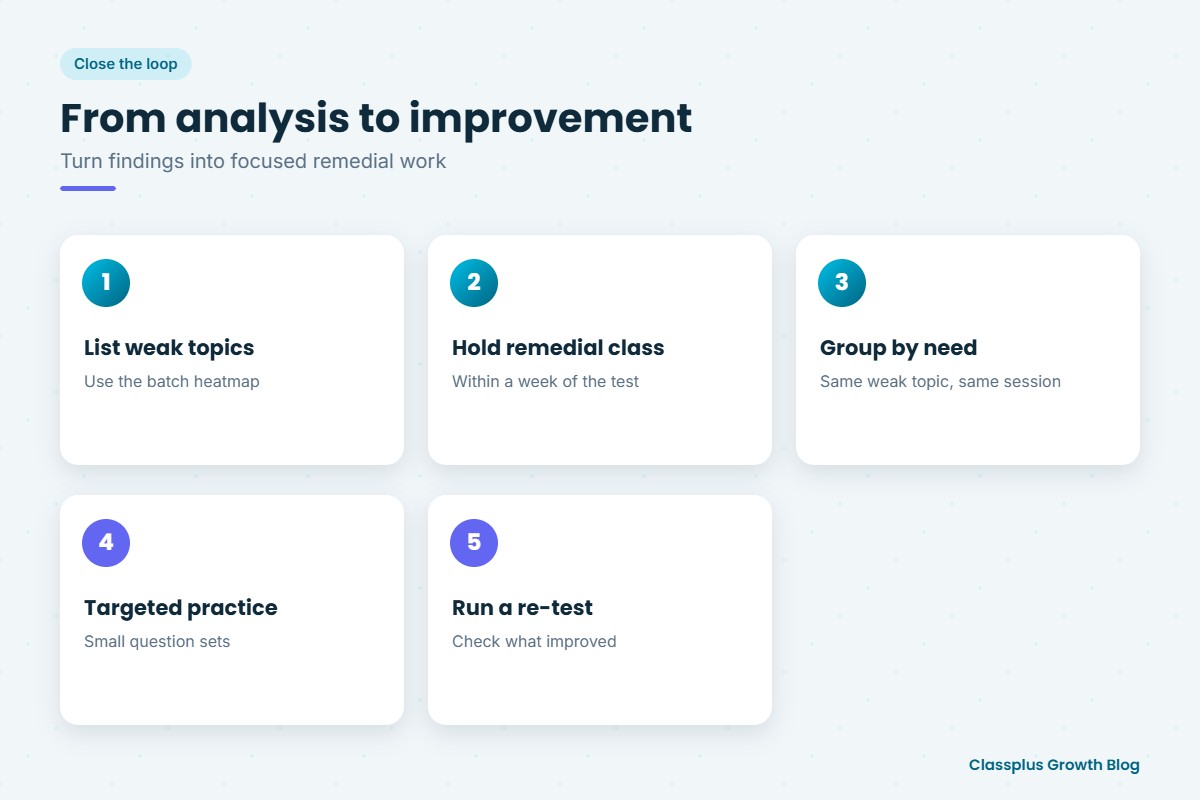
Analysis is wasted if nothing changes in the classroom. Turn findings into a short, specific plan.
- List weak topics from the batch heatmap. Pick only the few topics where the batch performed worst.
- Schedule remedial sessions. Hold short focused classes on those topics, ideally within a week of the test while mistakes are fresh.
- Group students by need. Students weak in the same topic can attend the same remedial session instead of the whole batch.
- Set targeted practice. Give a small set of questions on each weak topic rather than a full new chapter.
- Run a short re-test. A re-test on the same topics shows whether the remedial class worked.
- Use doubt sessions. Encourage students to bring specific doubts from their analysis. See our guide to setting up a doubt-solving system for your coaching institute.
Analysis Types and the Action Each One Triggers
| Analysis | What to look at | Action |
|---|---|---|
| Student accuracy | Correct ÷ attempted | Low: slow down, review error types |
| Student attempts | Attempted ÷ total | Low with high accuracy: practise speed and confidence |
| Time per question | Time spent by section or question | Uneven: teach test-taking strategy |
| Student topic weakness | Accuracy per topic | Assign targeted practice and doubt sessions |
| Question-wise analysis | Attempt and accuracy per question | Re-teach topics with low accuracy across the batch |
| Topic heatmap | Students × topics grid | Red column: re-teach; red row: mentor the student |
| Score distribution | Students per score band | Split batch: separate practice groups |
| Bad question check | Strong students wrong, defensible options | Fix key or drop question, inform students |
| Series trend | Scores and topic accuracy over tests | Flat or falling: change teaching approach |
Tracking Improvement Over a Test Series
A single test is a snapshot. A test series shows direction. To track improvement properly:
- Keep tests comparable. Keep a similar mix of easy, medium and hard questions, or compare students against each test’s batch average rather than raw scores.
- Track a few numbers per student over time. Score, accuracy, attempts and accuracy in their weakest topics are enough.
- Check if remedial work is working. If a topic stays weak after re-tests, try a different teaching approach.
- Watch participation. Students who start skipping tests are often losing interest. Reach out early. Our guide on student retention strategies for coaching has more ideas.
- Review the series at the end. Which topics improved, which did not, and which questions should be retired or rewritten next year?
If you also sell a test series online to outside students, the same discipline applies.
How Classplus Supports Test Analysis
With Classplus, you can conduct online tests and test series with test performance tracking inside your own branded app and website. You can also run live classes for remedial sessions, share recorded lessons on weak topics, manage batches and attendance, and send notifications to remind students about re-tests. Content security helps protect your test material and videos.
If you want to see how this could work for your test series, book a free demo with Classplus.
Conclusion
Tests are one of the most valuable tools a coaching institute has, but only when results are studied and acted upon. Good test result analysis looks beyond the total score to accuracy, attempts, time and topics for each student, and to question-wise patterns and topic heatmaps for each batch. Combine it with fair handling of bad questions, sensitive communication with families and focused remedial classes, and your test series will show steady improvement rather than a list of marks.
Frequently Asked Questions
What is test result analysis in coaching?
It is the process of studying test results beyond the total score. It covers each student’s accuracy, attempts, time spent and topic-wise performance, and batch-level patterns such as question-wise accuracy and topic heatmaps. The goal is to decide what each student and teacher should do next.
How do I calculate accuracy in a test?
Divide the number of correct answers by the number of questions the student attempted, then multiply by 100. Accuracy shows how reliable a student’s attempts are, which matters most in exams with negative marking.
What is a topic heatmap?
A topic heatmap is a grid with students in rows and topics in columns, where each cell is coloured by the student’s accuracy in that topic. A weak column shows a topic the batch has not understood, and a weak row shows a student who needs personal attention.
How can I tell if a test question is bad?
Review a question if almost nobody got it right, if stronger students did worse on it than weaker students, if many students chose the same defensible wrong option, or if it covered a topic not yet taught. Fix the answer key or drop the question and tell students openly.
Should coaching institutes publish rank lists?
Recognising top performers can motivate students, but publishing every student’s rank can discourage those lower down. Many institutes share only a few top names publicly and give each student their own rank and analysis privately.
How soon after a test should remedial classes happen?
Ideally within about a week, while students still remember their mistakes. Keep remedial sessions short and focused on the few topics where the batch struggled most, and follow up with a short re-test to check whether understanding has improved.