Most coaching institutes do their marketing in a rush. Results come out, a competitor puts up a banner, and suddenly everyone is printing pamphlets and running ads in the same two weeks. A coaching institute marketing plan fixes this by spreading the work across the year, so that by the time parents and students start searching, your institute is already visible, trusted and easy to contact.
This guide breaks admission season into four phases, tells you which channels to use in each, shows a simple way to split your budget using your own numbers, and lists what to measure so next year’s plan is better than this one.
Why a Coaching Institute Marketing Plan Beats Last-Minute Marketing
Admissions in most coaching segments follow a cycle tied to results, exam dates and new sessions. Your exact months will differ, but the pattern is the same: a quiet period, a build-up, a peak and a tail.
When you plan backwards from your peak, three things happen:
- You build trust before you ask for money. Parents who have seen your free content, your Google reviews or your scholarship test for months are easier to convert.
- You spend less on panic. Ads booked at the last minute often cost more and reach people who have already decided.
- Your team knows what to do each week.
The Four Phases of Admission Season
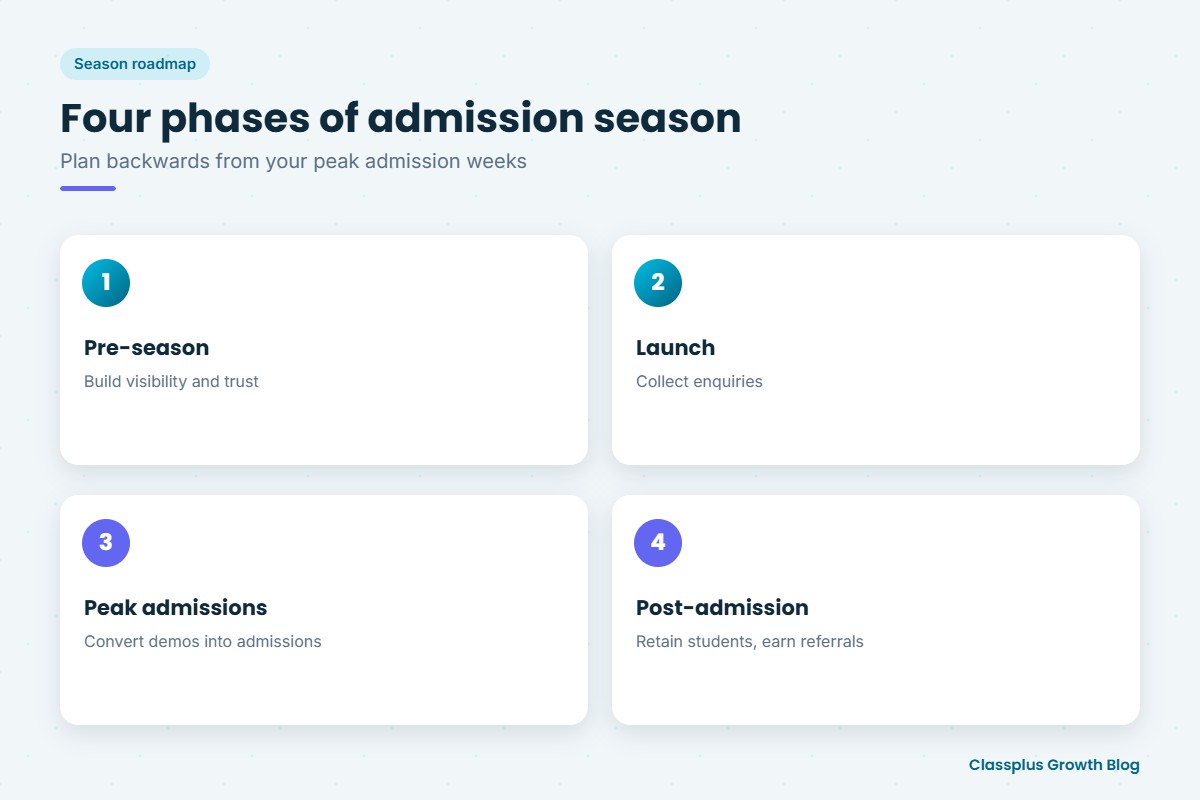
Before choosing channels, map your own calendar. Write down when your new batches start, when the relevant results are declared and when students in your segment typically decide. Then divide the year into these four phases.
| Phase | Typical timing (adjust to your segment) | Main goal | Key activities |
|---|---|---|---|
| Pre-season | 8 to 12 weeks before peak | Build visibility and trust | Update Google Business Profile, collect reviews, start content on social media, plan school tie-ups, announce scholarship test |
| Launch | 4 to 8 weeks before peak | Collect enquiries | Run scholarship test, open demo classes, start WhatsApp broadcasts, launch referral offer, local offline activity |
| Peak admissions | Results week to batch start | Convert enquiries into admissions | Daily follow-ups, demo-to-admission calls, limited-seat reminders, parent meetings |
| Post-admission | First 4 to 8 weeks of batch | Retain and generate referrals | Onboarding, early wins for students, collect reviews, activate referral programme, review data |
Pre-season: Build Before You Sell
This is the phase most institutes skip, yet it makes the rest easier. Start by fixing your Google presence. Our guide on setting up a Google Business Profile for your coaching institute walks through photos, categories, posts and review requests.
Use pre-season to also:
- Request reviews from current and past students and parents who are genuinely happy.
- Start posting useful content on Instagram, YouTube or Facebook: short concept explanations, exam tips, study plans.
- List the schools near you and decide which ones you will approach for workshops or tie-ups.
- Fix your scholarship test date, syllabus and registration form.
Launch: Open the Enquiry Taps
Now you start actively asking for enquiries. The scholarship test is often the strongest tool here because it gives students a reason to visit or sign up even if they are not ready to pay. See our detailed guide on running a scholarship test for your coaching institute.
In this phase:
- Announce free demo classes with fixed dates and times.
- Start WhatsApp broadcasts to past enquiries and current students’ families.
- Launch a referral offer for current students.
- Begin local offline activity such as school seminars, society notice boards and newspaper inserts, if they suit your area.
Peak Admissions: Follow Up Fast
During peak weeks, marketing is mostly follow-up. Every enquiry should get a response the same day. Assign one person to own the enquiry list, and track each lead from “enquired” to “attended demo” to “admitted”. For a step-by-step approach, read how to convert a demo class into an admission.
Keep your messages honest: real seat numbers, batch timings and fee details.
Post-admission: The Phase That Feeds Next Year
Once batches begin, shift focus to the students you have. A smooth first month makes students and parents more likely to recommend you. Ask for a review after the first few weeks, not on day one. This is also the right time to activate your referral programme, because new students are excited and talking to friends.
Channels to Use and When to Use Them
Not every channel suits every institute. Here is how the common channels fit into the plan.
Google Business Profile
Often the first thing a parent sees when searching for coaching nearby. Keep timings, phone number and photos updated and reply politely to every review. It matters most in pre-season and launch.
WhatsApp is where most conversations with Indian parents actually happen. Use it for demo reminders, test registration links, batch updates and polite follow-ups. Always take consent before adding people to broadcast lists and avoid sending too many messages. Our guide on WhatsApp marketing for coaching institutes covers templates and etiquette.
Referrals
Happy students and parents are your most trusted channel. Keep the referral reward simple, such as a fee discount or a useful study resource, and make the process easy to explain in one line.
Scholarship Test
A well-run scholarship test brings in a list of interested students, shows them your teaching style and gives you a natural reason to call parents. Make sure the scholarship terms are clear and written down before you announce it.
School Tie-ups
Workshops, career talks or free doubt sessions in nearby schools can build credibility with both students and parents. Start these conversations in pre-season, because schools plan their calendars early.
Social Media
Instagram, YouTube and Facebook help people know your teachers before meeting them. Focus on useful content and real faces, posted consistently.
Local Offline Marketing
Pamphlets, banners, newspaper inserts, society notice boards and auto-rickshaw ads still work in many towns. Use them with a clear call to action, such as a phone number or a QR code to register for the scholarship test, so you can tell whether they brought enquiries.
A Simple Budget Split Using Your Own Numbers
There is no single correct marketing budget for a coaching institute. Instead of copying someone else’s figure, work it out from your own numbers.
- Write down your admission target for the season (for example, call it T).
- Write down your average fee per student (F).
- Decide what share of the expected fee revenue you are willing to spend on marketing. This is your own business decision. Call it your marketing share, M.
- Your total marketing budget is T multiplied by F multiplied by M.
- Split that budget across the four phases based on effort. Many institutes give the most to launch, because that is when enquiries are generated, but you should decide based on what worked for you last year.
- Within each phase, divide money across channels. Give more to channels that brought admissions last season, and keep a small test amount for one new channel.
Keep a simple sheet with columns for channel, amount spent, enquiries, demo attendees and admissions. After one season, you will know your own cost per admission for each channel, which is far more useful than any industry average.
Staying Within the Rules on Coaching Advertisements
Coaching advertisements in India are now under closer watch. The Central Consumer Protection Authority (CCPA) has issued guidelines on misleading advertisements in the coaching sector, covering things like claims about toppers, selection numbers and guaranteed results. Before you print a topper banner or post a result reel, read our explainer on coaching advertisement guidelines for toppers and results and keep written consent and clear course details for any student you feature.
What to Measure
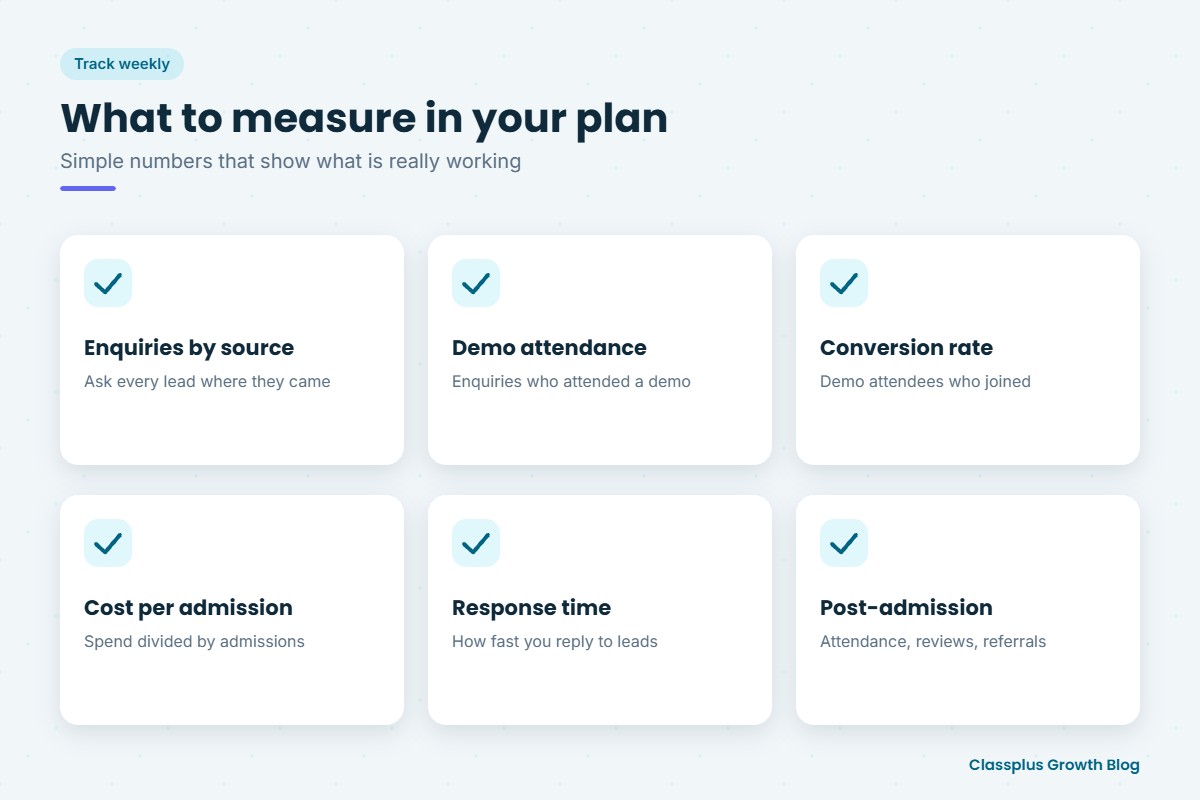
You cannot improve what you do not track. At minimum, measure these every week during the season:
- Enquiries by source: ask every new enquiry how they heard about you and record it.
- Demo attendance rate: how many enquiries actually attended a demo class.
- Conversion rate: how many demo attendees took admission.
- Cost per admission by channel: money spent on a channel divided by admissions from it.
- Response time: how quickly your team replies to a new enquiry.
- Post-admission signals: attendance in the first month, reviews collected and referrals received.
At season end, compare what you planned with what happened. That review becomes the first draft of next year’s plan.
How Classplus Supports Your Marketing Plan
Marketing brings students to your door, but what they experience after that decides whether they stay and recommend you. With Classplus, you get your own branded app and website, so your institute’s name is on the screen, not someone else’s. You can run live classes, sell recorded courses, conduct online tests and test series with performance tracking, collect fees online with coupons for scholarship winners or referrals, manage batches and attendance, and send notifications to students. Classplus also offers marketing assistance to help you plan your outreach.
If you want to see how this fits your admission season, book a free demo with Classplus.
Conclusion
A good coaching institute marketing plan is not about spending more. It is about doing the right thing at the right time: building trust in pre-season, collecting enquiries during launch, following up fast during peak admissions and looking after students afterwards so they bring in the next batch. Use your own calendar, your own numbers and your own data, and each season will be easier than the last.
Frequently Asked Questions
When should a coaching institute start marketing for admissions?
Ideally, start around two to three months before your peak admission period. This gives you time to update your Google Business Profile, collect reviews, build social media content and plan your scholarship test before enquiries start coming in.
How much should a coaching institute spend on marketing?
There is no fixed figure that suits every institute. Multiply your admission target by your average fee, then decide what share of that expected revenue you are comfortable spending. Track cost per admission by channel and adjust next season based on your own results.
Which marketing channel works best for coaching institutes?
It depends on your location, segment and audience. Many institutes find referrals, Google Business Profile and WhatsApp follow-ups useful, while others get strong results from scholarship tests or school tie-ups. Track enquiries by source to find out what works for you.
Is a scholarship test a good marketing idea?
Yes, for many institutes it is. It gives students a low-pressure reason to engage with you, lets them experience your teaching style and gives you a list of interested families to follow up with. Keep the terms clear and written down.
Can I show topper results in my coaching ads?
You can, but follow the CCPA guidelines on coaching advertisements. Get written consent from the student, mention the course they actually took and avoid misleading claims about guaranteed results or selection numbers.
What should I do after the admission season ends?
Focus on onboarding new students well, collect genuine reviews after a few weeks, activate your referral programme and review your data. Compare planned versus actual results and use that review to plan next year’s season.