Every year, the same thing happens the week results come out. Hoardings go up overnight. WhatsApp groups fill with poster after poster of smiling faces, big rank numbers and lines like “100% selection” and “Admissions closing in 3 days”.
Results really are the strongest proof a coaching institute has. Parents trust them more than any brochure. But since November 2024, the way you show those results is covered by specific rules from the Central Consumer Protection Authority (CCPA). A poster that looked normal two years ago can now count as a misleading advertisement.
This guide explains what the coaching advertisement guidelines say about toppers, testimonials and claims, in plain language. It then shows how to build results marketing that stays within the rules and still works.
Please note: This article explains the guidelines in general terms for coaching owners. It is not legal advice. For your specific situation, read the official notification or speak to a lawyer.
What are the CCPA coaching advertisement guidelines?
The full name is the Guidelines for Prevention of Misleading Advertisement in Coaching Sector, 2024. The CCPA issued the final version on 13 November 2024, under the Consumer Protection Act, 2019.
They are not the only rules you deal with. They sit alongside the CCPA’s general 2022 guidelines on misleading ads and the Ministry of Education’s January 2024 guidelines for coaching centres. If you have not sorted out your basic paperwork yet, our guide to coaching institute registration covers that side.
Who do they apply to?
- Coaching centres with more than 50 students. The guidelines define a coaching centre as one that provides coaching to more than fifty students.
- “Coaching” means academic support: tuition, study programmes, guidance and similar activity. Counselling, sports, dance, theatre and other creative activities are excluded.
- All forms of coaching ads. The definition of advertisement in the Consumer Protection Act covers print, electronic media, the internet and websites. Your Instagram reels, YouTube thumbnails, WhatsApp posters and app banners all count.
- Endorsers too. Anyone whose opinion or experience an ad appears to reflect, including a topper or a celebrity, can be responsible for it.
If you run a small home tuition with 20 students, the guidelines may not apply to you directly. Following them is still a good habit. Parents notice honest ads, and you will be ready when you grow.
What counts as a misleading coaching advertisement?
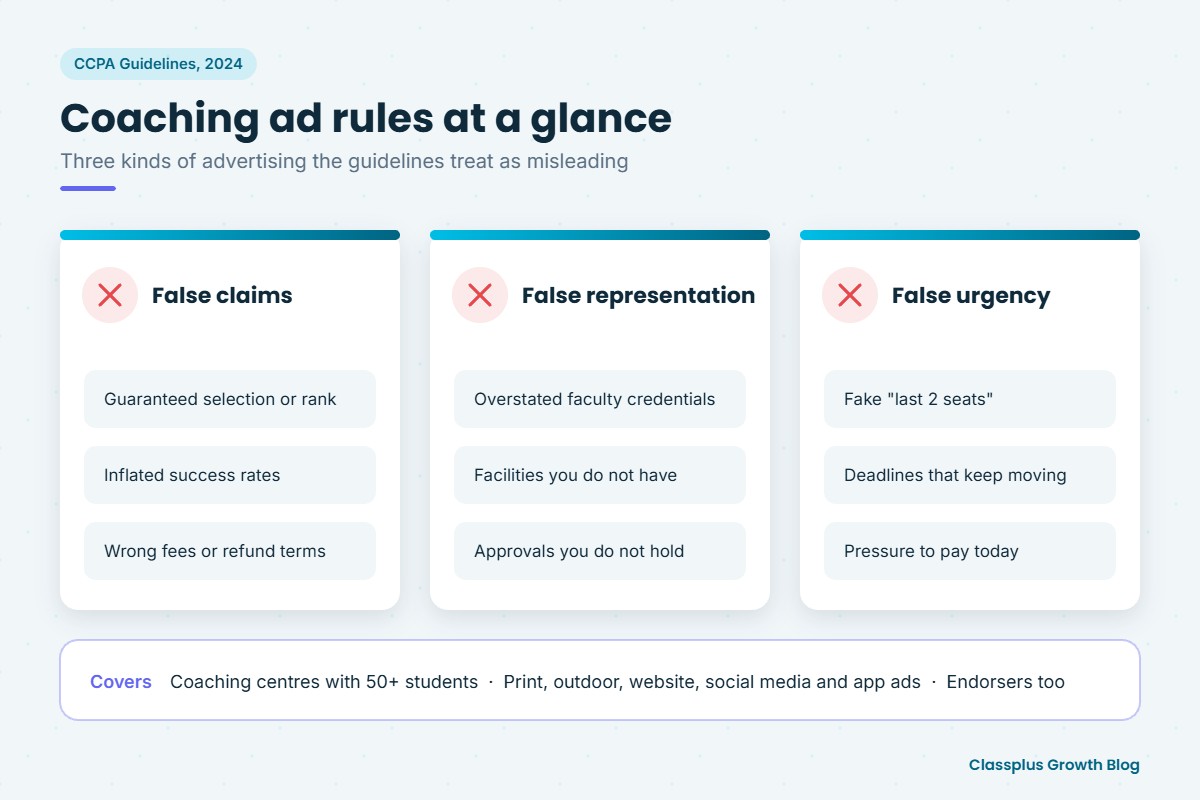
The guidelines group problems into three types: false claims, false representation and a false sense of urgency.
False claims
You cannot make false claims about:
- the course, its duration, faculty qualifications, fees, or your refund policy
- selection, ranks or “success rate” in any exam, or success at different stages of an exam
- “guaranteed selection”, guaranteed admission, job promotion, salary increase, or “good rank / high marks”
The word “guaranteed” is the biggest red flag. No institute controls an exam result, so a guarantee is very hard to defend.
False representation
This means presenting your services as being of a standard or quality they are not. Examples: calling faculty “IIT experts” when only one visiting teacher is from an IIT, or showing a “smart classroom” photo from another building.
The guidelines also ask you to:
- state truthfully whether a course has AICTE, UGC or other approval, wherever such approval is required
- describe your facilities, resources and infrastructure accurately
False urgency
Creating a false sense of urgency or scarcity to push someone into an immediate decision is not allowed. “Only 5 seats left” is fine if it is true. It is a problem if you print it on every poster in every season.
The rules for showing toppers and successful students
This is where most results posters go wrong. Here is what the guidelines require when you feature a successful candidate.
| Requirement | What it means for your poster or reel |
|---|---|
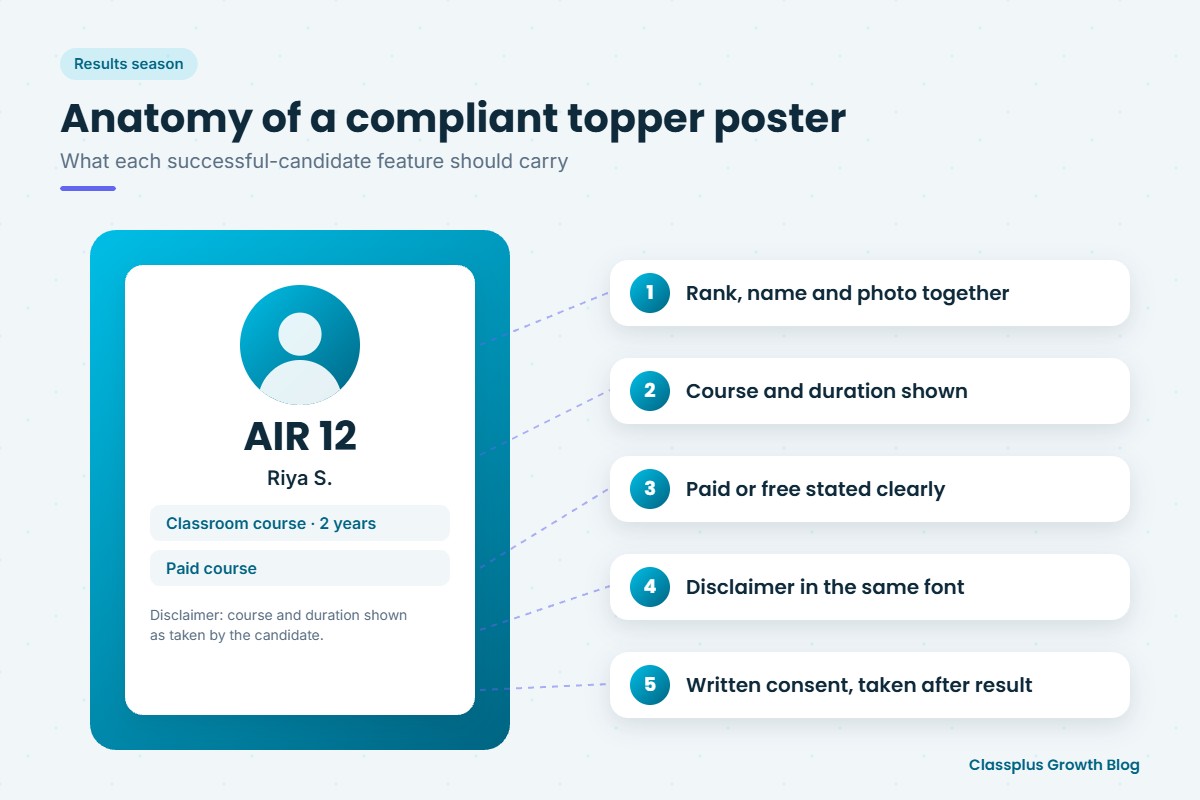
| Disclose rank, name and course duration | Show the student’s rank, name and how long they studied with you, next to their photo |
| Say whether the course was paid | State clearly if the student paid for the course they took |
| Written consent | No name, photo, testimonial or video without the student’s written consent |
| Consent after selection | Take that consent after the result is out, not in the admission form |
| Prominent disclaimer | The disclaimer, rank, name and duration must be displayed prominently |
| Same font | The disclaimer and the claim cannot be in different fonts |
The first two rules target a very common practice. A student studies for two years at one institute, joins a 10-day test series somewhere else, and then appears on both institutes’ hoardings. Showing course duration and whether it was paid lets parents see what the institute actually contributed.
Why “consent after selection” matters
Many institutes add a line to the admission form: “I allow the institute to use my name and photo for promotion.” Under the guidelines, consent has to be obtained after selection. Signing something at admission does not cover the use of a result that did not exist yet.
So every result season needs a fresh, written consent from each student you want to feature.
A compliant results campaign, step by step
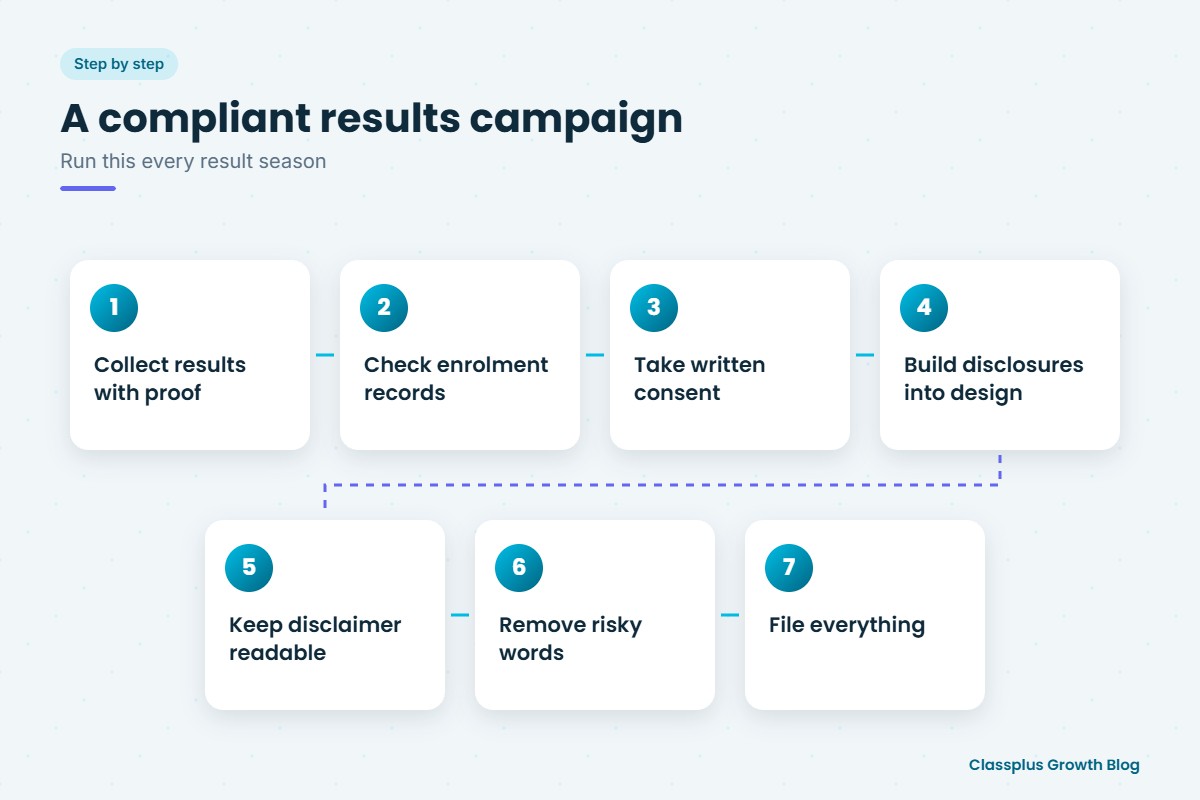
Here is a simple process you can run every result season.
- Collect results with proof. Ask students to share their scorecard or result screenshot. Keep a copy.
- Check enrolment records. Confirm which course each student took, from when to when, and whether they paid for it. This is much easier when admissions and fees are recorded in one system rather than across registers.
- Take written consent. Use a short form that names exactly what you will use: name, photo, rank, quote, video. Get it signed after the result. For minors, get it signed by a parent or guardian as well.
- Design the poster with the disclosures built in. Put rank, name, course and duration in a fixed block next to each photo. Write “Paid classroom course” or “Free scholarship batch” as applicable.
- Keep the disclaimer readable. Use the same font family as the headline, at a size people can actually read on a phone.
- Remove risky words. Search your draft for “guaranteed”, “100%”, “assured” and “No. 1”. Replace them with facts you can show.
- File everything. Keep the consent forms, scorecards and enrolment proof together, in case a parent or authority asks.
A simple consent form
You do not need a complicated legal document. A clear one-page form can cover:
- student name, exam, rank or score and result date
- the course taken, its duration and whether it was paid
- what you will use (name, photo, rank, written quote, video)
- where you will use it (posters, website, app, social media)
- for how long, and that the student can withdraw consent for future use
- signature of the student, and of a parent or guardian for minors, with date
Have your lawyer review the final wording once. After that, reuse it every season.
Before and after: rewriting common result claims
Most risky lines can be rewritten into something honest and just as strong.
| Risky line | Safer version |
|---|---|
| “100% selection guaranteed” | “[Number] of our 2025 classroom students cleared Prelims” (your real, provable count) |
| “AIR 12 from our institute” (student took a 2-week test series) | “AIR 12 – Riya S., Test Series (2 weeks, paid)” |
| “Best faculty in India” | “Physics taught by Mr. Sharma, 14 years of teaching experience” |
| “Last 2 seats! Admission closes tomorrow!” (not true) | “New batch starts 3 June. Seats are limited to 40 per batch.” |
| Photo of a topper with no details | Photo + rank + name + course + duration + paid/free, in one block |
The numbers in the table are only examples. Use your own real figures, and only the ones you can prove.
Results marketing that still works within the rules
The rules do not stop you from celebrating students. They push you towards proof that parents find more believable anyway.
- Tell the journey, not just the rank. A short video where a student explains how they fixed weak topics is more convincing than a big number.
- Show your process. Test schedules, doubt sessions and revision plans show what a new student will actually get. A scholarship test is also a good way to let parents see your teaching first-hand.
- Celebrate improvement. “Scored 42% in the first mock, 81% in the final” is a strong, honest story. Ask for consent in the same way.
- Get found where parents search. Keep your Google Business Profile accurate and collect real reviews.
- Use WhatsApp carefully. Results posters spread fastest on WhatsApp, so every version there must carry the same disclosures. Our guide to WhatsApp marketing for coaching institutes has more ideas.
- Be clear on fees and refunds. False claims about fees or refunds are covered too. A written refund policy helps you avoid disputes.
For more ways to fill batches without risky claims, see our guide on how to increase admissions in your coaching institute.
Where your own app helps
Disclosures are much easier when your records are in one place. If you run your institute on your own branded app, you already have each student’s batch, course dates, fee payments and test performance in one system. Checking “how long did this topper study with us, and did they pay?” takes minutes instead of a search through registers.
Your app is also an advertising channel in its own right. Banners, notifications and course pages all count as ads, so the same rules apply there. The upside is that you control every word, and you can fix a mistake everywhere at once.
Classplus helps coaching institutes run their own branded app and website, with live classes, recorded courses, tests, fee payments and batch management in one place. If you want to see how it would work for your institute, book a free demo with Classplus.
Quick compliance checklist for your next results poster
- Rank, name and course duration shown next to every photo
- Paid or free course clearly stated
- Written consent taken after the result, filed safely
- Disclaimer in the same font as the claim, easy to read on a phone
- No “guaranteed”, “100%” or “assured” claims
- Faculty and facility details are accurate
- Any deadline or seat limit is true
- The same disclosures on every version: hoarding, reel, WhatsApp, app banner
Frequently Asked Questions
Do the CCPA coaching guidelines apply to small tuition centres?
The guidelines define a coaching centre as one that coaches more than 50 students, so a smaller centre may fall outside that definition. Misleading advertising is still covered by the Consumer Protection Act, 2019, so honest ads are the safer choice at any size.
Can I use a topper’s photo if they signed a consent clause at admission?
The guidelines say consent for a successful candidate’s name, photo, testimonial or video must be written and must be obtained after selection. A clause signed at admission, before the result existed, is unlikely to be enough. Take fresh written consent after the result.
What must a topper poster show under the guidelines?
The candidate’s rank, name and course duration should be shown with their photo, and the ad must clearly state whether the course was paid for. These details and the disclaimer must be displayed prominently, in the same font as the claim.
Can I write “100% selection” or “guaranteed selection”?
The guidelines specifically list false claims of guaranteed selection, guaranteed admission, good rank or high marks, and false claims about success rates. Avoid these words and use specific, provable facts instead.
Do these rules apply to social media and WhatsApp ads?
Yes. The guidelines cover all forms of coaching-related advertisements, and the Consumer Protection Act’s definition of advertisement includes electronic media, the internet and websites.
What happens if an institute breaks these guidelines?
Violations can lead to action under the Consumer Protection Act, 2019. This can include orders to stop or change the advertisement and financial penalties. The CCPA had already fined several coaching institutes for misleading ads before these guidelines were issued.