Many coaching institutes start with a good teacher and a few students, and only later ask the money questions: Are we actually making a profit? How many students do we need to cover rent? Should we add a batch or raise fees? A coaching institute business plan answers these questions before they become problems. It does not need to be a fifty-page document. A clear plan of a few pages, updated every season, is enough to guide your decisions.
This guide walks through the sections of a practical plan, the costs you need to account for, a simple break-even formula with a worked example, how to think about fees and batch size, and how to plan growth. It ends with pointers on registration and GST.
Why Every Coaching Institute Needs a Business Plan
A business plan is useful even if you never show it to a bank or investor. It helps you:
- Know the minimum number of students you need before you sign a lease or hire a teacher.
- Set fees based on your real costs instead of copying the institute next door.
- Decide when it makes sense to add a batch, a subject, an online course or a new branch.
- Spot early when a batch or a course is losing money.
- Explain your plans clearly to a partner, family member or lender.
Sections of a Coaching Institute Business Plan
Keep each section short and practical. Here is a structure that works for most institutes.
- Summary: one paragraph on what you teach, to whom, where and how.
- Target students: class, exam, board, medium of instruction and the area you serve.
- Courses and batches: what courses you offer, duration, batch timings and mode (offline, online or both).
- Competition and positioning: other options students have nearby and online, and why a student would choose you.
- Team: founders, teachers and support staff, with roles.
- Marketing plan: how you will get enquiries and admissions through the year.
- Costs: one-time setup costs and monthly running costs.
- Fees and revenue: fee structure, expected students per batch and revenue forecast.
- Break-even and profit: how many students you need to cover costs and what profit looks like at different levels.
- Growth plan: what you will do in the next one to three years.
- Legal and compliance: registration, GST, contracts and local permissions.
For the marketing section, our guide to increasing admissions at your coaching institute is a useful starting point.
Cost Categories to Include
Write down every cost, even small ones. Missing costs are the most common reason a plan looks profitable on paper but not in reality. Split them into one-time and recurring costs.
| Cost category | Type | What it includes |
|---|---|---|
| Premises | Recurring | Rent, maintenance, security deposit (one-time) |
| Setup and furniture | One-time | Benches, whiteboards, projector, interiors, signage |
| Teacher salaries or fees | Recurring | Fixed salaries, per-lecture payments or revenue share |
| Support staff | Recurring | Counsellor, receptionist, cleaning, accounts |
| Utilities | Recurring | Electricity, internet, water, phone |
| Study material | Recurring or per student | Printed notes, test papers, books |
| Technology | Recurring | Teaching app, website, devices, software subscriptions |
| Marketing | Recurring and seasonal | Ads, pamphlets, scholarship tests, events |
| Compliance | Recurring | Accountant fees, registration renewals, taxes |
| Contingency | Recurring | Buffer for repairs and unexpected costs |
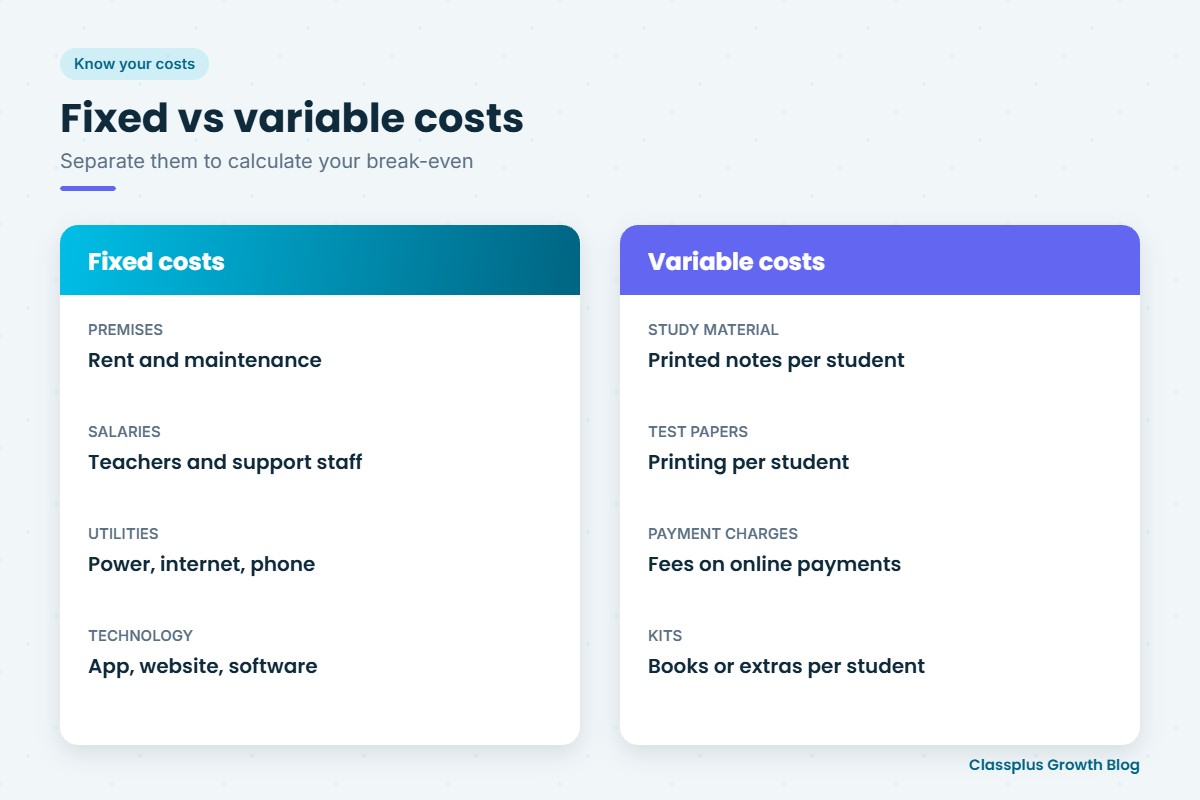
Also separate costs into fixed costs (which stay the same whether you have 10 students or 100, such as rent) and variable costs (which rise with each student, such as printed material). This separation is what makes the break-even calculation possible.
The Break-Even Formula, With a Worked Example
Break-even is the number of students at which your fee income exactly covers your costs. Below that number you lose money. Above it you make a profit.
The formula is:
Break-even students = Monthly fixed costs ÷ (Monthly fee per student − Monthly variable cost per student)
The part in brackets is called the contribution per student: what each student adds towards covering fixed costs after their own variable costs are paid.
Here is a worked example. These numbers are purely illustrative and are not benchmarks. Replace them with your own figures.
- Example monthly fixed costs (rent, salaries, utilities, software, marketing): ₹1,50,000
- Example monthly fee per student: ₹3,000
- Example monthly variable cost per student (notes, test papers, payment charges): ₹500
- Contribution per student: ₹3,000 − ₹500 = ₹2,500
- Break-even students: ₹1,50,000 ÷ ₹2,500 = 60 students
In this illustrative case, the institute needs 60 paying students every month just to cover costs. If it has 80 students, the profit would be 20 × ₹2,500 = ₹50,000 a month, before taxes.
If your fees are charged per course rather than per month, convert everything to the same period. For example, divide a yearly course fee by the number of months the course runs, or calculate fixed costs for the full course duration instead.
Using Break-Even to Make Decisions
Once you have the formula in a sheet, you can test decisions quickly:
- What happens to break-even if rent goes up?
- How many extra students do you need to afford a new teacher?
- Does a fee change move break-even meaningfully?
- Does adding an online batch, which may have lower variable costs, help?
Pricing and Batch Size
Fees and batch size are linked. A larger batch spreads fixed costs over more students, but beyond a point teaching quality, doubt solving and attention suffer. A smaller batch allows more personal attention, which can justify a higher fee.
When setting fees, consider:
- Your costs: your fee must comfortably cover your contribution target.
- Your students’ ability to pay: understand the families in your area.
- What makes you different: experienced faculty, smaller batches, strong test series, better study material or online access.
- Payment flexibility: instalments can make a course more affordable, but plan your cash flow for them.
- Discounts and scholarships: decide your limits in advance so discounts do not quietly erode your margins.
When deciding batch size, set a minimum (based on break-even for that batch) and a maximum (based on the teaching experience you want to deliver). Track attendance and test performance by batch to see whether larger batches are affecting results. Our guide on batch management for coaching institutes covers this in more detail.
If you sell online courses alongside classroom teaching, read how to price an online course for a separate pricing approach.
Planning Growth
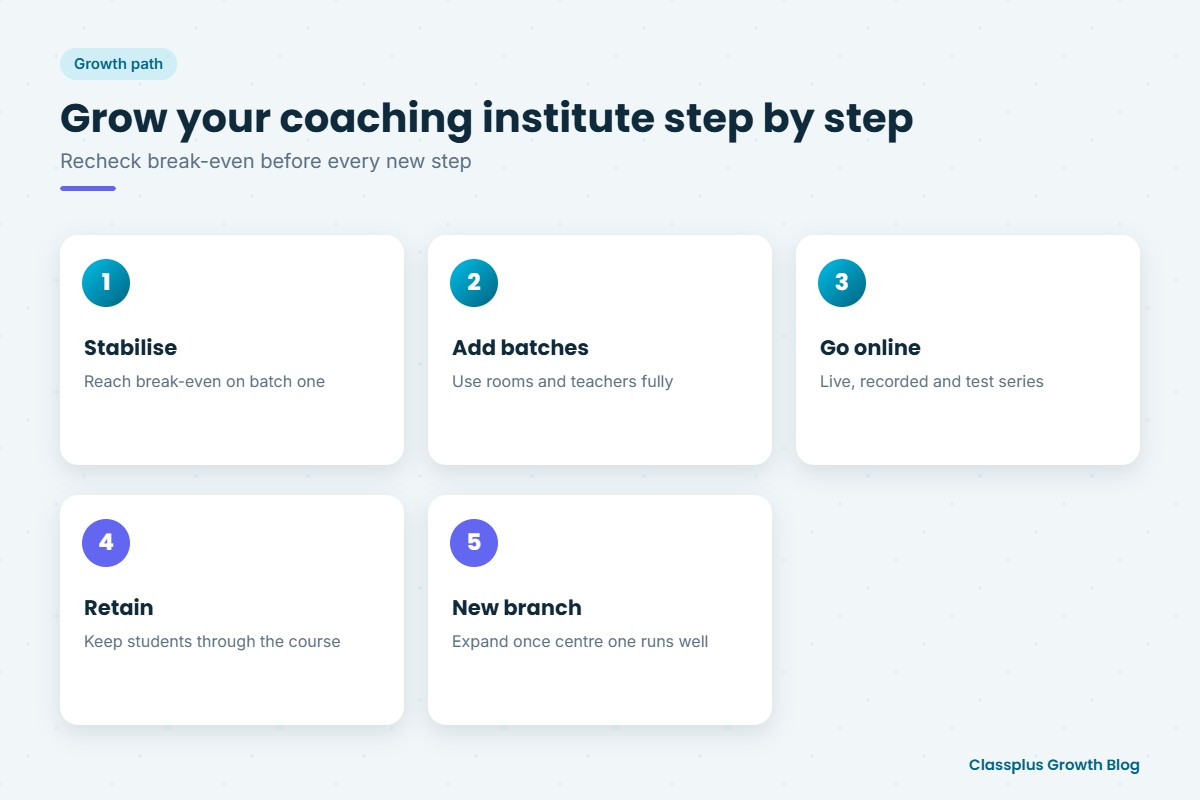
Your growth plan should be realistic and sequential. A typical path might look like this:
- Stabilise the first batch: reach break-even, build reviews and refine your teaching material.
- Add batches or subjects: use existing premises and teachers more fully, for example with morning or weekend batches.
- Add online offerings: recorded courses, live classes or test series can reach students beyond your area without needing extra classrooms.
- Strengthen retention: keeping current students through the full course is often cheaper than finding new ones.
- Consider a second branch: only once your first centre runs smoothly without you being present every hour.
For each step, run the break-even numbers again. A new branch, for example, brings a fresh set of fixed costs and needs its own break-even. Our guide on opening a second branch of your coaching institute explains what to check before expanding.
Registration and GST Pointers
Your business plan should state what legal structure you will use and what registrations you need. Common options include sole proprietorship, partnership, LLP or private limited company, and each has different implications for liability, taxes and paperwork. Local rules for coaching centres may also apply in your state. Read our guide on coaching institute registration for an overview.
GST may also apply to your coaching or online course income depending on your turnover and the nature of your services. Our explainer on GST on online courses covers the basics. Tax rules change and depend on your specific situation, so consult a qualified Chartered Accountant (CA) before finalising your structure, fees and invoicing.
How Classplus Fits Into Your Business Plan
Technology is a cost line in your plan, but it can also support revenue and efficiency. With Classplus, you get your own branded app and website, so you can run live classes, sell recorded courses and offer online tests and test series with test performance tracking. You can collect fees online and create coupons for scholarships or early admissions, manage batches and attendance in one place and send notifications to students. Content security helps protect your paid material, and marketing assistance supports your outreach.
Classplus pricing is shared during a demo based on your needs. To see how it fits your plan and numbers, book a free demo with Classplus.
Conclusion
A coaching institute business plan does not have to be complicated. List your costs honestly, separate fixed from variable, calculate your break-even, set fees and batch sizes that make sense for both your students and your margins, and plan growth one step at a time. Revisit the plan every season with real numbers, and get professional advice on registration and tax. With this foundation, every decision, from hiring a teacher to opening a new branch, becomes clearer.
Frequently Asked Questions
What should a coaching institute business plan include?
It should include a summary, target students, courses and batches, competition and positioning, team, marketing plan, costs, fees and revenue, break-even, growth plan and legal compliance. Keep each section short and update it every season.
How do I calculate break-even for my coaching institute?
Divide your monthly fixed costs by the contribution per student, which is the monthly fee minus the monthly variable cost per student. The result is the number of paying students you need each month to cover your costs.
What is the ideal batch size for a coaching institute?
There is no single ideal number. Set a minimum based on the break-even for that batch and a maximum based on the attention and doubt solving you want to offer. Track attendance and test results to see whether batch size is affecting quality.
How should I set fees for my coaching institute?
Start from your costs and required contribution, then consider what families in your area can pay and what makes your institute different. Plan discounts, scholarships and instalments in advance so they do not reduce your margins unexpectedly.
Do I need to register my coaching institute?
Most institutes need some form of business registration, and local rules may apply depending on your state. The right structure depends on your situation, so it is best to consult a Chartered Accountant or legal professional.
Is GST applicable on coaching fees?
GST may apply depending on your turnover, the type of services and other factors. Rules can change and depend on individual circumstances, so consult a qualified Chartered Accountant before finalising your fees and invoicing.