Every year, in the last few weeks before a big exam, students start searching for one thing: a focused, no-nonsense revision programme that helps them pull everything together. A well-planned crash course for competitive exams is exactly that. For a teacher or coaching institute, it is also one of the most natural products to sell, because the need is urgent, the goal is clear and the duration is short.
But a crash course is not your regular syllabus squeezed into fewer days. It needs its own structure, content mix and promotion. This guide covers who it is for, when to launch, how to structure it, how to price and promote it honestly, and how to deliver it live and recorded.
Who a Crash Course for Competitive Exams Is For
A crash course usually serves three kinds of students:
- Students who have studied the syllabus but need revision. They know the concepts but have forgotten parts, and need a structured way to revise everything once.
- Students who need exam-style practice. They understand topics but struggle with speed, accuracy or question selection under time pressure.
- Late starters. Some students begin seriously only a few months before the exam. A crash course gives them a way to cover the high-priority topics first.
It is generally not right for a student who has not touched the syllabus and expects to learn everything from scratch in a few weeks. Say this clearly on your course page; it builds trust and reduces refund requests.
A good crash course promises structure and practice, not miracles.
Timing Your Crash Course Around the Exam Calendar
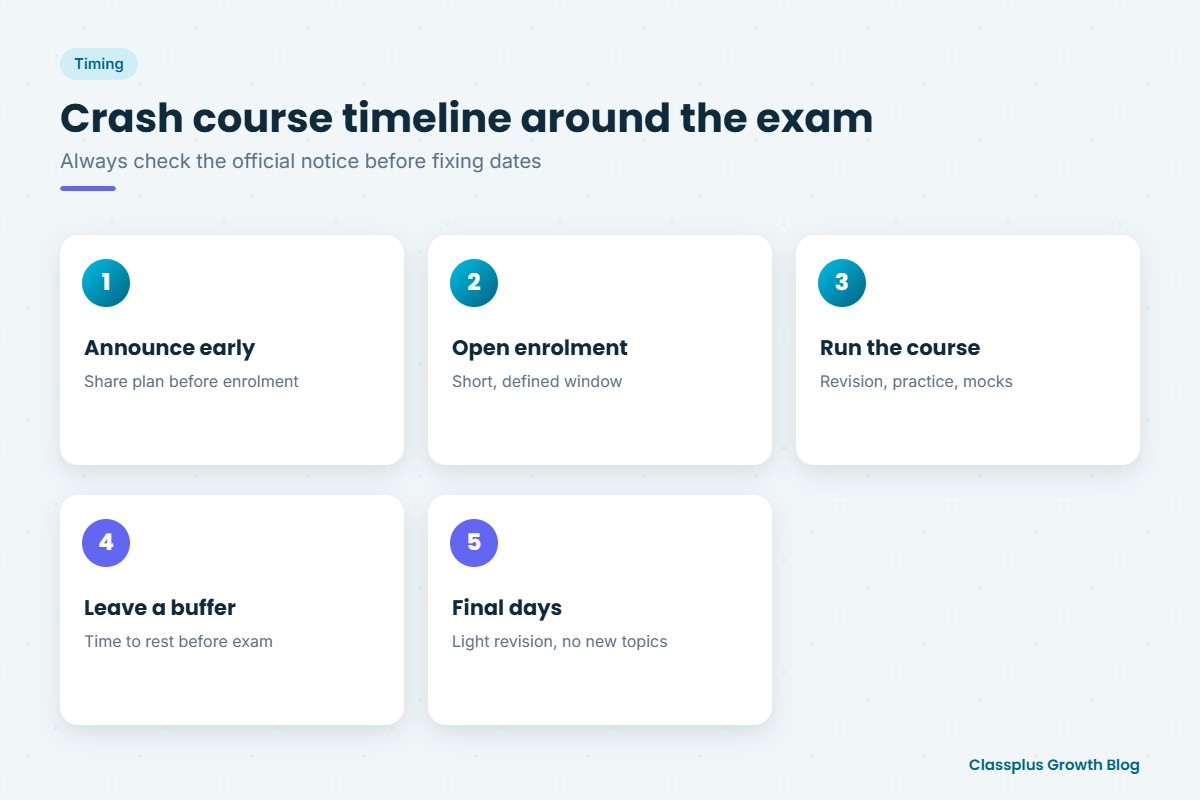
Launch too early and students feel they still have time. Launch too late and they have already joined someone else. Exam dates change and sometimes get revised, so always check the official notice or the exam conducting body’s website before fixing batch dates, and update your course page if the schedule changes.
Think about timing relative to the official exam date:
- Announcement window: Start talking about the course a few weeks before enrolment opens.
- Enrolment window: Keep enrolment open for a short, defined period so that the batch starts together.
- Course window: End with enough buffer before the exam for rest and light revision.
- Final days: Keep the last few days before the exam for short revision sessions, formula sheets and calm doubt-clearing, not new topics.
If you teach for more than one exam, plan a separate crash course for each rather than mixing audiences in one batch.
A Sample Structure for a Crash Course
Your structure will depend on the exam, the syllabus and how many weeks you have. The table below is only an example of a six-week format. Adjust the number of weeks and the topics to suit your exam.
| Week | Focus | What students do |
|---|---|---|
| Week 1 | High-weightage topics, part 1 | Daily revision lectures, short topic quizzes, one doubt session |
| Week 2 | High-weightage topics, part 2 | Revision lectures, PYQ-style practice sets, one sectional test |
| Week 3 | Remaining important topics | Revision lectures, mixed practice, first full-length mock |
| Week 4 | Weak-area repair | Analysis of mock results, targeted practice, doubt sessions |
| Week 5 | Full mock phase | Two or three full mocks with detailed discussion |
| Week 6 | Final revision | Formula and fact sheets, light practice, exam strategy session |
Within each week, a simple daily rhythm works well for most crash courses:
- A focused revision lecture on one or two topics.
- A short practice set on the same topics, to be done the same day.
- A quick solution discussion or recorded walkthrough.
- A fixed slot for doubts, either daily or on alternate days.
Keep the routine predictable. Stressed students stay on track when they know exactly what happens each day.
The Right Content Mix
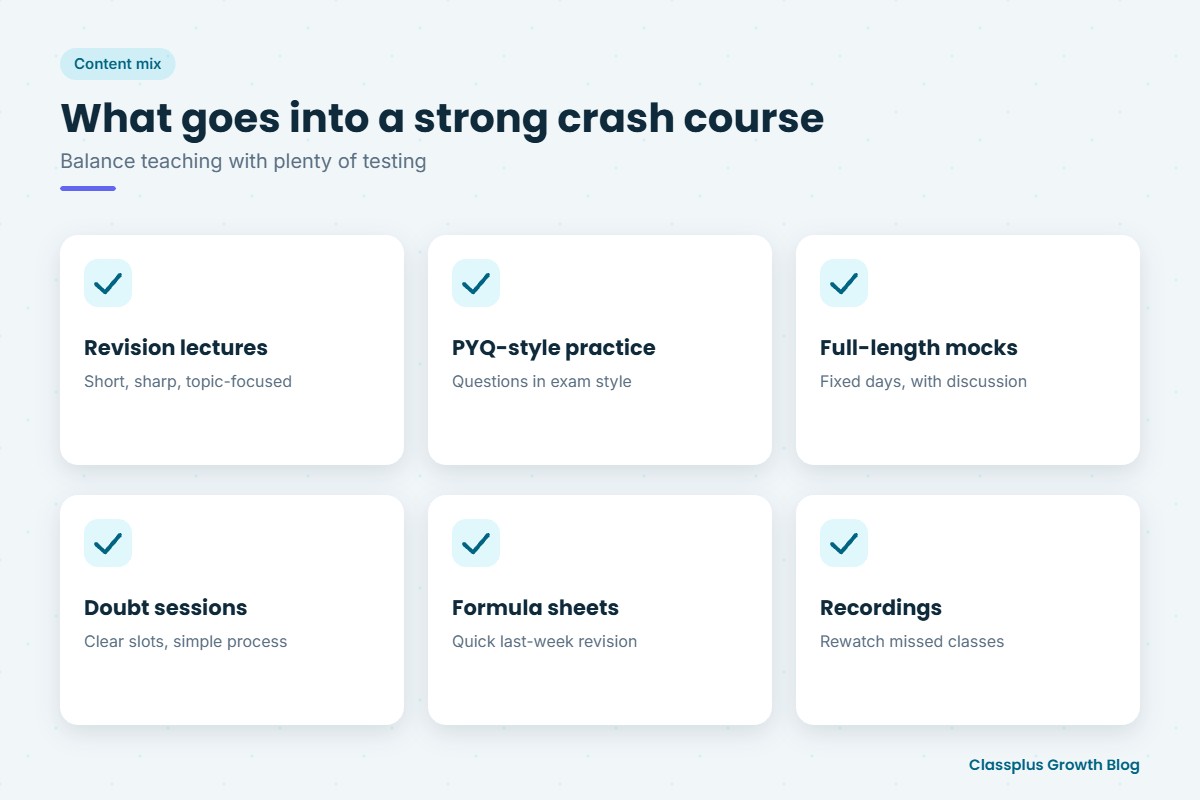
A crash course works when it balances teaching and testing. Here is how to think about each part.
Revision lectures
Keep revision lectures shorter and sharper than regular classes. Focus on key concepts, common traps, shortcuts that genuinely work and frequently asked question types.
PYQ-style practice
Previous year questions show students what the exam actually asks. Use them, and also create fresh questions in the same style and difficulty. If you use actual past papers, make sure you are using them from a legitimate source and label them correctly.
Mock tests
Full-length mocks are the backbone of a crash course. They build stamina, reveal weak areas and improve time management. Schedule them on fixed days and follow each with a detailed discussion. Our guide on how to sell test series online explains how to package tests well.
Doubt sessions
Unresolved doubts cause anxiety close to the exam. Set clear doubt slots and tell students how to submit questions. For ideas, see how to build a doubt solving system for your coaching institute.
How to Price a Crash Course
A crash course is shorter than a full-year programme but more intensive and time-sensitive. A few principles help:
- Price on value, not just hours. Students are paying for structure, curated practice and mocks, not only for the number of lectures.
- Offer clear tiers if needed. For example, one option with recorded revision plus mocks, and a higher option that adds live classes and doubt sessions.
- Consider your existing students. Many institutes offer a reduced fee or a coupon to students already enrolled in their regular batches.
- Be careful with deep discounts. Constant discounting trains students to wait for a lower price, which is risky when the course has a fixed start date.
For a step-by-step approach to setting a fee, read our guide on how to price an online course.
Launch and Promotion Plan
Because the enrolment window is short, plan promotion in advance:
- Prepare the course page. Write who the course is for, what it covers, the schedule, the number of mocks, the fee, the refund policy and how classes will be delivered.
- Announce to your existing audience first. Your current students, past students and followers already trust you. Tell them before anyone else.
- Run a free sample session. A free revision class or a free mini-mock lets students experience your teaching before paying.
- Use WhatsApp and social media. Share the schedule, a sample question each day and short tips. Our guide on WhatsApp marketing for coaching institutes covers how to do this without spamming people.
- Send reminders before enrolment closes. Give a real closing date and stick to it.
Market Honestly: No Guaranteed Results
Phrases like “guaranteed selection” can mislead students and parents who are already under pressure. Keep your messaging honest:
- Describe what the course includes, not what rank a student will get.
- If you mention past student achievements, make sure they are accurate, verifiable and shown with consent.
- Do not claim another institute’s toppers or present a student as yours if they only attended a short session.
- Avoid hidden conditions in fees and refunds.
Guidelines around coaching advertisements have been tightened in recent years. Read our explainer on coaching advertisement guidelines for toppers and results before you create your ads and posters.
Delivering the Course Live and Recorded
Live classes suit revision lectures, mock discussions and doubt sessions, and create a daily routine. Recorded classes give flexibility to students who miss a session or want to revise a topic the night before the exam. A practical setup:
- Run revision lectures live, then make the recording available the same day.
- Schedule mocks on fixed days, with results and analysis shared afterward.
- Hold doubt sessions live, and record the common ones for everyone.
- Share notes, formula sheets and practice sets in one organised place.
If you are new to combining both formats, our guide on choosing a teaching app for live and recorded classes explains what to look for.
Running Your Crash Course on Your Own App
A crash course needs live classes, recorded lectures, online tests, fee collection and reminders working together, which gets hard across separate tools when many students join in a short window.
Classplus helps educators run all of this from their own branded app and website. You can hold live classes, sell recorded courses, run online tests and test series with performance tracking, collect fees with coupons, manage batches and attendance, send notifications to students and keep your content secure. Classplus also offers marketing assistance to help you reach more students. Pricing is shared during a demo, so the simplest next step is to book a free demo with Classplus and see how it fits your crash course plan.
Conclusion
A successful crash course for competitive exams is built on a few simple ideas: know exactly who it is for, time it carefully around the official exam schedule, follow a clear week-by-week structure, balance revision with plenty of practice and mocks, price it fairly, and market it honestly. Deliver it through a mix of live and recorded classes so that every student can keep up, even on difficult days.
Start early, keep the promise realistic and give students a calm, organised path to exam day.
Frequently Asked Questions
How long should a crash course for competitive exams be?
There is no single right length. It depends on the exam, the syllabus and how much time remains before the exam. Many teachers run courses of a few weeks, but the key is to finish with enough buffer for students to rest and do a final light revision before the exam.
When should I start promoting my crash course?
Start talking about it a few weeks before enrolment opens, so students know it is coming. Always check the official exam notice first, because dates can change, and update your plan if the schedule is revised.
Should a crash course include full-length mock tests?
Yes. Mocks help students build stamina, manage time and find weak areas. Schedule them on fixed days and always follow each mock with a detailed discussion so students learn from their mistakes.
Can I offer a crash course only in recorded format?
You can, but most students benefit from at least some live interaction, especially for doubt clearing and mock discussions. A mix of live classes with recordings available afterward usually works best.
Is it okay to advertise guaranteed results for a crash course?
No. Promising guaranteed selection or ranks can mislead students and may go against advertising guidelines for coaching. Describe what the course includes and keep any claims about past students accurate and verifiable.
How should I price a crash course compared to my regular course?
Price it based on the value it offers, such as structure, curated practice and mocks, rather than just the number of hours. You can offer tiers with different levels of support and consider a special fee for students already enrolled with you.