In a coaching institute, teachers are the product. Students choose you because of how a particular teacher explains, and they often leave when that teacher leaves. That is why the decision to hire teachers for coaching institute batches deserves as much care as choosing your location or setting your fees. A good hire can lift an entire batch. A rushed hire can cost you students, reviews and months of effort.
This guide covers where to find good teachers, how to run a demo-lecture based hiring process, a simple evaluation rubric, the pros and cons of different pay structures, onboarding, retention and how recorded content and your own app can reduce dependence on any single person.
Start With a Clear Role Description
Before you post a vacancy, write down exactly what you need. This saves time for you and for candidates.
- Subject and level: for example, Class 11 and 12 Physics for JEE, or Class 9 and 10 Maths for CBSE.
- Mode: offline, online or both.
- Batch load: how many batches and roughly how many hours a week.
- Other duties: doubt sessions, test paper setting, notes preparation, parent meetings, recording lectures.
- Language: medium of instruction and comfort with mixed-language explanation.
- Pay structure: fixed, per lecture or revenue share (more on this below).
Where to Find Good Teachers
The best teachers are often not actively looking for jobs, so cast a wide net.
- Referrals from your current teachers: good teachers usually know other good teachers.
- Former students: students who did well and enjoy explaining may become strong junior faculty or doubt-solvers.
- Local colleges and universities: postgraduate students and research scholars often teach part-time.
- Teachers’ WhatsApp and Telegram groups: many subject communities share openings.
- Job portals and LinkedIn: useful for reaching a wider pool, especially for online roles.
- YouTube and Instagram educators: teachers who already create content may be open to part-time or online roles. They usually bring camera comfort too.
How to Hire Teachers for Coaching Institute Batches: The Demo-Lecture Process
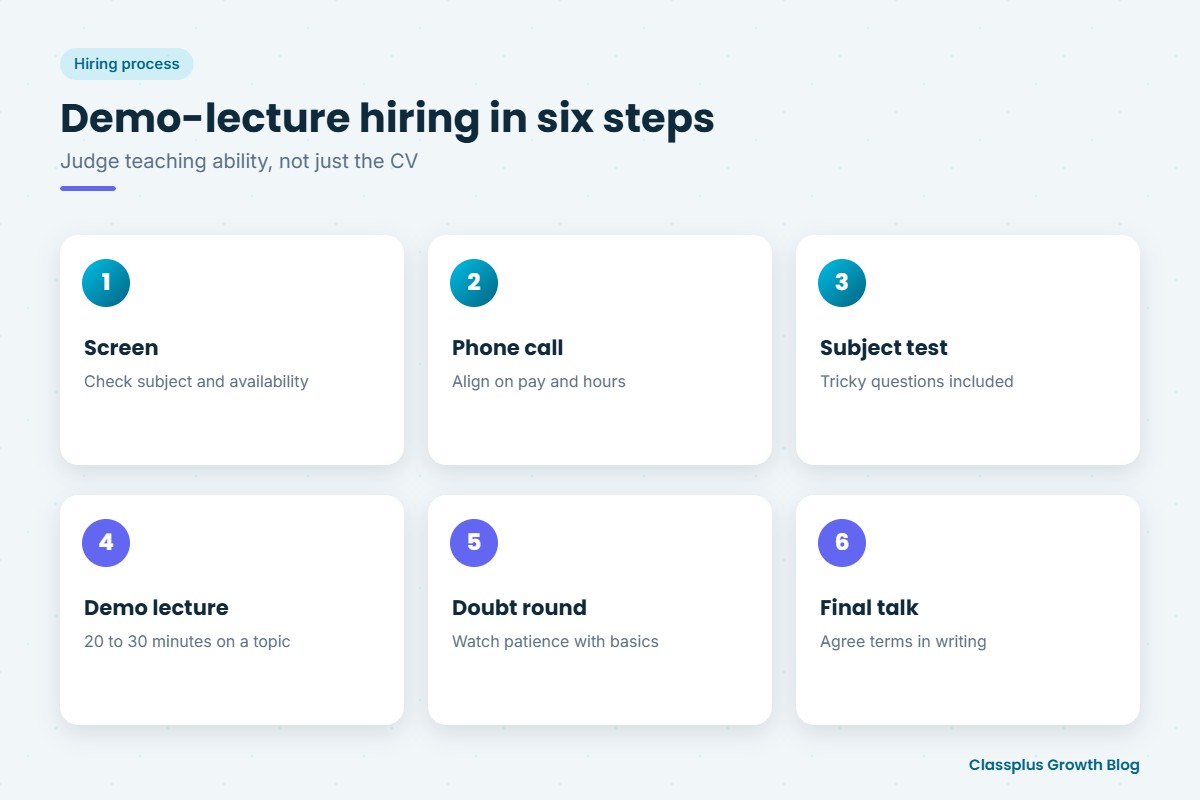
A degree or a long CV tells you little about how someone teaches. The demo lecture is the heart of the process. Here is a simple sequence.
- Screen applications: check subject knowledge, teaching experience and availability.
- Short phone call: understand their expectations on pay, hours and mode, and explain yours.
- Subject test: a short written or oral test on the topics they will teach, including a few tricky questions.
- Demo lecture: ask them to teach a specific topic for 20 to 30 minutes, ideally to a small group of real students or your existing teachers acting as students.
- Doubt-handling round: after the demo, ask a few questions a confused student might ask, including a basic one, and watch how patiently they respond.
- Feedback from observers: collect feedback from everyone who watched, including students if possible.
- Final conversation: discuss pay, contract terms, joining date and expectations in writing.
If the role involves online teaching, add a short recorded or live online demo to see how they manage the screen, voice and pacing.
Evaluation Rubric for Demo Lectures
Use a consistent rubric so that different interviewers judge candidates the same way. Score each area from 1 to 5 and note specific observations.
| Criterion | What to look for | Score (1–5) |
|---|---|---|
| Subject knowledge | Accurate concepts, correct answers to tricky questions | |
| Clarity of explanation | Breaks complex ideas into simple steps, uses examples | |
| Structure | Clear start, logical flow, summary at the end | |
| Student engagement | Asks questions, checks understanding, keeps attention | |
| Board or screen work | Neat, readable and well organised | |
| Doubt handling | Patient, does not dismiss basic questions | |
| Language and communication | Comfortable in the medium of instruction, clear voice | |
| Exam orientation | Connects concepts to question patterns and exam strategy | |
| Professionalism | Punctual, prepared, respectful |
Decide in advance what total score or must-have criteria qualify a candidate.
Pay Structures: Fixed, Per-Lecture and Revenue Share
There is no universally best pay structure. Each has trade-offs for you and for the teacher. Many institutes use a mix depending on the role.
Fixed Monthly Salary
- Pros: predictable cost for you, stable income for the teacher, encourages loyalty and involvement beyond class hours.
- Cons: you pay the same even in lean months, and there is less direct link between effort and income.
- Works well for: core faculty who take multiple batches and contribute to tests, notes and planning.
Per-Lecture or Per-Hour Payment
- Pros: cost scales with the number of classes, easy to start with part-time or visiting faculty.
- Cons: teachers may treat it as a side job, may be less involved in student outcomes and may leave for a better offer quickly.
- Works well for: visiting faculty, specialist topics, crash courses and trial periods.
Revenue Share
- Pros: aligns the teacher’s income with batch or course success, motivates them to bring and retain students.
- Cons: income becomes unpredictable for the teacher, requires transparent accounting and can create disputes if terms are unclear.
- Works well for: senior teachers with their own following, online courses and new batches where both sides share the risk.
Some institutes combine structures, for example a fixed base with a per-lecture component for extra batches, or a fixed base with a share of online course sales. Whatever you choose, write the terms down clearly, including how and when payment is calculated.
Onboarding New Teachers
A good first month sets the tone. Do not just hand over a timetable and walk away.
- Introduce the institute: your teaching approach, student profile, rules and expectations.
- Share material: syllabus, existing notes, test series, previous question papers and lesson plans.
- Explain tools: how attendance, tests, doubt handling and parent communication work, and how to use your app or software.
- Pair them with a senior teacher: for the first few weeks, a mentor can answer questions and observe a class or two.
- Set early check-ins: a short review after the first week and the first month, with feedback from students.
Retaining Good Teachers
Losing a teacher mid-session can unsettle a batch, so retention matters.
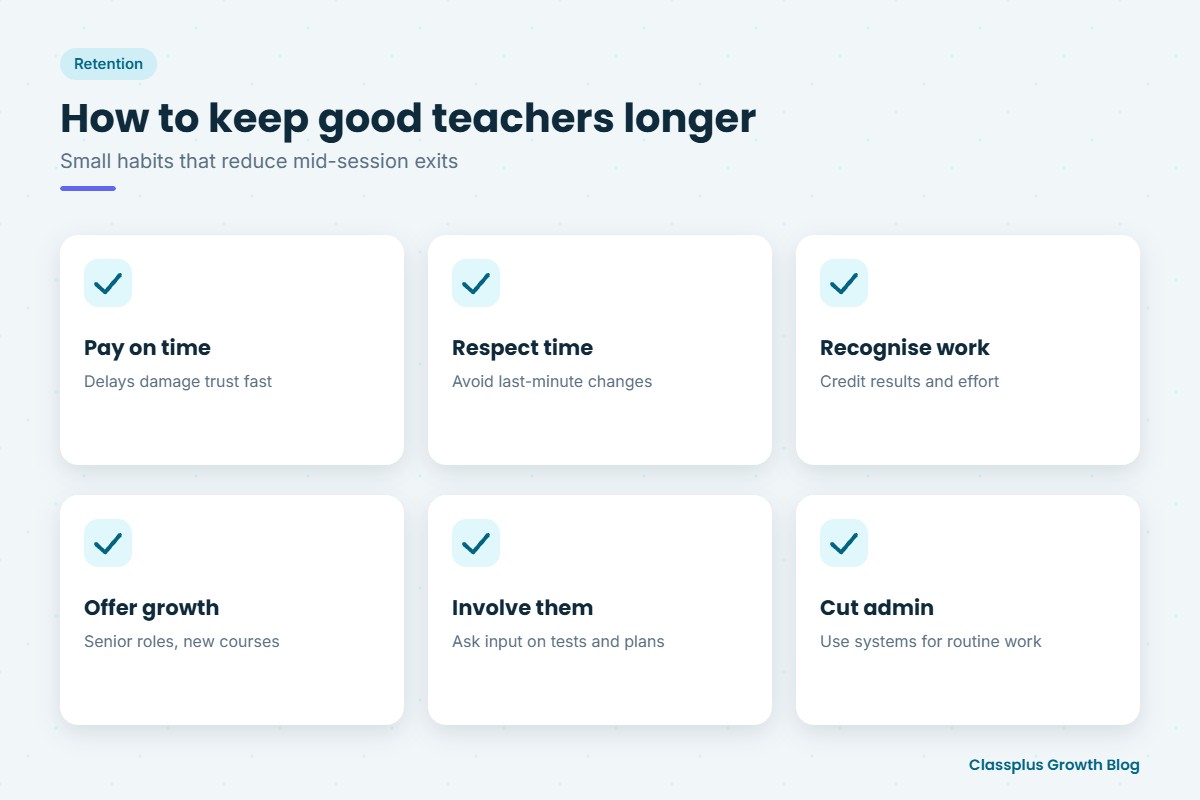
- Pay fairly and on time: delayed payments damage trust quickly.
- Respect their time: avoid last-minute schedule changes and unplanned extra duties.
- Give recognition: acknowledge good results, positive student feedback and extra effort, in private and in front of the team.
- Offer growth: senior roles, subject head positions, the chance to lead new batches or create online courses.
- Involve them in decisions: ask for input on syllabus, tests and batch planning.
- Reduce admin load: let teachers focus on teaching by handling attendance, fee follow-ups and communication through systems. Our guide on batch management for coaching institutes explains how to organise this.
- Have honest conversations: regular one-on-ones help you catch problems early.
Teacher stability also affects how long students stay with you. See our guide on student retention strategies for coaching institutes.
Contracts and Non-Compete Clauses
Put the relationship in writing. A teacher agreement typically covers role, pay structure, working hours, notice period, ownership of notes and recorded content, confidentiality of student data and conduct expectations.
Many institutes want to include non-compete or non-solicitation clauses to prevent teachers from taking students with them. Be aware that the enforceability of such clauses in India is limited and depends on how they are worded and applied. Ownership of recorded lectures and study material is another area that should be clearly defined. Take advice from a qualified lawyer before drafting or signing teacher contracts, rather than copying a template from the internet.
Using Recorded Content and Your Own App to Reduce Dependence
One of the biggest risks for a coaching institute is depending too heavily on one or two star teachers. Some practical ways to reduce that risk:
- Record key lectures: with clear agreement on ownership, build a library of recorded lessons that remains available to students even if a teacher leaves.
- Standardise material: maintain institute-owned notes, question banks and test series rather than relying on individual teachers’ personal material.
- Build the institute brand: make sure students and parents know your institute’s name, not only the teacher’s name.
- Keep student relationships with the institute: communication, fee payments, tests and progress tracking should run through your own platform.
Recorded content also helps students who miss classes. Read about using a teaching app for live and recorded classes, and learn how to protect your online course videos from piracy.
How Classplus Helps You Build an Institute, Not Just a Team
With Classplus, you get your own branded app and website, so students connect with your institute’s identity. Teachers can take live classes, and you can sell recorded courses that stay on your platform. Online tests and test series with test performance tracking, batch management and attendance, fee payments with coupons and notifications all run from one place, which reduces the admin load on teachers. Content security helps protect the lectures and material your team creates, and marketing assistance supports your growth.
To see how it can work for your faculty and students, book a free demo with Classplus.
Conclusion
When you hire teachers for coaching institute batches, treat it as one of your most important business decisions. Write a clear role description, look beyond job portals, judge candidates on a real demo lecture with a consistent rubric, choose a pay structure that fits the role and put everything in writing. Then invest in onboarding and retention, and build institute-owned content and systems so your institute stays strong even when people move on.
Frequently Asked Questions
How do I find good teachers for my coaching institute?
Ask your current teachers for referrals, reach out to local colleges, check teachers’ communities on WhatsApp and Telegram, use job portals and LinkedIn, and consider former students and educators who already create content online.
Why is a demo lecture important when hiring teachers?
A CV shows qualifications but not teaching ability. A demo lecture lets you see how a candidate explains concepts, engages students, uses the board and handles doubts, which are the skills that matter most in a classroom.
Which pay structure is best for coaching teachers?
It depends on the role. Fixed salaries suit core faculty, per-lecture payments suit visiting or part-time teachers, and revenue share suits senior teachers or online courses. Many institutes combine structures and write the terms down clearly.
How can I stop good teachers from leaving?
Pay fairly and on time, respect their schedules, recognise good work, offer growth opportunities, involve them in decisions and reduce their admin work. Regular one-on-one conversations help you spot problems early.
Are non-compete clauses enforceable for teachers in India?
Enforceability of non-compete clauses in India is limited and depends on wording and circumstances. It is best to consult a qualified lawyer before drafting or relying on such clauses in teacher contracts.
How can recorded lectures help a coaching institute?
Recorded lectures keep learning available when students miss classes or a teacher leaves, allow you to sell courses beyond your city and reduce dependence on individual teachers, provided ownership is clearly agreed in writing.