An AI doubt-solving bot answers student questions from your own notes and lecture material at any hour, and passes anything it is unsure about to a teacher. It works well for repeatable, syllabus-bound doubts. It fails in predictable places, and most of the work in setting one up is deciding where it should stop.
What an AI doubt-solving bot does, and what it does not
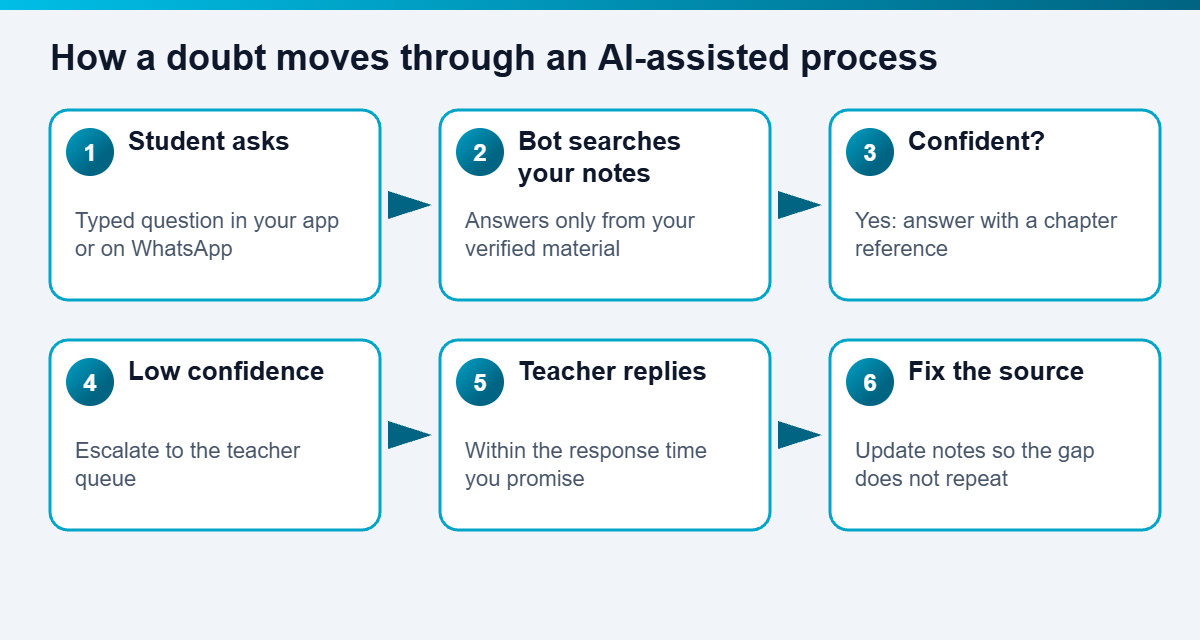
The bot reads a student’s question (typed, or in some setups a photo), finds the relevant part of your material, and writes an answer in the way your faculty explains it. It does not replace the teacher who spots a conceptual gap or knows a student is struggling. Think of it as the first responder for doubts that have a clear, repeatable answer, such as a formula application, a definition, or a solved-example variation.
If you have not yet built a doubt process at all, start with our guide to building a doubt-solving system in your coaching institute, then add AI on top of it.
How to set one up, step by step
- Audit your current doubts. Export a month of doubts from WhatsApp groups, doubt classes or your app. Tag each by subject, chapter and type (concept, calculation, past-paper question). The tags show which doubts are repetitive enough for a bot.
- Collect source material. Use your own notes, solved examples, formula sheets and lecture transcripts. The bot should answer from these, not from the open internet, so that its method matches what students are taught.
- Start with one subject and one batch. A narrow scope is easier to check. Chemistry theory or one maths chapter set is a better start than the whole syllabus.
- Choose where students ask. Pick one channel: your branded app, a WhatsApp number, or a web form. Spread across channels, doubts become impossible to track.
- Write the answer rules. Ask for step-by-step answers in your faculty’s method, in the language students use, with the chapter reference. Tell it to say “I am not sure” and escalate rather than guess, and to refuse out-of-syllabus questions.
- Build the escalation path. Low-confidence answers and any student who re-asks the same doubt go to a teacher queue with a response-time promise, for example the same evening.
- Pilot for two to three weeks. Have a faculty member review a sample of answers every week and correct the source material, not just the answer.
Where AI doubt solving goes wrong
- Calculation errors. Multi-step maths and physics numericals can contain slips that look convincing. Always audit these.
- Method mismatch. A correct answer by a method your faculty does not teach can confuse students preparing for a specific exam pattern.
- Diagrams and handwriting. Photos of messy working or diagrams are read less reliably than typed text.
- Mixed languages. Hinglish and regional-language questions need testing before launch, not after.
- Invented references. A bot can cite a chapter or page that does not exist. Restrict it to quoting your uploaded material.
- Dependence. If students ask before attempting, learning drops. Consider a rule that the bot gives a hint first and the full solution on a second request.
Guardrails to set from day one
- Label answers as AI-generated and show how to reach a teacher.
- Switch the bot off for live tests and assignments.
- Do not feed student phone numbers, fees or other personal data into the tool.
- Keep a log of questions and answers so a faculty member can review them.
What to measure
| Metric | Why it matters |
|---|---|
| Share of doubts resolved without a teacher | Shows how much teacher time you are saving |
| Escalation rate | High means the source material or scope has gaps |
| Wrong-answer rate in weekly audits | Your quality gate before widening the scope |
| Time to first response | Students judge the service on speed |
| Repeat doubts by chapter | Tells you which topics need a revision class |
Keep doubts connected to the rest of the learning journey
A doubt is most useful when it is linked to the lecture, test or assignment it came from. If your students already learn through a branded app with live classes, recordings and tests, raise and track doubts in that same place rather than in scattered chat groups. Classplus helps educators and coaching institutes run live classes, recorded courses, tests and student management under their own branded app, so your doubt process can sit alongside the rest of your teaching.
Frequently asked questions
Can an AI bot replace doubt-solving teachers?
No. It can take the repetitive first layer of doubts. Teachers are still needed for conceptual gaps, exam strategy and anything the bot escalates.
Is AI accurate enough for maths and physics doubts?
It can be, when it answers from your verified solutions, but numerical slips happen. Audit a sample every week and keep a human review step for calculation-heavy subjects.
Which subjects should we start with?
Start with subjects where answers are clear and repeatable, such as definitions, theory chapters and standard formula applications, before moving to long numericals.
How do we stop students from relying on it too much?
Give hints before full solutions, disable it during tests, and track students who ask many doubts without attempting practice questions.