Most students don’t leave a coaching institute because of one bad class. They leave because doubts pile up quietly. A concept from week two that never clicked makes week five confusing, and by week eight they’ve stopped asking. Some even stop attending.
The fix isn’t asking teachers to stay later. It’s a doubt-solving system: clear ways for students to ask, a promised response time, someone responsible for answering, and a simple record that shows which topics need re-teaching.
This guide shows you how to build one for offline, online and hybrid batches.
Why Doubt Solving Deserves a System
- Doubts compound. In subjects like physics and maths, one gap blocks the next three chapters.
- Quiet students suffer most. The students who need help most are often the least likely to raise their hand.
- Teachers get overwhelmed. Without structure, doubts arrive on WhatsApp at midnight, in corridors and after every class.
- Patterns stay hidden. If 30 students ask the same question, that’s a teaching signal you’ll miss without records.
A good system protects teaching quality and student retention at the same time.
Choose Your Doubt Channels
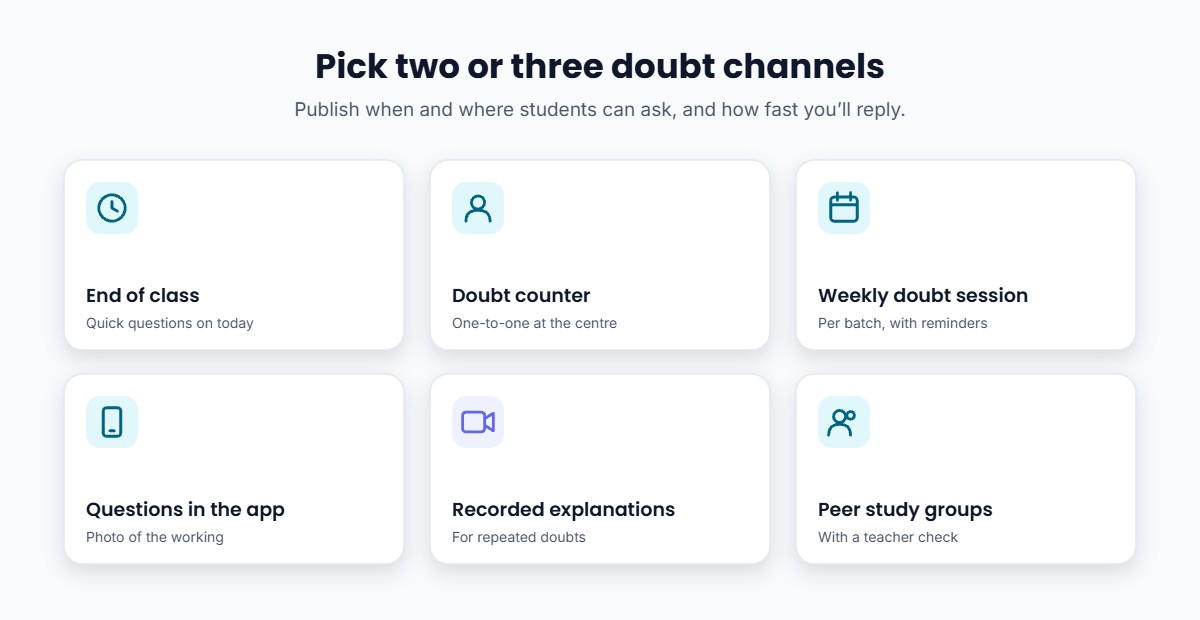
You don’t need every channel. Pick two or three that fit your institute.
| Channel | Best for | Watch out for |
|---|---|---|
| Last 5–10 minutes of class | Quick questions on today’s topic | Gets skipped when classes run late |
| Doubt counter or office hours | One-to-one help at the centre | Queues at peak times; publish timings |
| Weekly doubt session per batch | Common doubts, revision | Low turnout without reminders |
| Questions sent in the app or by message | Students who are shy or remote | Needs a response-time promise |
| Short recorded explanations | Doubts many students share | Keep them short and topic-tagged |
| Peer study groups | Practice and simple doubts | Needs a teacher check on answers |
How to Build the System: Step by Step
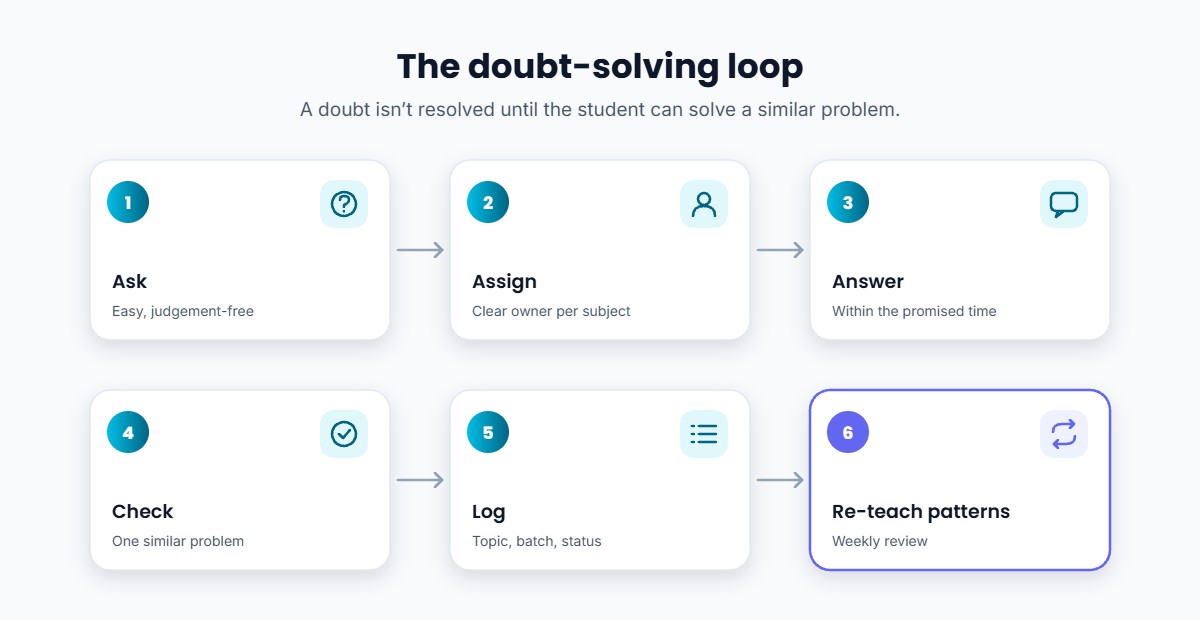
Step 1: Set Channels and Timings
Publish when and where students can ask: for example, “Doubt counter: Mon–Sat, 4–6 pm. Weekly doubt session: Saturday, 11 am, per batch. Message doubts: answered within one working day.”
Step 2: Promise a Response Time
A clear promise (such as “within one working day”) stops students from worrying and stops teachers from feeling they must reply instantly at night.
Step 3: Make Asking Easy
- Let students share a photo of the question and their working.
- Offer an anonymous way to raise doubts in class, such as slips in a box.
- Encourage “there are no silly questions” from the very first class.
Step 4: Assign Ownership
Decide who answers what: subject teachers for concept doubts, a doubt faculty or teaching assistant for routine problems, and a clear escalation for anything complex.
Step 5: Keep a Simple Doubt Log
Record the student, batch, subject, topic, date, status (open or resolved) and who answered. It takes seconds and turns scattered questions into useful data.
Step 6: Find Patterns and Re-Teach
Review the log weekly. If many students in a batch ask about the same topic, re-teach it in class, record a short explanation, and add practice questions to the next test. Our guide on using an AI question paper generator can help you create practice sets faster.
Step 7: Close the Loop
A doubt isn’t resolved until the student can solve a similar problem. Follow up with one practice question, or check it in the next test.
Helping Quiet Students Ask
- Call on students by name for small, low-pressure questions.
- Run short quizzes and follow up privately with students who struggled.
- Pair quiet students with a study partner.
- Share common doubts and answers with the whole batch, so nobody feels singled out.
- Watch test results: a sudden drop often means unasked doubts.
Doubt Solving in Online and Hybrid Batches
Online students can’t walk up to a counter, so make the digital route clear: a fixed slot for live doubt sessions, a way to submit questions with a photo, and recorded explanations for repeated doubts. For more practical tips, see our guide to attending students’ doubts in online classes.
What to Track
| Measure | Why it matters |
|---|---|
| Doubts raised per batch | Very few may mean students aren’t comfortable asking |
| Average response time | Shows whether you’re keeping your promise |
| Repeat topics | Tells you what to re-teach |
| Students with many open doubts | Early warning for students at risk of falling behind |
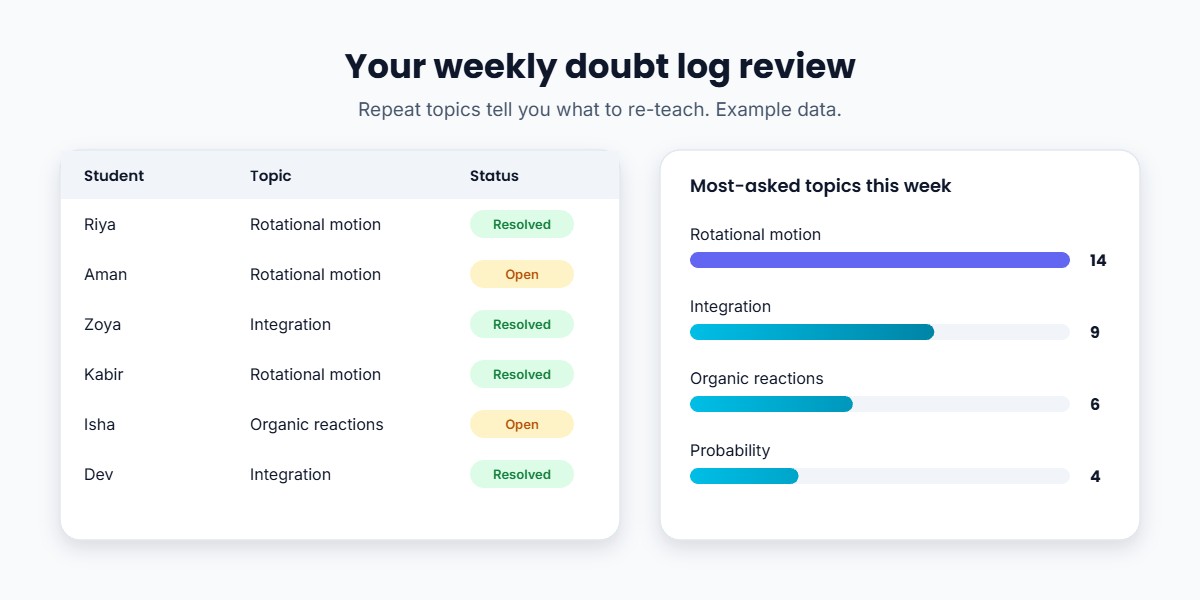
Review these alongside attendance and test results in your weekly batch review, and mention progress in your parent updates.
Common Mistakes to Avoid
- No published timings, so doubts arrive at all hours
- One teacher answering every subject’s doubts
- Answering the same doubt 40 times instead of re-teaching it once
- No record, so patterns and struggling students go unnoticed
- Making students feel judged for asking
- Treating a doubt as solved without checking understanding
How Classplus Can Help
With Classplus, your institute gets its own branded app, which makes a doubt-solving system easier to run:
- Hold weekly doubt sessions as live classes, and share the recordings with the batch
- Upload short explanation videos and notes for common doubts, batch by batch
- Use tests to check that doubts are really resolved
- Send notifications about doubt-session timings and new explanations
- Manage students and batches in one place
Give every doubt a clear path to an answer. Live sessions, recorded explanations, tests and notifications in your own branded app. Explore Classplus →
Conclusion
A doubt-solving system doesn’t need to be complicated: publish your channels and timings, promise a response time, assign ownership, keep a simple log, re-teach the patterns and check understanding. Students learn better, teachers get their evenings back, and fewer students quietly drift away.
Frequently Asked Questions
How should a coaching institute handle student doubts?
Offer two or three clear channels, such as end-of-class time, a doubt counter and a weekly doubt session. Publish timings, promise a response time, assign who answers what, and log doubts to spot patterns.
How often should doubt-clearing sessions be held?
Many institutes run one dedicated doubt session per batch each week, plus a few minutes at the end of classes. Adjust based on how many doubts your log shows.
How can I encourage shy students to ask doubts?
Offer anonymous or written ways to ask, use short quizzes to spot gaps, follow up privately, and share common doubts with the whole batch so nobody feels singled out.
How do I manage doubts in online classes?
Set a fixed live doubt slot, let students submit questions with a photo of their working, promise a response time, and record explanations for repeated doubts.
What is a doubt log?
A simple record of each doubt: student, batch, subject, topic, date, status and who answered. Reviewing it weekly shows which topics need re-teaching and which students need extra help.
How do I know if a doubt is really resolved?
Ask the student to solve a similar problem, or include a related question in the next test. If they can solve it independently, the doubt is resolved.