Every coaching institute has a plan in the owner’s head. Then a teacher goes on leave, school exams eat two weeks, a festival lands mid test series, and the syllabus falls behind as the exam approaches. A written coaching institute academic calendar prevents most of this by putting the whole year on one page, with dates, phases and buffers that everyone can see.
This guide builds that calendar step by step, from exam dates and syllabus planning to timetables and a mid-year review, with a sample month-by-month plan you can adapt.
Why You Need a Coaching Institute Academic Calendar
An academic calendar is the master plan that tells students, parents and teachers what happens when. It helps you:
- Finish the syllabus on time with room for revision, instead of rushing the last chapters.
- Plan tests in advance, so students know what is coming and teachers prepare papers early.
- Avoid clashes with school exams, festivals and board practicals.
- Use teachers and rooms well, without double-booking or idle slots.
- Build trust with parents, who can see that the institute has a clear plan for the year.
Step 1: Map the Exam Dates
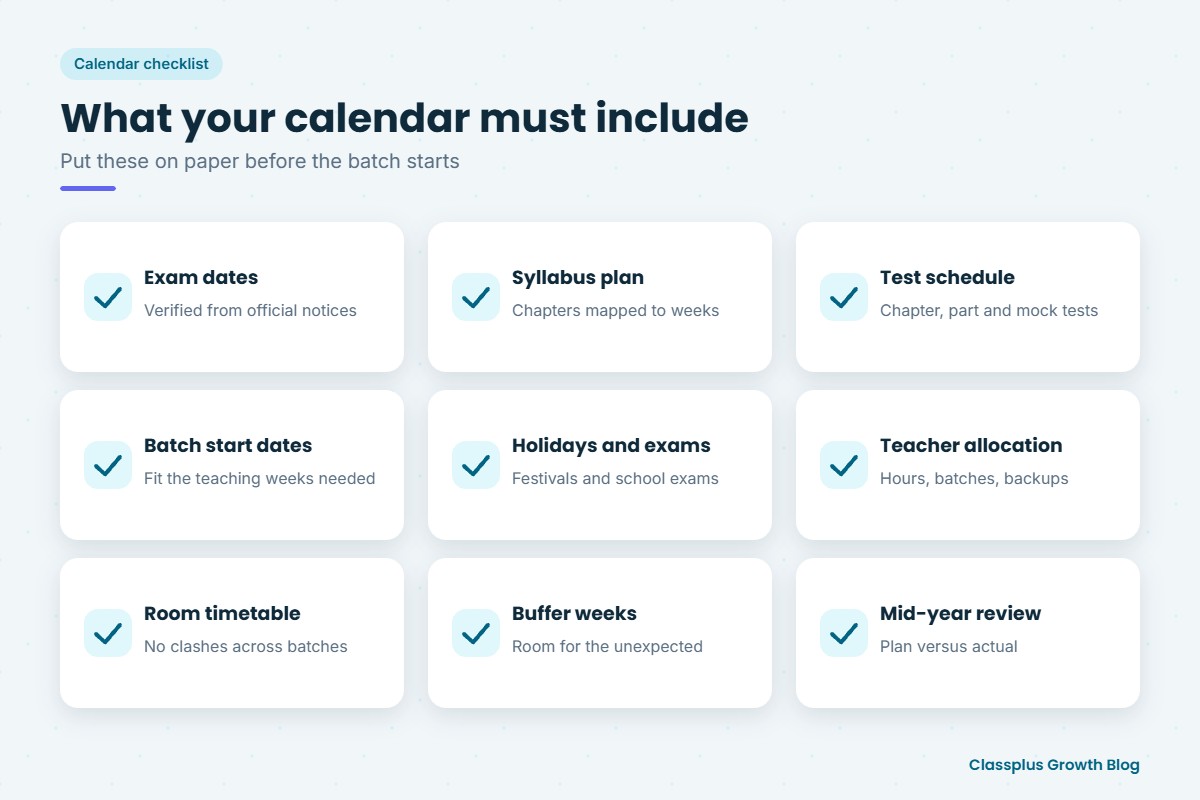
Start from the end. Write down the target exam for each course and its expected date. Always check the official notice from the conducting body for the exam schedule, registration window, admit card release and any change in pattern or syllabus. Do not rely on last year’s dates, forwarded messages or unofficial websites.
If the date is not announced yet, plan with an estimate marked “to be confirmed” and update once the notice is out.
Also note board exams, pre-boards and practicals, which pull students’ attention away from coaching.
Step 2: Build the Syllabus Completion Plan
Once you know the exam date, work backwards.
- List every chapter or unit in the syllabus for each subject.
- Estimate the number of classes each chapter needs, based on its weight and difficulty. Your experienced teachers are the best source for this.
- Decide your syllabus completion date. Leave enough time after it for full revision and the mock test phase.
- Count the teaching weeks available between batch start and the completion date, after removing holidays and buffer weeks.
- Distribute chapters across those weeks. Put foundational chapters early, because later chapters depend on them.
If chapters do not fit, add classes per week, start earlier or shorten revision. Decide now, not in the final months.
Step 3: Plan Revision and Test Series Phases
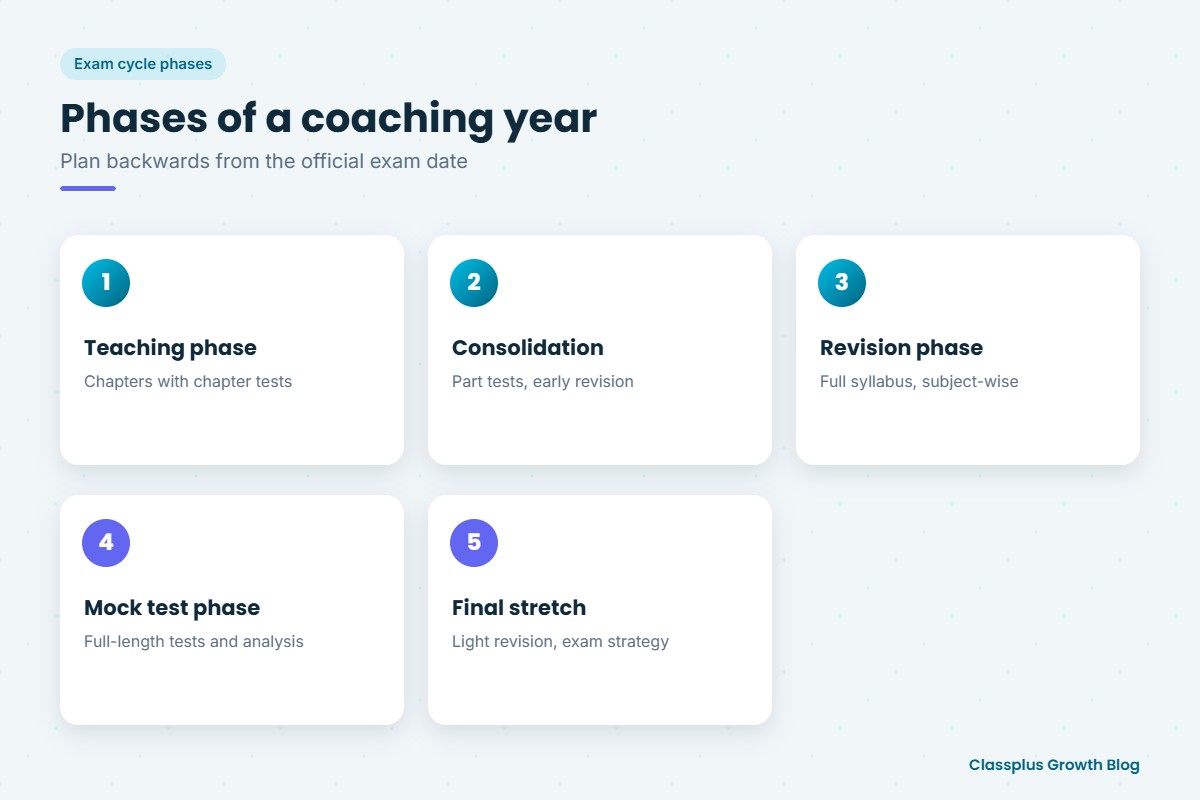
Most exam cycles can be divided into phases. The exact length of each depends on your course, but the order usually stays the same.
- Foundation and teaching phase: chapters are taught, with short chapter-wise tests after each unit.
- Consolidation phase: part tests covering several chapters, plus first revision of early topics.
- Revision phase: structured revision of the full syllabus, subject by subject.
- Full mock test phase: full-length tests in exam conditions, with analysis and doubt sessions after each.
- Final stretch: light revision, formula sheets, exam strategy and rest before the exam.
Put test dates on the calendar now, so students can plan their study around them.
Step 4: Fix Batch Start Dates
Your batch start dates should come out of the syllabus plan, not the other way round. If a course needs a certain number of teaching weeks, the batch must start early enough to fit them.
Consider:
- When students are available, for example after school results or board exams.
- Multiple intakes. A later batch for the same exam needs a faster pace or more classes per week.
If you run a scholarship test to fill batches, schedule it a few weeks before the batch start. Our guide on running a scholarship test for your coaching institute covers timing and format.
Step 5: Mark Holidays, Festivals and School Exams
Get the local school calendars for the schools most of your students attend. Mark:
- Major festivals and public holidays in your region.
- School unit tests, half-yearly exams, pre-boards and practicals.
During school exam weeks, reduce new teaching and switch to doubt sessions or lighter revision.
Step 6: Allocate Teachers
Once the subjects and weekly class counts are clear, assign teachers.
- List each teacher’s subjects, batches and the hours they can give each week.
- Check no teacher is overloaded in peak months, especially during the mock test phase when evaluation and doubt sessions add work.
- Plan a backup for each subject in case a teacher is unavailable.
- Mark known leave, such as a teacher’s own exams or family events, on the calendar early.
Step 7: Design the Timetable for Multiple Batches and Rooms
With several batches, a few teachers and limited rooms, the timetable is a puzzle. Solve it in this order:
- Fix room capacity. List every room and how many students it seats.
- Fix batch slots. Assign each batch its regular time slots, keeping school timings in mind.
- Assign teachers to slots. Make sure no teacher is in two rooms at once and that travel time between branches is allowed for.
- Keep test slots separate. Reserve fixed slots for tests so they do not displace regular classes.
- Leave some open slots. Free slots can be used for remedial classes, doubt sessions or make-up classes.
A simple grid with rooms as columns and time slots as rows, one sheet per day, makes clashes easy to spot. Our guide on batch management for coaching institutes goes deeper into batch sizes and timings. If some classes run online, a live class app for teachers can ease the pressure on rooms.
Step 8: Build in Buffer Weeks
Something will go wrong: an unplanned holiday, a sick teacher, a slow chapter. Add buffer weeks to the plan. For example, you might keep one buffer week after every few months of teaching, and one before the revision phase begins. If you do not need a buffer, use it for extra practice or an additional test.
Sample Month-by-Month Academic Calendar (Example Only)
The table below is an illustrative example for one twelve-month exam cycle, assuming the target exam falls in Month 12. It is not tied to any specific exam. Always check official notices for real exam dates and adjust the phases to your own course, syllabus and student needs.
| Month | Phase | Teaching focus | Tests and events |
|---|---|---|---|
| Month 1 | Batch start | Orientation, foundational chapters | Baseline test, parent orientation |
| Month 2 | Teaching | Foundational chapters continue | Chapter tests |
| Month 3 | Teaching | Core chapters | Chapter tests, first part test |
| Month 4 | Teaching + buffer | Core chapters, buffer week | Chapter tests, mid-term parent update |
| Month 5 | Teaching | Core chapters | Part test, check against school exam dates |
| Month 6 | Teaching | Advanced chapters | Chapter tests, mid-year calendar review |
| Month 7 | Teaching | Advanced chapters | Part test, lighter week during school exams |
| Month 8 | Syllabus completion + buffer | Remaining chapters, buffer week | Cumulative part test |
| Month 9 | Revision | First full revision, subject-wise | Subject-wise revision tests |
| Month 10 | Revision + mocks | Second revision of weak topics | Full mock tests begin, analysis sessions |
| Month 11 | Mock test phase | Doubt sessions, exam strategy | Full mock tests, final parent update |
| Month 12 | Final stretch | Light revision, formula sheets | Last mocks, then exam |
Step 9: Share the Calendar with Students and Parents
A calendar only helps if people see it. Share a simple version with students and parents at the start of the batch, showing batch timings, holidays, test dates and phases. Keep the internal version, with teacher allocation and room plans, for your team.
Share it as a clear one-page PDF or image, send reminders before tests and holidays, and announce any change once, clearly, with the reason.
Our guide on parent communication for coaching institutes covers how to keep parents informed without overloading them.
Step 10: Review the Calendar Mid-Year
Around the midpoint of the cycle, sit with your teachers and compare plan versus actual.
- Which subjects are ahead or behind the syllabus plan?
- Have any official exam dates or patterns changed since you made the plan?
- Did test results show topics that need extra time?
- Are any batches or teachers overloaded?
Adjust the remaining months, use buffer weeks and share changes with families. A small mid-year correction beats a final-month panic.
How Classplus Helps You Run the Calendar
Running the calendar is easier when classes, tests and communication sit in one place. With Classplus, you get your own branded app and website where you can run live classes and recorded courses, schedule online tests and test series with performance tracking, manage batches and attendance, collect fees online, and send notifications to students about tests, holidays and schedule changes.
If you want to see how this could fit your academic year, book a free demo with Classplus.
Conclusion
A coaching institute academic calendar turns a year of good intentions into a plan your whole team can follow. Start from verified exam dates, plan the syllabus backwards, put revision and test phases on paper, respect holidays and school exams, allocate teachers and rooms carefully and keep buffer weeks for the unexpected. Share it openly, review it mid-year, and your students will reach exam day prepared rather than rushed.
Frequently Asked Questions
When should a coaching institute prepare its academic calendar?
Ideally before admissions open for the new cycle, so that batch start dates, timings and test schedules can be shared with students and parents at the time of enquiry. Update it as soon as official exam notices are released.
How do I plan syllabus completion for a coaching batch?
Start from the exam date and work backwards. Leave time for revision and mock tests, then count the teaching weeks available after removing holidays and buffer weeks. Estimate classes needed per chapter and distribute chapters across those weeks, with foundational chapters first.
What are buffer weeks in an academic calendar?
Buffer weeks are planned weeks with no new syllabus scheduled. They absorb delays caused by unplanned holidays, teacher absence or chapters that take longer than expected. If no delay occurs, you can use them for extra practice or an additional test.
How should I handle school exams in the coaching calendar?
Collect the calendars of the main schools your students attend and mark their exam weeks. During those weeks, reduce new teaching and focus on doubt sessions or light revision so students do not fall behind or skip classes.
Should I share the academic calendar with parents?
Yes. A simple version showing batch timings, holidays, test dates and phases helps parents plan and builds trust in your institute. Keep teacher allocation and room plans in a separate internal version.
How do I make a timetable for multiple batches with limited rooms?
List rooms with their capacity, assign each batch fixed slots that suit school timings, then allocate teachers so no one is double-booked. Reserve separate slots for tests and keep a few open slots for remedial or make-up classes.