Most coaching businesses in India don’t go online with a plan. A teacher starts a Zoom batch for a few students who moved away, shares notes on WhatsApp, collects fees over UPI, and a year later is running a small online institute held together by five different apps.
That works until it doesn’t. If you are planning to start online coaching classes in 2026, whether from home or as an extension of your offline centre, it pays to set things up properly from day one. This guide walks you through the full process: choosing a niche, picking a teaching model, planning batches, getting the compliance basics right, setting up your tools, pricing, finding your first students and keeping them.
How to Start Online Coaching Classes: The Quick Answer
To start online coaching classes in India, follow these eight steps:
- Choose a specific niche (exam, class, subject or skill) and confirm that students want it.
- Pick a teaching model: live classes, recorded courses or a hybrid of both.
- Plan your curriculum and batch structure backwards from the exam or outcome.
- Set up the legal and compliance basics, including business registration, GST if applicable and a clear fee and refund policy.
- Set up your teaching tools: a reliable device, microphone, lighting and one platform for classes, content, tests and fees.
- Price your batches based on outcome, duration and the level of support you offer.
- Get your first 20 students from your network, free demo sessions and social media.
- Deliver, measure and retain, using attendance, tests and parent updates to keep students enrolled.
The rest of this article explains each step in detail.
Step 1: Choose a Specific Niche and Validate Demand
“Maths tuition” is not a niche. “CBSE Class 10 Maths for Hindi-medium students” is. “UPSC coaching” is too broad for a new teacher. “UPSC Prelims CSAT for working professionals” is a niche you can own.
A narrow niche helps you in three ways:
- Your marketing becomes easier, because you know exactly who you are talking to.
- Your content becomes sharper, because it is built around one syllabus and one set of problems.
- Your pricing becomes stronger, because a specialist can charge more than a generalist.
How to validate your niche before you invest
Do not rely on a gut feeling. Before building anything, check for real demand:
- Talk to 15–20 potential students or parents. Ask what they struggle with, what they currently pay for and what they wish their current coaching did better.
- Read YouTube comments on popular videos in your subject. Repeated doubts and complaints are course ideas.
- Check Google autocomplete and “People also ask” for your topic. The questions people type are the problems they want solved.
- Run a free two-day workshop. If you cannot get 30–50 people to register for something free, a paid batch will be harder.
Step 2: Choose Your Teaching Model
There are three common models for online coaching. Each suits a different kind of teacher and student.
| Model | Best for | Advantages | Watch out for |
|---|---|---|---|
| Live classes | Competitive exams, school tuition, doubt-heavy subjects | High engagement, instant doubt solving, easy to start | Your income is tied to your time; timings must suit students |
| Recorded courses | Skills, concepts that don’t change often, large audiences | Sell repeatedly, students learn at their own pace | Lower completion rates; needs strong marketing |
| Hybrid (live + recorded) | Most coaching institutes | Live batches for engagement, recordings for revision and extra income | Needs a platform that handles both well |
For most coaching teachers, hybrid is the practical choice. Teach live, save the recordings for revision, and later package your best recorded lectures as a separate self-paced course.
Step 3: Plan Your Curriculum and Batch Structure
Start from the finish line. If your students write the board exam in March, work backwards: when must the syllabus be complete, how many weeks do you need for revision, and when will you run full-length mock tests?
A simple structure for a live batch looks like this:
- Core classes: three to five live sessions a week, 60–90 minutes each.
- Weekly practice: one assignment or chapter test every week.
- Doubt sessions: one dedicated slot a week, so doubts don’t eat into teaching time.
- Monthly review: a cumulative test plus a short progress note to parents.
- Revision phase: the final four to six weeks reserved for revision and mock tests.
Write this down as a calendar before you announce the batch. Students and parents trust a batch more when they can see exactly what they will get and when.
Step 4: Get the Legal and Compliance Basics Right
Many guides skip this part. You don’t need a law firm to start, but you do need a few basics in place. This is general information, not legal or tax advice. Please speak to a chartered accountant or lawyer for your specific situation.
Business structure and registration
Most individual teachers start as a sole proprietorship, which needs little paperwork. As you grow, you may move to a partnership, LLP or private limited company. You can also register as an MSME on the government’s Udyam Registration portal. The portal states that registration is free, online and based on self-declaration.
GST
Whether you need GST registration depends on your turnover and how you sell. We have explained the rules for educators in detail in our guide to GST on online courses and coaching classes.
Coaching centre guidelines
In January 2024, the Ministry of Education issued the Guidelines for Regulation of Coaching Center 2024 for states to adopt. Among other things, they say coaching centres should:
- not make misleading promises or guarantee ranks or marks,
- refund fees on a pro-rata basis if a student who paid in full leaves midway,
- engage tutors with at least a graduation-level qualification, and
- not enrol students below 16 years of age, or before they complete secondary school.
The guidelines are written mainly with physical centres (with more than 50 students) in mind, and how they apply depends on your state’s rules. Even so, a fair refund policy and honest marketing are good practice for any online coaching business.
Advertising rules for coaching
In November 2024, the Central Consumer Protection Authority (CCPA) issued the Guidelines for Prevention of Misleading Advertisement in Coaching Sector, 2024. According to the government’s announcement, they apply to every person engaged in coaching and prohibit, among other things:
- false claims about selection rates, ranks, guaranteed marks or assured admissions,
- misleading information about courses, faculty, fees or refund policies,
- creating false urgency, such as fake “limited seats” messages, and
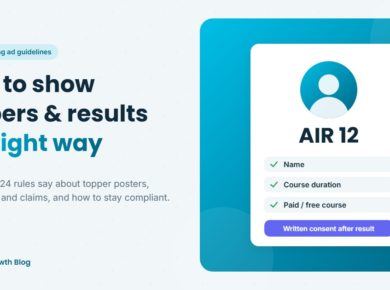
- using a student’s name, photo or testimonial without written consent obtained after the student’s result.
Keep these in mind when you write your posters, reels and landing pages.
Student data and privacy
When you collect names, phone numbers and marks, you are handling personal data. The Digital Personal Data Protection Rules, 2025, notified in November 2025 with a phased compliance period, require a clear notice explaining why you collect data and, where children are involved, verifiable parental consent, subject to certain exemptions. At minimum: only collect what you need, tell students and parents how you’ll use it, and keep it in a secure system rather than scattered across personal phones.
Step 5: Set Up Your Teaching Tools
Equipment
You don’t need a studio to start online coaching classes, but you do need to be clearly heard and seen.
| Item | Why it matters | Starter option |
|---|---|---|
| Laptop or tablet | Runs your classes and screen-sharing | A device you already own, if it handles video calls smoothly |
| External microphone | Students forgive average video, not bad audio | A lapel or USB microphone |
| Lighting | Makes you look professional on camera | A window in front of you, or a ring light |
| Writing surface | For maths, science and problem-solving | Pen tablet, iPad with stylus, or a document camera |
| Internet | Drops break the flow of a class | A wired or fibre connection, plus a mobile hotspot as backup |
For detailed recommendations at different budgets, see our studio setup guide for online teaching.
Platform: why a patchwork of apps stops working
Many teachers start with a video-call tool for classes, WhatsApp for notes, Google Forms for tests and UPI for fees. It is cheap and quick, but it creates problems as you grow:
- Study material gets lost in chats.
- Recordings and PDFs can be forwarded freely.
- Fee follow-ups become a daily chore.
- Your brand is invisible, because students associate your classes with someone else’s app.
Once you have more than one batch, it makes sense to move everything into one place. A branded coaching app lets students attend live classes, watch recordings, take tests and pay fees in an app that carries your name. We have compared the options in our guide to getting an own branded app for your coaching institute.
Step 6: Price Your Batches
Pricing is where many new online coaches undersell themselves. A few principles:
- Price the outcome, not the hours. A complete Class 12 Physics programme with tests and doubt support is worth more than “40 hours of classes”.
- Offer two or three options. For example, a full-year batch, a crash course and a test series. Students self-select by budget and need.
- Use genuine early-bird pricing, not permanent discounts. A launch offer with a real deadline rewards early enrolments without training students to wait for sales. Never invent fake deadlines or “last few seats” claims.
- Allow part payments for longer batches. Monthly or instalment plans make a higher total fee easier to accept.
For a step-by-step method, read our guide on how to price an online course in India.
Step 7: Get Your First 20 Students
Your first 20 students will usually come from people who already know or trust you. Focus here before spending money on ads.
- Your existing network: past students, their parents, colleagues and local community groups. A one-to-one note works better than a forwarded poster.
- A free demo week: let students attend three or four real classes before paying, so they judge your teaching rather than your poster.
- Short-form content: solve one common doubt per day on YouTube Shorts or Instagram Reels, and point viewers to your demo class.
- Referrals: offer existing students a small benefit, such as a free test series, for every friend who enrols.
We have covered this in much more depth in our guide on how to get students for online tuition. If you already run a centre, our list of lead generation ideas for coaching institutes will help too.
Step 8: Deliver, Measure and Retain
Getting a student is expensive. Keeping one is not. Retention is what turns online coaching into a stable business.
- Track attendance and call students who miss two classes in a row.
- Test regularly and share results, so students and parents can see progress.
- Send parents a short monthly update. For school students, parents decide on renewals.
- Collect feedback at the end of every month and act on at least one point.
- Protect your content so paid recordings are not shared freely. Our guide on protecting online course videos from piracy explains how.
Common Mistakes to Avoid When Starting Online Coaching
- Starting too broad. Teaching “everything for everyone” makes you easy to ignore.
- Launching without a schedule. Parents want to see a plan before they pay.
- Ignoring audio quality. Poor sound is a common reason students drop off a live class.
- Guaranteeing marks or ranks. It is misleading, and both the coaching guidelines and the CCPA advertising guidelines prohibit it.
- Running everything on personal WhatsApp. It blurs your personal and professional life and makes it hard to scale.
- Stopping marketing once the batch is full. Build your audience continuously so the next batch fills faster.
Where Classplus Fits In
Once your first batch is running, the bottleneck is usually operations rather than teaching. Classplus is built for this stage. It helps educators and coaching institutes run their business from their own branded mobile app, where they can:
- conduct live classes and share recordings,
- upload and sell recorded courses alongside live batches,
- manage students by batch,
- share assignments and study material,
- run tests and track student performance,
- collect payments online, and
- send notifications to keep students informed.
The main advantage is ownership. Your students download your app, your content stays in one place and your brand grows with every batch, instead of depending entirely on third-party platforms.
Frequently Asked Questions
Can I start online coaching classes from home?
Yes. Many successful online coaches in India teach from home. You need a quiet room, a reliable internet connection, a good microphone and a platform to run classes and collect fees. As you grow, you can add a dedicated teaching corner or hire help without renting a physical centre.
How much does it cost to start online coaching classes in India?
It depends on your setup. Many teachers start with a laptop or tablet they already own, add an external microphone and basic lighting, and pay for a teaching platform. The main ongoing costs are your platform, marketing and, later, support staff. Start lean and upgrade equipment once fees start coming in.
Do I need a licence or registration to start online coaching?
There is no single national licence for online tutoring. What you need depends on your business structure, turnover (for GST) and your state’s coaching regulations. The Ministry of Education’s 2024 coaching guidelines also recommend that tutors hold at least a graduation degree. Speak to a chartered accountant for advice specific to you.
Should I start with live classes or recorded courses?
Start with live classes if your students need doubt-solving and discipline, as most school and competitive-exam students do. Live batches also help you learn what students struggle with. Once your content is proven, package the best recordings as a recorded course for a second income stream.
How many students do I need to start an online coaching batch?
You can start with as few as five to ten students. A small first batch lets you refine your teaching, schedule and tools, and gives you your first testimonials. Focus on results for this group; they become your best source of referrals for the next batch.
Which app is best for starting online coaching classes?
The best app lets you teach live, share recordings and notes, run tests, collect fees and manage students in one place, ideally under your own brand. Classplus offers this through a branded app for your coaching business, so you don’t need to juggle separate tools for each task.
How do I get students for my online coaching classes?
Start with your existing network, offer a free demo week, post short doubt-solving videos on YouTube and Instagram, and reward referrals. Our guide on how to get students for online tuition covers 12 practical methods in detail.
Conclusion
Starting online coaching classes in India in 2026 is less about technology and more about clarity. Choose a narrow niche, commit to a teaching model, publish a clear batch plan, follow honest and fair fee practices, and put your classes, content, tests and payments in one place. Your first students will come from trust. The next hundreds will come from results, retention and referrals.
Ready to launch your online coaching classes? Classplus helps you set up your own branded coaching app to teach live, sell courses, run tests, collect fees and manage students from one platform.