A good test series is only as strong as the questions behind it. Many teachers write a fresh paper every week, which works for a while but becomes exhausting, leads to repeated questions and makes it hard to keep difficulty consistent. A well-organised question bank for test series solves this. Once your questions are written, reviewed, tagged and stored in one place, you can assemble a chapter test, a sectional test or a full mock in a fraction of the time, and every paper can be balanced by topic and difficulty.
Why Build a Question Bank for Test Series
A question bank turns question writing into a steady, shared process.
- Faster paper setting: pick questions by tag instead of drafting from a blank page.
- Consistent difficulty: every mock can follow the same mix of easy, medium and hard questions.
- Fewer repeats: you can see which questions a batch has already attempted.
- Better analysis: because every question is tagged, results show exactly which topics students struggle with.
To sell tests beyond your own students, see how to sell a test series online.
Sourcing Questions Legally
Commercial books, other institutes’ material and paid test series are protected by copyright, so do not copy their questions, solutions or diagrams into your bank, even with small changes to numbers or wording.
Safer sources include:
- Your own original questions: written by you or your teachers, based on the syllabus and your teaching experience.
- Previous-year-question style: study the patterns, formats and topic weightage of past exams, then write fresh questions that test the same concepts in the same style. Check the terms under which an exam body publishes its past papers before reproducing any of them directly.
- Common student mistakes: turn the errors you see in class and in doubt sessions into questions that test those exact misconceptions.
- Commissioned writers: if you hire external question writers, get a written agreement confirming the work is original and that the rights belong to your institute.
If you are unsure whether a source can be used, take advice from a lawyer before adding it to your bank.
Designing a Tagging Scheme
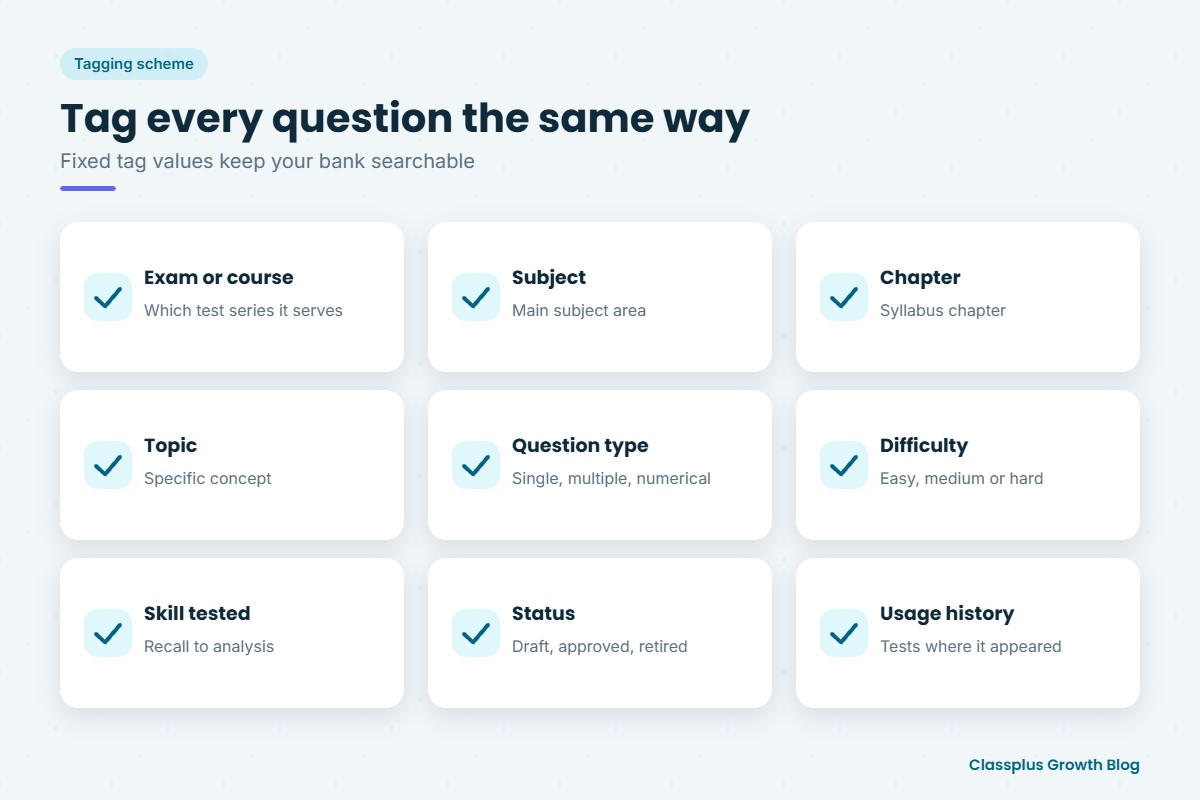
Tags are what turn a pile of questions into a usable bank. Decide your tagging scheme before you add questions, and use the same tag names everywhere. The table below shows an example scheme; adapt the fields and values to your exam and syllabus.
| Tag field | What it records | Example values |
|---|---|---|
| Exam or course | Which test series the question belongs to | Board Class 10, entrance exam, government exam |
| Subject | Main subject | Physics, Mathematics, Reasoning |
| Chapter | Syllabus chapter | Current Electricity, Quadratic Equations |
| Topic | Specific concept within the chapter | Ohm’s law, nature of roots |
| Question type | Format of the question | Single correct, multiple correct, numerical, assertion-reason |
| Difficulty | Expected level | Easy, Medium, Hard |
| Skill tested | What the student must do | Recall, understanding, application, analysis |
| Expected time | Roughly how long it should take | Under 1 minute, 1 to 2 minutes, over 2 minutes |
| Source | Where the question came from | Original, PYQ-style, teacher name |
| Status | Where it is in the review process | Draft, reviewed, approved, retired |
| Usage history | Where it has already appeared | Mock 3, Chapter test 5, batch name |
Keep tag values in a fixed list, otherwise “Current Electricity”, “current elec” and “CE” become three different chapters.
Setting Difficulty Before and After
Assign an initial difficulty based on the writer’s judgement, then update it once students have attempted the question. An “easy” question that most students got wrong deserves a higher tag or a closer look at its wording.
Quality Review Before a Question Goes Live
Every question should pass a second pair of eyes before it reaches students. A simple review checklist could include:
- Correctness: the answer key is right, and only one option is correct where only one is intended.
- Clarity: the language is unambiguous and suits the level of the students.
- Syllabus fit: the question is within the current syllabus for that exam.
- Option quality: wrong options are plausible and based on real mistakes, not obviously silly.
- Formatting: units, symbols and diagrams display correctly.
- Tags: all tag fields are filled in and correct.
- Originality: the question is not copied from a protected source.
Only approved questions should be used in tests; others go back to the writer with comments.
Writing Good Solutions
Solutions are where much of the learning happens. A strong solution:
- Shows the steps, not just the final answer.
- Names the concept or formula used, so students know what to revise.
- Explains why common wrong options are wrong.
- Mentions a faster method where one exists.
Students who still have questions after reading a solution should know where to ask. Our guide on setting up a doubt-solving system for your coaching institute can help.
Versioning Questions and Avoiding Repeats
Questions get corrected and updated over time. Keep changes organised.
- Give every question a unique ID that never changes, even when the question is edited.
- Record a version number and a short note on what changed and why.
- Retire rather than delete: mark outdated questions as retired, so you keep the history and results linked to them.
- Track usage by batch: before assembling a test, filter out questions that batch has already seen.
- Create variants: write versions with different numbers or contexts to retest a concept without repeating the question.
Assembling Tests From the Bank
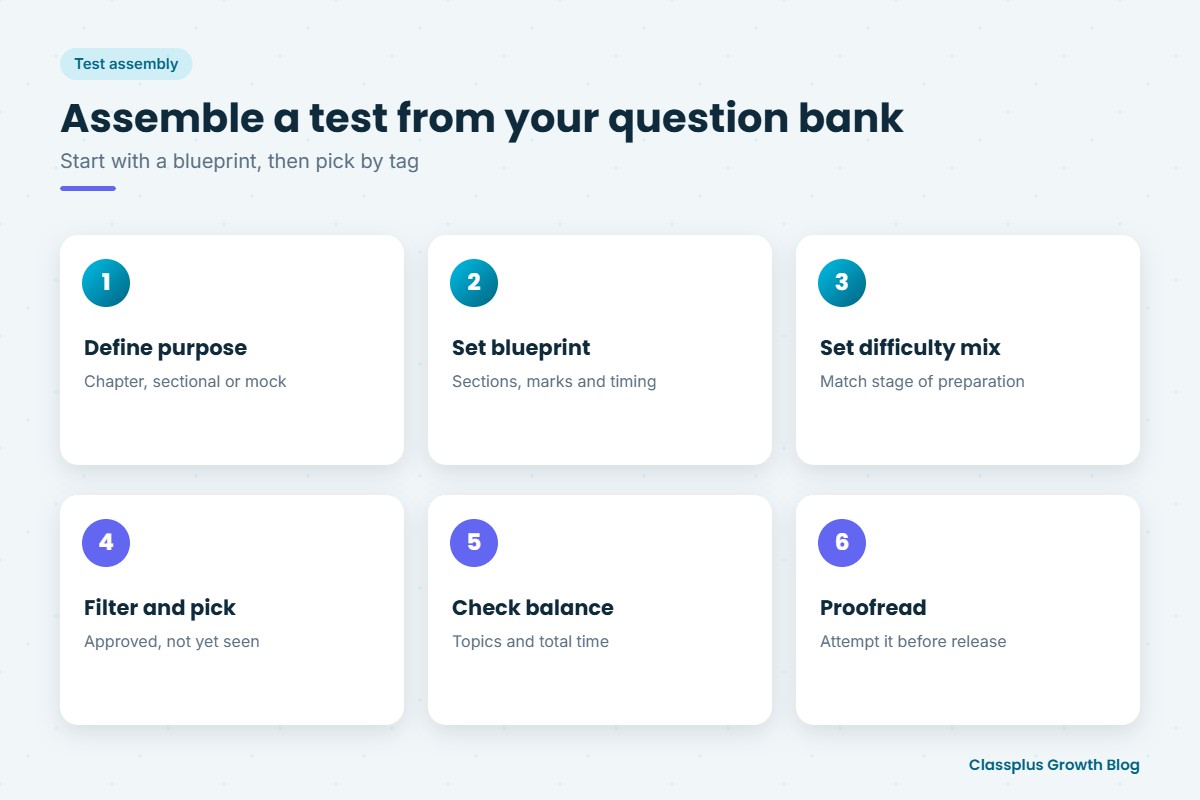
With a tagged bank, you set a blueprint and pick questions to match it.
- Define the purpose: chapter practice, sectional test, full mock or scholarship screening.
- Set the blueprint: number of questions, sections, marking scheme, time limit and topic coverage.
- Set the difficulty mix: choose a balance of easy, medium and hard questions that matches the stage of preparation.
- Filter and pick: select approved questions by tag, excluding ones the batch has already seen.
- Check balance: make sure no single topic dominates and that the expected time adds up to the time limit.
- Preview and proofread: attempt the paper yourself or have a colleague do it before releasing it.
Types of Tests You Can Build
- Chapter tests: short tests on one chapter, ideal right after it is taught.
- Sectional tests: one subject or section of the exam, used to build speed and accuracy in that area.
- Full-length mocks: follow the real exam pattern and timing as closely as possible.
- Scholarship or admission tests: a separate set of questions kept aside for this purpose. Our guide on running a scholarship test for your coaching institute explains how to plan one.
Using Results to Improve the Bank
Every test tells you about your questions as well as your students.
- Questions most students get wrong: check whether the concept was taught well, or whether the wording is confusing.
- Questions almost everyone gets right: they may be easier than tagged; update the difficulty or use them for practice instead of mocks.
- Questions that strong students get wrong but weaker students get right: these often have a flaw in the key or the wording and should be reviewed immediately.
- Topic-level gaps: if a whole topic scores low, plan a revision class and add practice questions.
Treat each valid answer-key challenge from students as a reason to review and version the question.
Keeping Your Question Bank Secure
Leaked questions make mocks less useful, so protect the bank.
- Limit access: only teachers and staff who need the bank should be able to view or edit it.
- Separate roles: writers add, reviewers approve, few can export.
- Keep scholarship and final-mock questions separate and release them only at test time.
- Use online tests where students attempt questions inside an app rather than on downloadable files.
- Keep regular backups.
- Use written agreements with teachers and writers about ownership and confidentiality.
Our guide on how to protect online course content from piracy covers broader content-security practices.
How Classplus Supports Your Test Series
With Classplus, you get your own branded app and website where you can run online tests and test series with test performance tracking, so you can see how students do and use those results to improve your questions. Content security helps protect your paid material, and notifications let you tell students when a new test is live. You can also run live classes, sell recorded courses, collect fees and create coupons, manage batches and attendance, and get marketing assistance. See our guide to choosing a teaching app for test preparation coaching.
Classplus pricing is shared during a demo based on your needs. To see how your test series could run on your own app, book a free demo with Classplus.
Conclusion
Building a question bank for test series takes some effort upfront, but it pays off every time you set a paper. Source questions legally, tag them with a fixed scheme, review them before they go live, write solutions that teach, version and track usage to avoid repeats, assemble tests from clear blueprints and use results to keep improving. Protect the bank as one of your institute’s most valuable assets, and it will serve your students for years.
Frequently Asked Questions
How many questions should a question bank have before I start a test series?
There is no fixed number. A practical approach is to have enough approved questions to build your first few tests without repeats, then keep adding questions chapter by chapter as the series runs.
Can I use questions from reference books in my question bank?
Questions, solutions and diagrams in commercial books are usually protected by copyright, so do not copy them, even with small changes. Write original questions instead, or take advice from a lawyer if you are unsure about a source.
What tags should I use for a question bank?
Common tags include exam, subject, chapter, topic, question type, difficulty, skill tested, expected time, source, review status and usage history. Use a fixed list of values for each tag so the bank stays consistent.
How do I avoid repeating questions across tests?
Give every question a unique ID, record where it has been used, and filter out questions a batch has already seen when you assemble a new test. Writing variants of popular concepts also lets you test the same idea without repeating the exact question.
How do I decide the difficulty level of a question?
Start with the writer’s judgement when the question is created, then update the tag after students attempt it. If far more or far fewer students answer correctly than expected, adjust the difficulty or review the wording.
How can I keep my question bank secure?
Limit access to the people who need it, separate writing, approving and exporting roles, keep scholarship and final-mock questions aside until test time, run tests online rather than sharing files, and keep regular backups.