Fees are one of the first things a parent asks about and one of the last things many coaching owners plan properly. The fee often gets copied from the institute down the road, and then discounts, instalments and special cases pile up until nobody is sure what a course actually earns. A clear coaching institute fee structure fixes this. It tells parents exactly what they pay and when, tells your team what they can offer, and tells you whether each batch covers its costs.
Start With Your Costs, Not Your Competitor’s Fee
Before writing a single number, list what it costs to run one batch for the full course: a share of rent, teacher pay, study material, test papers, technology, marketing and payment charges. Divide that by the number of students you realistically expect. That gives you a floor below which the batch loses money.
Use competitor fees only as a reference for what local families are used to paying. Our guide on how to price an online course covers pricing methods that apply to classroom courses too.
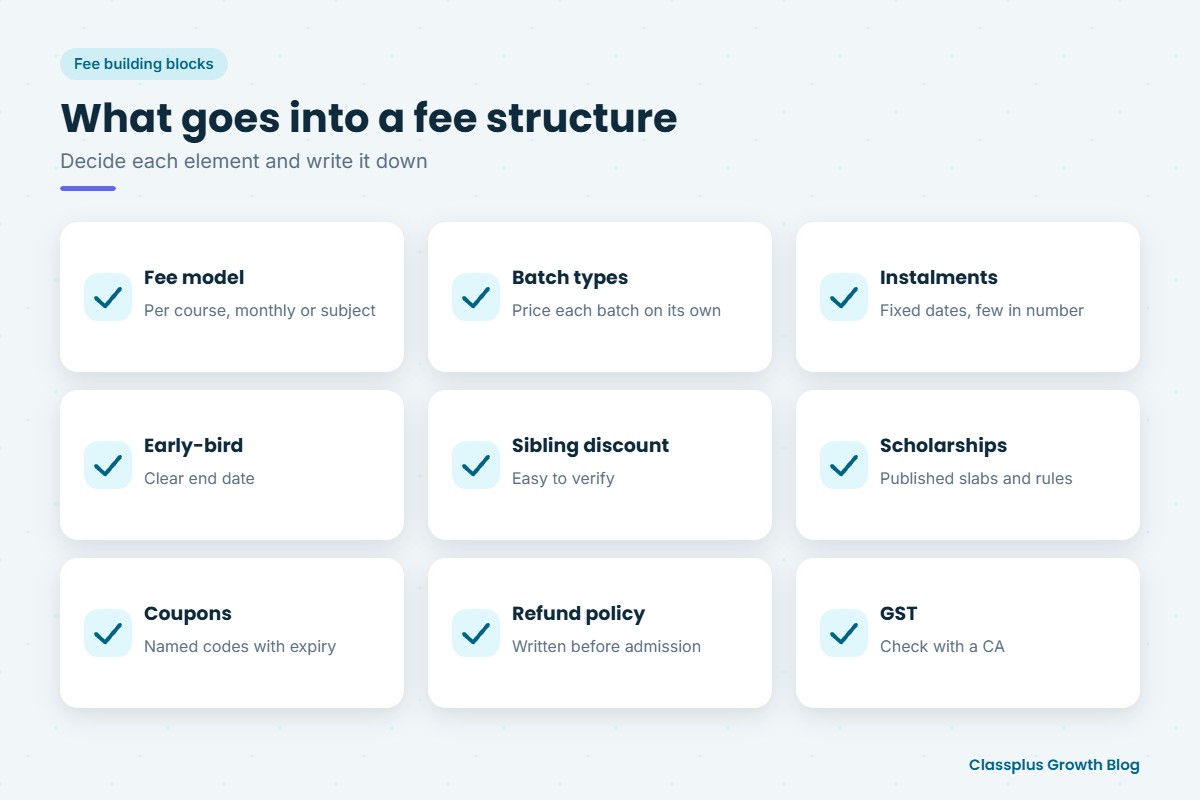
Choosing a Fee Model for Your Coaching Institute Fee Structure
Most institutes use one main model and offer another as an option.
- Per course: one fee for the whole course. Simple and predictable, but the upfront amount can feel heavy for some families.
- Monthly: students pay each month they attend. Easier on budgets and common for school tuition, but income is less predictable and mid-year dropouts are easier.
- Per subject: students pay only for the subjects they need. Flexible, but harder to manage timetables.
- Bundle with per-subject option: a combined fee for all subjects that costs less than buying each separately, while still allowing single-subject admissions.
Whatever you choose, write it down in one place so every counsellor quotes the same thing.
Pricing Different Batch Types
Each batch type should have its own fee logic rather than one number for everything.
- Regular batches: your core offering, priced from your cost floor plus the margin you need.
- Small or premium batches: fixed costs are spread over fewer students, so the fee usually has to be higher.
- Crash and revision courses: priced separately so they do not discount your main course.
- Weekend batches: the fee may reflect fewer contact hours.
- Online and hybrid batches: costs differ from classroom batches, so price them on their own numbers.
- Test-series-only access: a lower-priced option for students who study elsewhere but want your tests.
A Sample Fee Structure Table
The table below shows one way to lay out fees. All amounts are purely illustrative and are not benchmarks or recommendations. Use figures based on your own costs and market.
| Course or batch | Duration | Fee model | Example full fee | Example instalment plan |
|---|---|---|---|---|
| Class 10 all subjects (regular) | 10 months | Per course | ₹30,000 | 3 instalments of ₹10,000 |
| Class 10 single subject | 10 months | Per subject | ₹10,000 | 2 instalments of ₹5,000 |
| Class 12 science (small batch) | 11 months | Per course | ₹55,000 | 4 instalments of ₹13,750 |
| Exam crash course | 2 months | Per course | ₹8,000 | Full payment only |
| Weekend practice batch | Monthly | Monthly | ₹2,000 per month | Paid monthly in advance |
| Online test series only | 6 months | Per course | ₹2,500 | Full payment only |
Instalments and Cash-Flow Planning
Instalments make a course more affordable, but they push income later while rent and salaries arrive every month. Plan before you offer them.
- Front-load sensibly: a larger first instalment at admission covers early costs like material.
- Fix dates: “10th of every alternate month” is clearer than “every two months”.
- Limit the number: more instalments mean more follow-ups and more missed payments.
- Decide whether instalments cost more: some institutes charge slightly more for instalment plans to reward full payment. If you do, show both prices clearly.
- Map collections against costs: a simple sheet showing when each instalment arrives reveals months that may run short.
- Write a late-payment rule: a reminder sequence and a grace period, decided in advance.
Discounts: Early-Bird, Sibling and Others
Discounts work best as planned rules, not favours given at the counter. Unplanned discounts quietly reduce margins and make other parents feel they overpaid.
- Early-bird: for admissions before a fixed date. It fills batches early. Stick to the end date.
- Sibling: for families with two or more children enrolled. Easy to verify and rewards loyalty.
- Full payment: for paying the whole fee upfront.
- Returning student: for students continuing to the next class or course.
- Referral: for students who bring a friend. See our guide on running a referral program for your coaching institute.
Set a maximum combined discount so a student who qualifies for several offers does not fall below your cost floor, and write down which offers can be combined.
Scholarships
Scholarships are based on merit or need, not timing or family. Many institutes run a scholarship test with fee waivers in score-based slabs. Publish the slabs, eligibility and seats per slab before the test so the process feels fair. For need-based support, decide who approves it and what documents you will ask for. Our guide to running a scholarship test for your coaching institute covers planning and promotion.
Coupons for Online Fee Collection
If you collect fees online, coupons are a tidy way to apply approved discounts. Instead of counsellors changing fees manually, create a code for each offer, such as an early-bird code with an end date or a sibling code. This records who received which discount. Give each coupon a clear name, an expiry date and, where possible, a usage limit.
Refunds and Transfers
Most fee disputes start here, so put the rules in writing before admission and have the parent or student acknowledge them.
- Refund window: whether refunds are possible, until when, and on what basis.
- Deductions: any non-refundable portion, such as registration charges or material already given.
- Batch and course transfers: whether students can switch batch, timing, mode or course, and how fees are adjusted.
- Process and timelines: how to request a refund or transfer and how long it takes.
Consumer protection and other rules may affect what you can do, so have your policy reviewed by a lawyer. Our guide on writing a refund policy for your coaching institute goes into more detail.
GST and Invoicing
GST may apply to your fees depending on turnover, the nature of your courses and other factors. This affects whether your published fee includes tax and how you issue invoices. Because rules change and depend on your situation, consult a qualified Chartered Accountant (CA) before finalising fees and invoice formats. Our explainer on GST on online courses gives a general overview.
Communicating Fees to Parents
Parents rarely object to a fair fee. They object to surprises.
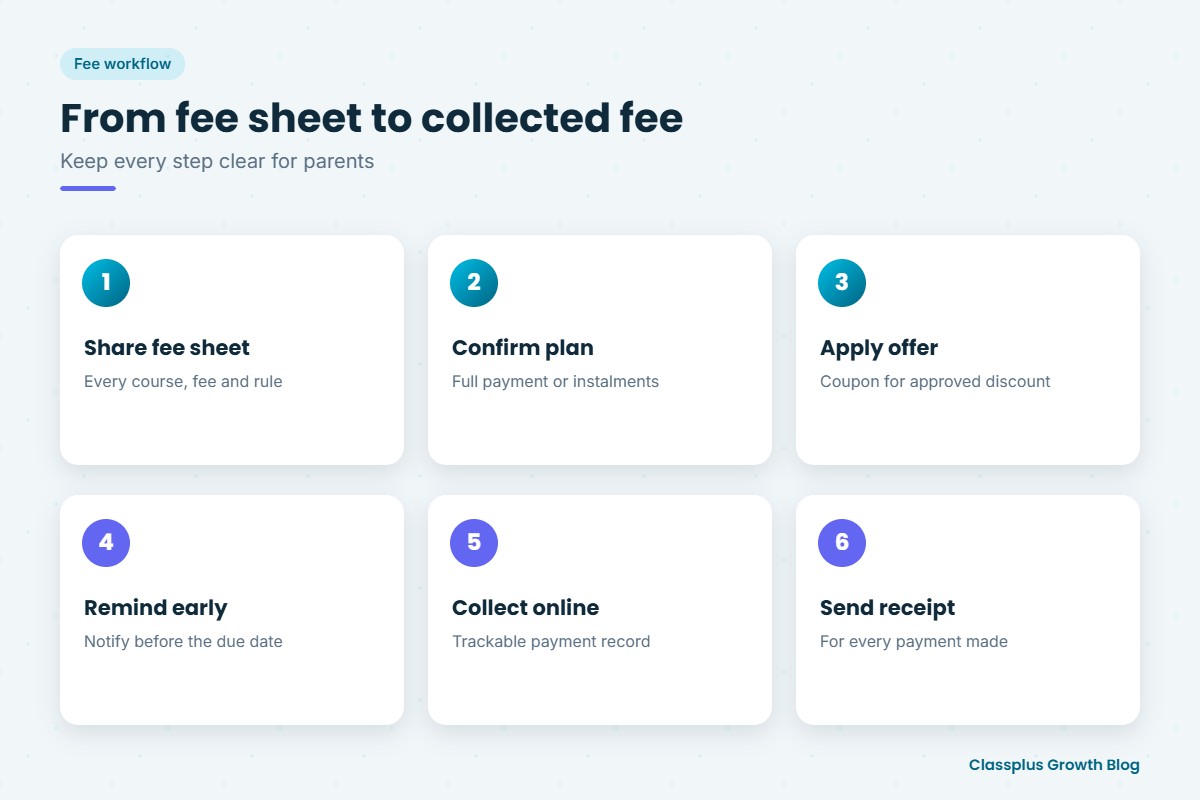
- One fee sheet: every course, fee, instalment option, discount and refund rule in one document.
- What is included: classes, material, tests, doubt sessions, online access, and what costs extra.
- The value, not just the number: batch size, faculty experience, number of tests and how progress is shared.
- Reminders in advance: a polite reminder before the due date beats a call after it is late.
- A receipt every time: it builds trust and prevents disagreements later.
- Consistent exceptions: handle genuine hardship through a set process, not on the spot.
Collecting Fees Online
Collecting fees through an app or payment link helps both sides. Parents pay from home using common methods such as UPI, cards or net banking, and you get a clear record of who has paid. It also makes coupons, instalment tracking and reminders simpler. If you are evaluating tools, our guide on coaching fee management software lists what to look for.
Common Mistakes to Avoid
- Copying a competitor’s fee without checking your own costs.
- Offering too many instalments, which creates constant follow-ups.
- Adding hidden charges for material or tests that parents discover later.
- Not revisiting fees each year as costs rise.
How Classplus Helps You Manage Fees
With Classplus, you get your own branded app and website where students can pay fees online, and you can create coupons for early-bird, sibling or scholarship offers. Batch management and attendance sit in the same place, and notifications help you send fee reminders. You can also run live classes, sell recorded courses and offer online tests and test series with performance tracking, with content security for paid material and marketing assistance for outreach.
Classplus pricing is shared during a demo based on your needs. To see how fee collection could work for your institute, book a free demo with Classplus.
Conclusion
A good coaching institute fee structure starts from your costs, uses a fee model that suits your students, prices each batch on its own numbers and turns discounts, scholarships, instalments and refunds into written rules. Share it clearly with parents, collect fees in a trackable way and review it every year, with professional advice on GST and refund terms. Fee conversations then become shorter, fairer and far less stressful.
Frequently Asked Questions
What is the best fee model for a coaching institute?
It depends on your students and courses. Per-course fees give predictable income, monthly fees are easier on family budgets, and per-subject fees suit school tuition. Many institutes use one main model with an alternative, such as a bundle plus a per-subject option.
How many instalments should a coaching institute offer?
Keep the number small enough to follow up comfortably and still cover monthly costs. Fix clear due dates, consider a larger first instalment at admission, and map expected collections against monthly expenses before deciding.
Should coaching institutes give sibling and early-bird discounts?
They can help if they are planned rules with clear conditions and end dates. Set a maximum combined discount so students who qualify for several offers do not pay less than it costs you to teach them.
How is a scholarship different from a discount?
A discount is usually based on timing, family or payment method, while a scholarship is based on merit or need. Scholarships work best when slabs, eligibility and seats are published in advance, often through a scholarship test.
What should a coaching institute refund policy include?
It should cover whether refunds are allowed, the time window, any non-refundable portion, how batch or course transfers work and how to make a request. Because regulations may apply, have the policy reviewed by a lawyer.
Do coaching institutes need to charge GST on fees?
GST may apply depending on your turnover, the type of courses and other factors. Rules can change and depend on individual circumstances, so consult a qualified Chartered Accountant before finalising fees and invoices.