Parents and students keep asking coaching institutes the same things. Can my child rewatch a missed class? Is there an online batch for students outside the city? A hybrid coaching model, where you run offline and online batches side by side, is how many institutes answer these questions without giving up the classroom they have built.
Going hybrid does not mean becoming a fully online business. It means adding online delivery where it genuinely helps students. This guide explains the common hybrid formats, their pros and cons, how to set fees, how to schedule, how to keep quality equal, what technology you need and how to roll it out step by step.
What Does a Hybrid Coaching Model Mean?
In simple terms, a hybrid coaching model is any setup where the same institute teaches students both in a physical classroom and online. There is no single correct version. Most institutes choose one of three common variants, or combine them over time.
| Variant | How it works | Best suited for |
|---|---|---|
| Offline classes + recorded backup | Students attend in person; each class is recorded and shared for revision or missed days | Institutes that want to support existing offline students without changing their timetable |
| Separate online batches | A dedicated live online batch runs alongside offline batches, often for students in other cities or towns | Institutes with demand from students who cannot travel to the centre |
| Blended week | Students attend some sessions offline and some online, for example concept classes in person and practice or doubt sessions online | Senior students, working learners or batches that need flexibility |
Start by deciding which variant fits your students today. You can always add another later.
Pros and Cons of Running Offline and Online Together
A hybrid setup brings real benefits, but it also adds work. Be honest with yourself about both before you start.
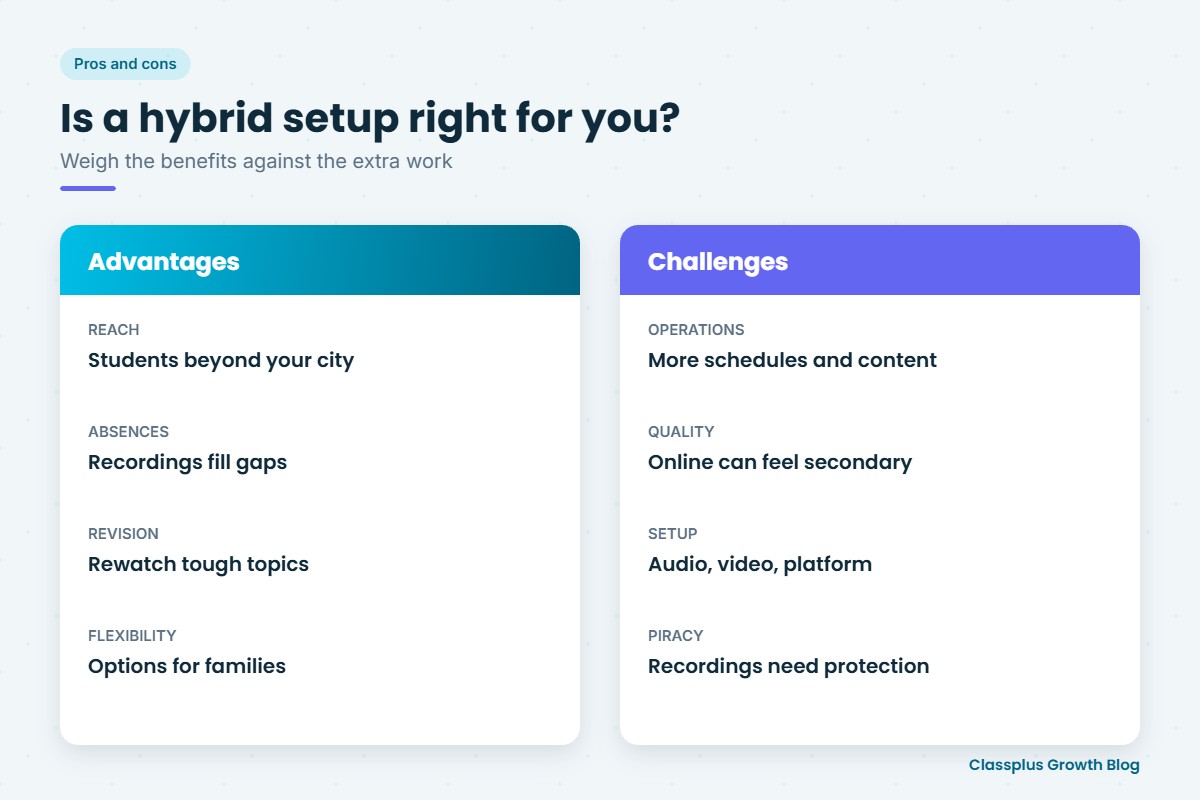
Advantages
- Wider reach. Online batches let you teach students who live too far from your centre.
- Better support for absent students. Recordings mean a missed class does not become a learning gap.
- More revision options. Students can rewatch difficult topics before tests.
- Flexibility for families. Parents value options during illness, travel or exam weeks.
- Better use of your best teachers. One strong teacher can serve students across locations.
Challenges
- More operational work. Two formats mean more schedules, more communication and more content to manage.
- Risk of unequal quality. Online students can feel like an afterthought if the class is designed only for the room.
- Technology and setup costs. You will need decent audio, video and a reliable platform.
- Content piracy concerns. Recorded content can be shared without permission if it is not protected.
Fee Structures for Each Batch Type
Fees are where many institutes get confused. The aim is a structure that feels fair to every student and is simple to explain. Here are common approaches. Amounts are for you to decide based on your costs, market and value.
| Batch type | Common fee approach | Things to consider |
|---|---|---|
| Offline with recorded backup | Recordings included in the offline fee, or offered as a paid add-on | Including them often improves satisfaction and reduces complaints about missed classes |
| Online live batch | Separate fee, often set differently from offline | Online has lower travel and space costs for students, but your teaching effort is the same |
| Blended week | A single fee for the combined programme | Be clear about how many sessions are offline and how many are online |
| Recorded-only course | Usually the most accessible option | Works for self-motivated students and revision-focused learners |
A few practical tips:
- Keep it simple. Too many options confuse parents. Two or three clear choices are usually enough.
- Explain what is included. List classes, tests, notes, doubt support and recordings for each batch type.
- Use instalments and coupons carefully. They help families manage payments, but track them properly.
- Have a clear refund and transfer policy, including what happens if a student shifts from offline to online mid-year.
For more help, see our guides on coaching fee management software and how to price an online course.
Scheduling Offline and Online Batches
Scheduling is where a hybrid setup either runs smoothly or becomes chaotic. A few principles help.
- Avoid back-to-back clashes. If the same teacher takes an offline batch and then an online batch, leave time to reset equipment and take a short break.
- Use fixed slots. Students and parents should know exactly when each batch runs, every week.
- Keep online timings realistic. Students in other cities may have different school or college schedules, so ask before you fix times.
- Align tests across batches. Running the same test on the same day for all batch types makes comparison and analysis easier.
- Publish recordings on a predictable schedule, for example by the same evening.
A shared calendar, visible to teachers and students, prevents a lot of confusion. Our guide on batch management for coaching institutes covers how to organise batches, timetables and attendance.
Keeping Quality Equal Across Both Formats
The biggest risk in a hybrid coaching model is that one group of students gets a weaker experience. Here is how to prevent it.
- Use the same syllabus plan and materials. Notes, practice sets and tests should be identical across batches.
- Design for the camera as well as the room. Write clearly on the board or use a digital board, repeat student questions aloud and keep the camera on what matters.
- Engage online students by name. Ask them questions, invite them to unmute or use chat, and respond to their doubts during class.
- Give equal access to doubt support. Online students should have a clear, reliable way to get doubts solved.
- Track performance the same way. Compare test results across batches to spot where one group is struggling.
- Collect feedback from both groups regularly, and act on it.
If online students consistently score lower, treat it as a signal to fix delivery.
The Technology You Need
You do not need a studio to run a good hybrid setup, but you do need a few basics done well.
- Clear audio. A good microphone matters more than an expensive camera. Online students forgive average video but not poor sound.
- A stable camera setup. Position it to capture the board and the teacher clearly.
- Reliable internet, with a backup connection if possible.
- A platform for live classes and recordings, so you are not juggling separate tools. Our guide on choosing a live class app for teachers explains what to look for.
- Online tests and performance tracking, so all students can be assessed the same way.
- Fee collection and batch management, so you can see who has paid and who is attending.
- Content protection, so your recordings are not easily copied. Read more on how to protect online course videos from piracy.
A Step-by-Step Rollout Plan
Do not try to change everything at once. A gradual rollout is safer.
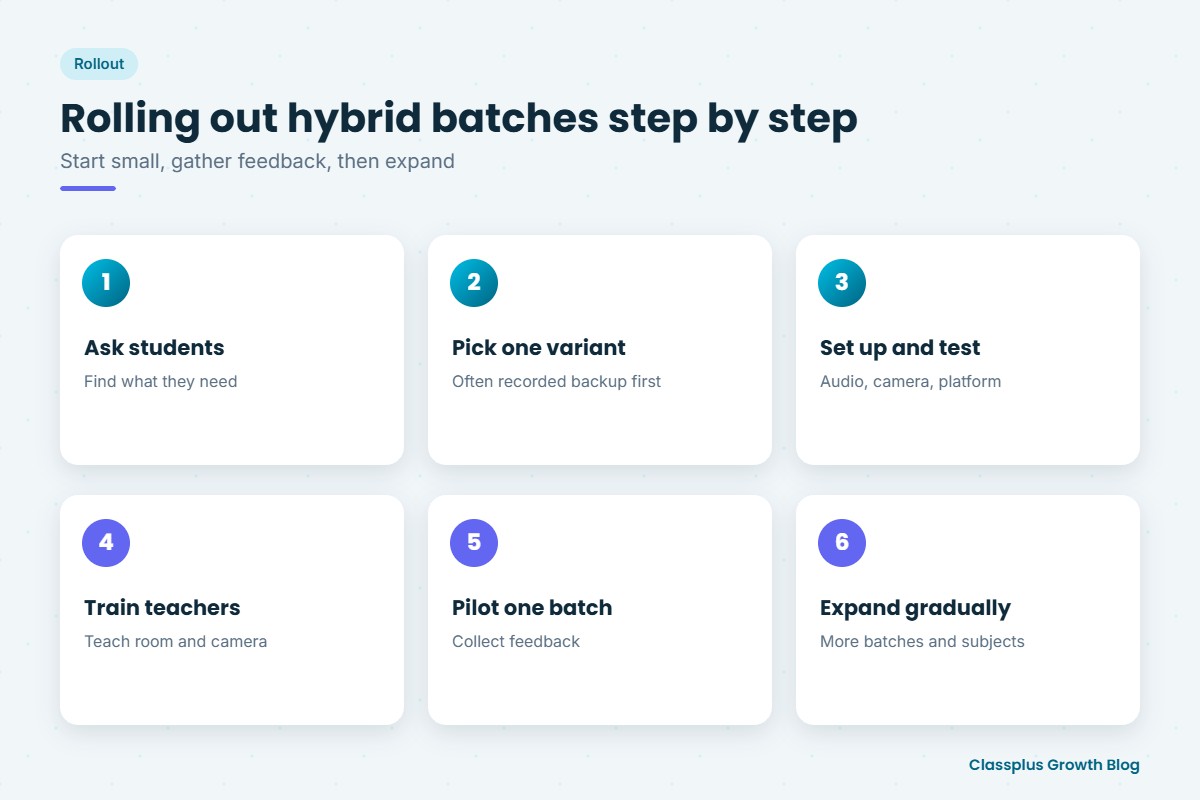
- Talk to your students and parents. Ask what they actually need: recordings, an online batch or flexibility.
- Pick one variant to start. Recorded backup for existing offline batches is often the easiest first step.
- Set up the technology and test it with a few classes before announcing anything.
- Train your teachers on teaching to both the room and the camera.
- Decide fees and policies, and write them down clearly.
- Launch with one batch or subject as a pilot.
- Collect feedback and fix issues for a few weeks.
- Expand gradually to more batches, subjects or online-only students.
If you are moving from a fully offline setup, our guide on how to take your coaching institute online covers the bigger picture.
Common Mistakes to Avoid
- Treating online students as a side audience. If they only watch a camera pointed at the room, they will disengage.
- Launching too many formats at once. It overloads teachers and staff.
- Unclear fee rules. Confusion about what each fee includes leads to disputes.
- Ignoring audio quality. Poor sound is the fastest way to lose online students.
- Not protecting recordings. Unprotected videos can spread outside your paid students.
- No feedback loop. Without regular feedback, small problems grow into drop-outs.
- Overpromising in marketing. Describe your hybrid batches accurately, without claims you cannot support.
Running a Hybrid Institute on One Platform
Running offline and online batches together is much easier when everything sits in one place. Classplus gives educators their own branded app and website where they can run live classes, sell recorded courses, conduct online tests and test series with performance tracking, collect fees with coupons, manage batches and attendance, send notifications and keep content secure. Classplus also offers marketing assistance to help institutes reach more students. Pricing is shared during a demo, so you can book a free demo with Classplus to see how it fits your hybrid setup.
Conclusion
A hybrid coaching model lets you keep the strengths of your classroom while reaching more students and supporting them better. Start by choosing the right variant for your students, set clear and fair fees for each batch type, schedule carefully, and work hard to keep quality equal across offline and online learners. Get the basic technology right, roll out step by step and avoid the common mistakes. Done thoughtfully, a hybrid setup can make your institute more flexible and more useful to every student you teach.
Frequently Asked Questions
What is a hybrid coaching model?
It is a setup where a coaching institute teaches students both in a physical classroom and online. Common versions include offline classes with recorded backup, separate online batches and a blended week that mixes offline and online sessions.
Should online batch fees be lower than offline fees?
There is no fixed rule. Some institutes set different fees because students save on travel and the institute uses less classroom space, while others keep fees similar because teaching effort is the same. Decide based on your costs, market and the value each batch offers.
How do I keep online students engaged in a hybrid class?
Design the class for the camera as well as the room. Use clear audio, show the board properly, repeat questions aloud, ask online students questions by name and give them a reliable way to get doubts solved.
Is it necessary to record every offline class?
It is not mandatory, but recordings help students who miss classes and make revision easier. Many institutes start with recordings as their first step into hybrid teaching because it requires the least change to their timetable.
What technology do I need to start hybrid coaching?
At minimum, you need clear audio, a stable camera setup, reliable internet and a platform for live classes, recordings, tests, fees and batch management. Content protection for your recordings is also important.
Can a small coaching institute run a hybrid model?
Yes. Small institutes can start with one batch or subject, add recordings or a small online batch, and expand gradually. Starting small keeps costs and workload manageable while you learn what your students need.